Simone Peterzano portréja

A 14 legnevezesebb Simone Peterzano festmény, egy galériaválaszték

Frissítve: november 2026 · rangsorolva népszerűségi pontszámunk alapján (minden mű keresései, látogatásai és megrendelései alapján) · 14 mű Simone Peterzano alkotása a katalógusunkban

Röviden

Simone Peterzano hagyatékából a leghíresebb alkotás Venus and Cupid (1554), amely a Koppenhága városi Statens Museum for Kunst gyűjteményében található. Röviddel ezután követik őket Head of an Old Bearded Man (1578) és Ecce Homo (1585). Katalógusunkban 14 mű található Simone Peterzano alkotótól; a galéria megőrizte a világ által leginkább csodált 14 darabot, melyeket a dátummal, a múzeummal és a történetükkel együtt mutatunk be.

1540 – 1599, Velence Mannerism A legtöbb mű: Civiche Raccolte d'Arte

Simone Peterzano legjobb 10 festménye: a galéria válogatása

1
Venus and Cupid (1554) (1889) -ja Simone Peterzano

Venus and Cupid

1554 · Oil · Statens Museum for Kunst, Koppenhága

This work, titled Venus and Cupid, was executed by the Italian Mannerist painter Simone Peterzano. The painting presents a quiet encounter between the mythological figures of Venus and her young son, Cupid. It is a piece that reflects the specific stylistic transitions occurring in late sixteenth-century Italy, capturing a moment of classical grace through a Mannerist lens.

2
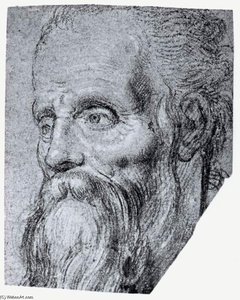
Head of an Old Bearded Man (1578) (1889) -ja Simone Peterzano

Head of an Old Bearded Man

1578 · Chalk · Museo Civici, Milán

The artwork, titled Head of an Old Bearded Man, is a focused portrait study by the artist Simone Peterzano. Created about 1578, this work captures the likeness of an elderly man. The subject's face is the singular point of interest, rendered with a quiet, heavy presence. It is a study of age and the physical weight of time.

3
Ecce Homo (1585) (1889) -ja Simone Peterzano

Ecce Homo

1585 · Oil On Canvas · Kunsthistorisches Museum, Bécs

This vertical oil on canvas portrait, dated 1585, focuses on the upper body of a man positioned slightly off-center. The subject is Christ, depicted with a crown of thorns upon his head and eyes cast downward. A strong sense of three-dimensional volume is achieved through highly directional lighting that emerges from the upper left, casting deep shadows across the right side of the face and torso. The color palette relies…

4
Study of a Half-Length Figure (1580) (1889) -ja Simone Peterzano

Study of a Half-Length Figure

1580 · Charcoal · Civiche Raccolte d'Arte, Milan

In this intimate study, Simone Peterzano presents "Study of a Half-Length Figure," a work that focuses intently on the human form. Created about 1580, the drawing captures the torso and head of a nude female figure. The composition is tightly framed around the upper body, creating a sense of proximity that invites a quiet, close observation of the anatomy. There is a subtle tension in the way the subject is…

A Simone Peterzano válogatás folytatódik: 11 – 14

A témák, amelyek Simone Peterzano figyelmét meghúzták

A négy leggyakorobban előforduló téma ebben az eredeti művekben, mindegyik a legkiválóbb példájával.

A műemlékek, amelyek Simone Peterzano eredeti műveit őrzik

A 5 olyan múzeum, amely a legtöbb ezen az oldalon szereplő festményet őrzi.

Múzeum Város Simone Peterzano művei Ebből a listából származó festmények
Civiche Raccolte d'Arte, MilanCiviche Raccolte d'Arte Milan 4 Study of a Half-Length Figure, Still-Life of Figs, Peapods and Cherries
Statens Museum for Kunst, KoppenhágaStatens Museum for Kunst Koppenhága 1 Venus and Cupid
Museo Civici, MilánMuseo Civici Milán 1 Head of an Old Bearded Man
Kunsthistorisches Museum, BécsKunsthistorisches Museum Bécs 1 Ecce Homo
Musée Des Beaux, StrasbourgMusée Des Beaux Strasbourg 1 Deposition of Christ

Simone Peterzano évtizede folgtva: az eredeti művek, amelyek meghatározzák az egyes korzakot

Művek évtizedenként

Váassz ki egy évtizedet, hogy megnézhesd az azt meghatározó eredetiműveket.

Gyűjtői kérdések Simone Peterzano festményeivel kapcsolatban

Melyik művel a(z) Simone Peterzano a leghíresebb?Fedje fel a választ

Venus and Cupid (1554), Statens Museum for Kunst, Koppenhága. Ezután Head of an Old Bearded Man (1578) és Ecce Homo (1585) következik.

Hány éves volt Simone Peterzano, amikor a Venus and Cupid készült?Fedje fel a választ

14 éves: Venus and Cupid 1554-ből származik, Simone Peterzano pedig 1540-ben született.

Melyek a tíz leghíresebb Simone Peterzano festmény?Fedje fel a választ

Venus and Cupid, Head of an Old Bearded Man, Ecce Homo, Study of a Half-Length Figure, Autoportret simone peterzano, Madonna and child, An allegory of music, Still-Life of Figs, Peapods and Cherries és Still-Life of Squash, Lilies, Peaches, and Pears. A fenti rangsor a művek évszamarát és a múzeumát jelzi.

Hány festményet hagyott hátra Simone Peterzano?Fedje fel a választ

Katalógusunkban 14 mű található Simone Peterzano alkotótól, 1554 és 1585 év közötti időszakból.

Mely múzeumokban állnak Simone Peterzano remekművei?Fedje fel a választ

Leginkább Civiche Raccolte d'Arte (Milan), Statens Museum for Kunst (Koppenhága) és Museo Civici (Milán) található. A fenti múzeumi táblázatban mindegyik felsorolásra került.

Mely években festette Simone Peterzano leghíresebb műveit?Fedje fel a választ

1580s alatt: a jelen laphonon található 14 műből 4 készült ebben az időszakban, köztük Ecce Homo.

Mikszétek az első és az utolsó híres eredeti műve a(z) Simone Peterzano alkotótól?Fedje fel a választ

Ezen az oldalon a leghitelesebb Venus and Cupid (1554), a legutóbbi pedig Ecce Homo (1585).

Milyen témaköröket választott leggyakrabban Simone Peterzano?Fedje fel a választ

Man (2) és Italian art (2), a jelen oldalon található 14 műművészeti alkotás között.

Mely művészeti irányba tartozik Simone Peterzano?Fedje fel a választ

Mannerism, ezen az oldalon található eredetiek alapján.

Mely Simone Peterzano művei láthatóak a Civiche Raccolte d'Arte falán?Fedje fel a választ

Study of a Half-Length Figure, Still-Life of Figs és Peapods and Cherries: a Civiche Raccolte d'Arte, Milan 4 művet őrzi ezen az oldalon.

Simone Peterzano: életmű és életút

Simone Peterzano: Life and Legacy

Early Life and Training

  • Born: Venice, Italy in 1540.
  • Initial training under the tutelage of Titian, a master of Venetian Renaissance painting. This foundational experience deeply influenced Peterzano’s use of color and composition.
  • Peterzano's early career saw him move to Milan, where he began to establish himself as a painter of religious subjects.

Artistic Development and Style

  • Peterzano’s style evolved within the context of Mannerism, characterized by elongated figures, stylized poses, and dramatic compositions. However, he infused this with a Venetian sensibility learned from Titian.
  • His work demonstrates influences from other prominent artists of the time, including Veronese and Tintoretto, particularly in his use of vibrant colors and dynamic scenes.
  • Over time, Peterzano’s style became more monumental and austere, reflecting a shift towards a more restrained aesthetic.

Major Works and Achievements

  • Frescoes in San Maurizio al Monastero Maggiore (Milan): Early works showcasing his Venetian influences and establishing his reputation in Milan.
  • Frescoes at Garegnano Charterhouse (1578-1582): Considered one of his most significant achievements, these frescoes demonstrate a masterful command of composition and narrative.
  • Religious Paintings: Numerous altarpieces and devotional works for churches throughout Milan and the surrounding region, including “Madonna with Child and Saints” (Bioggio) and “St. Ambrose between Sts. Gervasius and Protasius” (Duomo of Milan).
  • Still Life paintings: Peterzano also created several still life paintings, demonstrating a keen eye for detail and texture.

Influence and Historical Significance

  • Peterzano’s most enduring legacy lies in his role as the teacher of Caravaggio, one of the most revolutionary artists in Baroque history. He instructed Caravaggio between 1584 and 1588.
  • While Caravaggio ultimately developed a highly individual style, Peterzano provided him with a solid foundation in technique and composition.
  • Peterzano’s work represents a bridge between the Mannerist tradition and the emerging Baroque style. His emphasis on dramatic lighting and emotional intensity foreshadowed developments in 17th-century painting.
  • Death: Peterzano died in Milan in 1596, leaving behind a significant body of work that continues to be studied and appreciated today.

Legacy and Further Study

  • Peterzano’s contributions to art history are increasingly recognized for their influence on Caravaggio and his role in the transition from Mannerism to Baroque.
  • His paintings offer valuable insights into the artistic climate of late 16th-century Italy.