Early Life and Artistic Foundations
Richard Diebenkorn, born in Portland, Oregon, in 1922, began his artistic journey at a remarkably young age. Even as a child, a deep-seated passion for drawing manifested itself—a clear indication of an innate talent and a lifelong dedication to visual expression. His family’s relocation to San Francisco when he was just two years old proved formative, immersing him in the light and atmosphere of California, which would become inextricably linked to his artistic vision. Early influences were diverse; he encountered the rigorous discipline of oil painting under Victor Arnautoff at Stanford University, learning classical techniques alongside the evocative realism championed by Daniel Mendelowitz, who admired the works of Edward Hopper—whose quiet introspection and masterful use of light profoundly impacted Diebenkorn’s early style. Hopper's influence is readily apparent in these initial paintings, characterized by a contemplative mood and a sophisticated understanding of shadow and form. This period laid the crucial foundation for his future artistic explorations, establishing both technical skill and an emotional depth that would become hallmarks of his work.Navigating Abstraction and Figuration
The American art world underwent a dramatic transformation following World War II, with the center of creative innovation shifting from Paris to New York. Richard Diebenkorn keenly felt this change, enrolling at the California School of Fine Arts (now the San Francisco Art Institute) and embracing abstract expressionism as his primary mode of self-expression. He was drawn to the bold experimentation with form and color exhibited by artists like Clyfford Still, Arshile Gorky, Hassel Smith, and Willem de Kooning—artists who were pushing the boundaries of artistic convention. However, Diebenkorn wasn’t simply a follower of trends; he sought to forge his own path within this dynamic landscape. Alongside Elmer Bischoff, Henry Villierme, David Park, and James Weeks, he became a leading figure in the Bay Area Figurative Movement—a deliberate return to representational painting after the dominance of abstract expressionism. This transition wasn’t abrupt; it was a gradual process of reintroducing recognizable forms into his work, blending abstraction's emotional intensity with figuration’s narrative potential. He aimed to bridge the gap between inner experience and external reality, creating paintings that were both deeply personal and universally resonant—a testament to his unique artistic vision.The Rise of Bay Area Figurative Painting
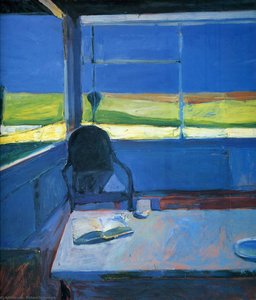
The Bay Area Figurative Movement, which Diebenkorn spearheaded, represented a significant shift in American art. Rejecting the purely abstract tendencies of some of their contemporaries, these artists sought to capture the essence of California life – its landscapes, its people, and its atmosphere – through a combination of representational forms and expressive color. Influenced by European masters like Matisse and Cézanne, as well as the work of American painters such as Hopper and Rothko, Diebenkorn developed a distinctive style characterized by lyrical abstraction and subtle emotional depth. His paintings often depicted solitary figures in evocative settings—windows overlooking vast landscapes, quiet interiors filled with light—creating a sense of introspection and longing. This movement reflected the unique cultural landscape of the Bay Area, where artistic innovation thrived alongside a deep appreciation for nature and a commitment to social justice.The Ocean Park Series: A Masterpiece of Composition
In 1967, Richard Diebenkorn embarked on what is arguably his most celebrated series—the *Ocean Park* paintings. Named after the Santa Monica neighborhood where he lived and worked, these works represent a culmination of his artistic explorations and a masterful synthesis of abstraction and representation. Unlike the gestural spontaneity of abstract expressionism or the direct depiction of earlier Bay Area Figurative paintings, the *Ocean Park* series is characterized by carefully considered composition, subtle color palettes, and a sense of serene order. These weren’t literal depictions of Ocean Park; rather, they were distillations of its light, space, and atmosphere—evocations of place through abstract form. He explored printmaking alongside his painting, beginning with drypoint in 1961 at UCLA, and forging a long-lasting collaboration with Kathan Brown at Crown Point Press from 1965 to 1992, producing numerous prints that further expanded his artistic vocabulary. The *Ocean Park* series garnered widespread critical acclaim, establishing Diebenkorn as a major force in contemporary art—a testament to his innovative spirit and unwavering commitment to artistic vision.Legacy and Lasting Influence
Richard Diebenkorn’s impact on postwar American art is undeniable. His ability to seamlessly blend abstract expressionism, lyrical abstraction, and figurative painting created a unique artistic voice that resonated with artists for decades to come. A significant retrospective at the Pasadena Art Museum in 1960—later shown at the California Palace of the Legion of Honor in San Francisco—cemented his reputation as a leading figure in the art world. He didn’t adhere to any single dogma, instead forging his own path by embracing experimentation and following his artistic intuition. His work continues to inspire artists and collectors alike, celebrated for its beauty, complexity, and emotional depth. Diebenkorn's passing in 1993 marked the end of a remarkable career, but his legacy lives on through the enduring power of his paintings—a poignant reminder of the transformative potential of art.Gyakran Ismételt Kérdések
Hol tekinthetném meg Richard Diebenkorn munkásságának színprofilját?
Richard Diebenkorn színek használata a ez a weboldal oldalon található műveiben a művész Paletta Genom oldalán tanulmányozható.
Richard Diebenkorn műveit témák szerint is felfedezhetem?
Richard Diebenkorn művei témánként is felfedezhetők a művész Témakör-atlasz oldalán.
Hol és melyik országban született Richard Diebenkorn?
Richard Diebenkorn Portland városban, Egyesült Államok országban született.