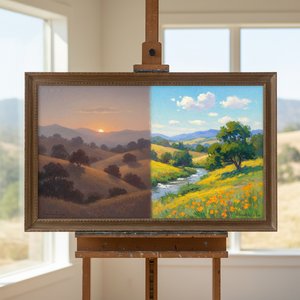
Raymond Dabb Yelland: A Californian Romantic
Raymond Dabb Yelland, born in London in 1848 and tragically passing away in Oakland in 1900, remains a captivating figure within the history of California landscape painting. His journey from British immigrant to respected instructor and artist profoundly shaped his unique artistic vision – one deeply rooted in Romanticism yet subtly infused with Luminist sensibilities. Yelland’s work isn't merely depictions of scenery; it’s an exploration of light, atmosphere, and a profound connection to the natural world, particularly the rugged beauty of the California coast. He sought to capture not just what he saw, but *how* it felt – the quiet grandeur of the landscape, the shifting moods of the sky, and the sense of timelessness inherent in nature’s rhythms.Early Life and Artistic Foundations
Raymond Dabb’s early life was marked by a quiet transition from Victorian England to the burgeoning American West. Arriving in New York City as a young child, he received his initial education before dedicating himself fully to art. His military service during the Civil War provided a brief but formative period of discipline and experience – an understanding of structure, observation, and the importance of meticulous detail that would later inform his approach to composition. Crucially, Yelland’s formal artistic training at the National Academy of Design in New York laid the groundwork for his understanding of traditional techniques – a foundation he skillfully adapted to suit the distinctive light and landscapes of California. However, it was his time studying with luminist masters like George Inness that truly shaped his later style, emphasizing atmospheric perspective and capturing the fleeting effects of light. Inness’s influence is evident in Yelland's ability to create a sense of depth and distance through subtle gradations of color and tone, lending an ethereal quality to his landscapes.California’s Embrace: A New Artistic Home
In 1874, Yelland embarked on a significant chapter of his life by migrating to Oakland, California, a region rapidly transforming into a hub for art and culture. This move proved pivotal, offering him access to the dramatic coastal scenery that would become the defining subject of his oeuvre. He quickly secured a position as an instructor at Mills College, one of the first women’s colleges west of the Rocky Mountains, where he honed his teaching skills while simultaneously developing his artistic practice. The decision to change his name legally – adding his mother's maiden name, Yelland – reflects a desire for stability and recognition within this new environment. He found inspiration in the dramatic cliffs, rolling hills, and expansive skies of Northern California, translating these scenes onto canvas with remarkable sensitivity. His early work often reflected the influence of the Hudson River School, characterized by detailed renderings of familiar landscapes, but he quickly moved towards a more atmospheric and evocative style.A Luminist Vision: Light, Atmosphere, and the California Coast
Yelland’s paintings are distinguished by a masterful manipulation of light and atmosphere – hallmarks of the Luminist movement. He eschewed the detailed realism favored by the Hudson River School, instead opting for looser brushwork and an emphasis on capturing the *feeling* of a place rather than its precise topographical representation. His subjects—the dramatic cliffs of Monterey Bay, the serene shores of Half Moon Bay, and the golden sunsets over the Pacific – are rendered with a remarkable sensitivity to color and light. His compositions often feature expansive vistas, drawing the viewer into the scene and creating a sense of immersion. The influence of Sanford Robinson Gifford is readily apparent in his use of atmospheric perspective and the evocative portrayal of natural beauty. He wasn’t simply painting landscapes; he was conveying an emotional response to them – a reverence for the power and serenity of nature. He particularly excelled at capturing the fleeting effects of light, using subtle gradations of color to suggest the warmth of the sun or the coolness of shadow.Legacy and Continuing Appreciation
Raymond Dabb Yelland's impact on California art extends beyond his individual works. His role as a teacher at Mills College and the San Francisco School of Design helped nurture a generation of artists, including notable figures like Homer Davenport and Maynard Dixon. His paintings are now held in collections across the United States, testament to their enduring appeal. The Crocker Art Museum’s exhibition on Yelland highlights his evolution from a classically trained artist to a pioneering Luminist painter who captured the spirit of California's dramatic coastline. His work aligns with his interest in transcendentalist themes, as he portrayed the California landscape with a spiritual quality. Yelland continued to improve his artistic skills throughout his life, studying in New York and Massachusetts as well as in Paris with the French painter Luc-Olivier Merson. He exhibited throughout his career, including at the 1893 World’s Columbian Exposition in Chicago and the 1894 California Midwinter International Exposition in San Francisco. Today, his legacy lies not only in the beauty of his landscapes but also in his ability to evoke a sense of wonder and connection with the natural world – a quality that continues to resonate with viewers today.Kérdések és válaszok
Látogathatom Raymond Dabb Yelland műveinek virtuális múzeumát?
Raymond Dabb Yelland művei megtekinthetők a művész virtuális, 3D-s galériájában, a 3D Galéria oldalon.
Hol találhatók statisztikák Raymond Dabb Yelland műveire vonatkozóan?
Raymond Dabb Yelland Statisztikák oldala a ez a weboldal felületén található műalkotásokból számított statisztikákat mutatja be.
Raymond Dabb Yelland műveit színspektrum szerint is felfedezhetem?
A Színindex oldalon Raymond Dabb Yelland műveit szín szerint csoportosítva találhatja.