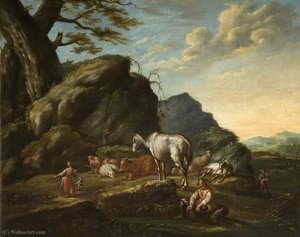
Goats and Flock of Sheep
Goats and Flock of Sheep is an oil painting by Philipp Peter Roos. The artist, who was also known by the moniker Rosa di Tivoli, produced this work about 1681. He was a German Baroque painter born in Sankt Goar, Germany.
Röviden
Philipp Peter Roos hagyatékából a leghíresebb alkotás Goats and Flock of Sheep (1681), amely a Munchen városi Bavári Állami Festırménygyűjtemények gyűjteményében található. Röviddel ezután követik őket Piece of Livestock (1681) és Landscape with Cattle and Shepherd (1681). Katalógusunkban 93 mű található Philipp Peter Roos alkotótól; a galéria megőrizte a világ által leginkább csodált 92 darabot, melyeket a dátummal, a múzeummal és a történetükkel együtt mutatunk be.
Goats and Flock of Sheep is an oil painting by Philipp Peter Roos. The artist, who was also known by the moniker Rosa di Tivoli, produced this work about 1681. He was a German Baroque painter born in Sankt Goar, Germany.
Piece of Livestock is an oil painting by Philipp Peter Roos, executed in 1681. The work originates from the Baroque period, a time when the artist was establishing his presence within the Italianate landscape tradition.
Landscape with Cattle and Shepherd is a work by the German Baroque painter Philipp Peter Roos. Created about 1681, the painting reflects the artist's specialized focus on pastoral scenes and animal subjects. Roos was a significant figure in the development of Italianate landscapes, often characterized by his intimate study of livestock and the natural environment.
In Piece of Livestock, Philipp Peter Roos organizes a pastoral scene through a close-up, ground-level perspective that establishes an immediate intimacy with the subjects. The composition is dominated by a large, seated cow positioned slightly to the right of the center. To the left, a smaller lamb or calf provides a sense of scale, while a woman interacts with a dog in the space behind the primary subject. This arrangement…
Resting Flock with Shepherds is an oil painting by the German Baroque artist Philipp Peter Roos. Created about 1681, this work captures a quiet moment within a rugged landscape. The composition focuses on a group of livestock and a shepherd, rendered with a sense of immediate presence that draws the viewer into the scene.
Resting Flock with Shepherds is an oil painting by Philipp Peter Roos. The canvas captures a heavy stillness among livestock and their guardian. This work was created about 1681. It presents a scene of animals and men gathered in a quiet, layered space under a turbulent sky.
In this Baroque-style oil painting, the mythological drama of the Liberation of Io unfolds with a sudden, heavy intensity. Created by Philipp Peter Roos about 1681, the scene captures a moment of profound tension between the divine and the mortal. A massive, powerful bull dominates the foreground, its muscular form rendered with a weight that feels almost tangible. This central figure looms over the landscape, its presence commanding the space…
This oil on canvas painting, dated 1681, presents a monochromatic scene rendered in various shades of gray. In the foreground, a young woman is positioned amidst a group of livestock, including sheep or goats. The composition is a medium shot, placing the human subject and the animals in the immediate front and middle ground. The terrain is undulating, forming rolling hills that recede into a background of hazy mountains and…
Returning Flock with Shepherds is an oil painting by Philipp Peter Roos. Created about 1681, the work captures a quiet moment of pastoral movement. The artist, a German Baroque painter, was born in Sankt Goar. He would later become known by the moniker Rosa di Tivoli.
The scene unfolds in Shepherd with Cow, Sheep and Goats in Italian Mountain Landscape, a work that captures a quiet moment of pastoral life. This painting, created about 1680, brings together a shepherd and his diverse herd amidst a rugged, mountainous setting. The figures and animals exist within a landscape that feels both immediate and deeply rooted in the natural world.
A négy leggyakorobban előforduló téma ebben az eredeti művekben, mindegyik a legkiválóbb példájával.
A 8 olyan múzeum, amely a legtöbb ezen az oldalon szereplő festményet őrzi.
| Múzeum | Város | Philipp Peter Roos művei | Ebből a listából származó festmények |
|---|---|---|---|
| Munchen | 15 | Goats and Flock of Sheep, Piece of Livestock, Landscape with Cattle and Shepherd | |
| Koppenhága | 5 | Cattle Piece, Landscape with a Bull, Sheep and Goats, A Shepherd with his Herd | |
| Buenos Aires | 4 | Landscape with shepherd and animals, Landscape with figures and animals, Shepherd and animals in a landscape | |
| Pozsony | 3 | Goat Herd with a Goatherd, Shepherd's Idyl in a Romantic Landscape with Ruins, Herd by an Ancient Well | |
| Prága | 3 | Ravine with a Stream, a Shepherd and His Herd, Horse and Goats Grazing, Shepherd with a Herd of Sheep and Goats | |
| Bécs | 3 | Herd with Sleeping Shepherds, Rider Meeting, Landscape with Flock of Sheep | |
| Szentpétervár | 3 | Landscape with a Grotto, Landscape with a Waterfall, Landscape with a Herd | |
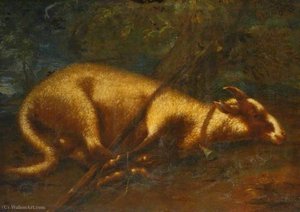
| Stockholm | 3 | Dead Hare, Landskap med hjord, A Goat Resting |
Váassz ki egy évtizedet, hogy megnézhesd az azt meghatározó eredetiműveket.
This large-scale oil painting, dated 1669, presents a crowded, maximalist composition of diverse animal species. The arrangement is packed, with various animals overlapping to create a sense of density and movement. The color palette relies on deep, earthy tones, including rich browns, blacks, and dark ochres. These dark shades are interrupted by specific highlights of white and cream, alongside splashes of red from a rooster and parrots. The lighting follows…
Goats and Flock of Sheep is an oil painting by Philipp Peter Roos. The artist, who was also known by the moniker Rosa di Tivoli, produced this work about 1681. He was a German Baroque painter born in Sankt Goar, Germany.
A heavy, dark-colored cow anchors the center of this scene, its presence felt in the weight of its silhouette. To the left, two goats rest upon the ground, one a pale contrast of white and light tan against the shadows. A man sits nearby, leaning back in a moment of stillness, his gaze directed toward the animals or perhaps the viewer. The air in the enclosure feels thick and dim,…
In this work, titled Shepherd's Idyl in a Romantic Landscape with Ruins, the artist Philipp Peter Roos presents a quiet moment of rural existence. Created about 1700, the painting captures a shepherd tending to his flock amidst a landscape of rolling hills and weathered stone structures. There is a sense of stillness in the way the figures and animals occupy the space, suggesting a life governed by the rhythms of…
Goats and Flock of Sheep (1681), Bavári Állami Festırménygyűjtemények, Munchen. Ezután Piece of Livestock (1681) és Landscape with Cattle and Shepherd (1681) következik.
24 éves: Goats and Flock of Sheep 1681-ből származik, Philipp Peter Roos pedig 1657-ben született.
Goats and Flock of Sheep, Piece of Livestock, Landscape with Cattle and Shepherd, Piece of Livestock, Resting Flock with Shepherds, Resting Flock with Shepherds, Liberation of Io, Piece of Cattle, Returning Flock with Shepherds és Shepherd with Cow, Sheep and Goats in Italian Mountain Landscape. A fenti rangsor a művek évszamarát és a múzeumát jelzi.
Katalógusunkban 93 mű található Philipp Peter Roos alkotótól, 1669 és 1700 év közötti időszakból.
Leginkább Bavári Állami Festırménygyűjtemények (Munchen), Statens Museum for Kunst (Koppenhága) és Nemzeti Szépművészeti Múzeum (Buenos Aires) található. A fenti múzeumi táblázatban mindegyik felsorolásra került.
1680s alatt: a jelen laphonon található 92 műből 21 készült ebben az időszakban, köztük Goats and Flock of Sheep.
Ezen az oldalon a leghitelesebb Various animals gathered before Noah's Ark (1669), a legutóbbi pedig Shepherd's Idyl in a Romantic Landscape with Ruins (1700).
Landscape (33), Animals (29) és Goats (19), a jelen oldalon található 92 műművészeti alkotás között.
Oil On Canvas, a jelen oldalon található 92 műből 18 darab esetén.
Baroque, ezen az oldalon található eredetiek alapján.
Goats and Flock of Sheep, Piece of Livestock és Landscape with Cattle and Shepherd: a Bavári Állami Festırménygyűjtemények, Munchen 15 művet őrzi ezen az oldalon.
Az olasz barokk aranyos fényében kevés név idézi meg a vidéki táj pastoralitását úgy, mint Philipp Peter Roos. A történelem az evocatív becenévén, Rosa di Tivoli néven ismerte, ez a német származású mester a természetvilághoz fűződő mély, szinte vizgalis kapcsolata révén formálta át a tájfestészet művészetét. 1655-ben született a Rajna vidékén – pontosabban Sankt Goar közelében –, és már korai évektől elrendeltetetten fogott a pincét. Johann Heinrich Roos, a tekintélyes tájfestő fia volt, aki alapvető tanításokat adott neki a tónusok harmóniájáról és a kompozíció egyensúlyáról, amelyek később meghatározták művész érett stílusát. Ez a korai tanítség nem csupán a technikáról szólt; ez a világ látásmódjának mély átélésének kezdete volt a fény, az árnyék és a föld csendes méltóságán keresztül.
Roos életének pályája drasztikusan megváltozott 1677-ben, amikor II. Károly, Hesse-Kassel hercege a bővénységével megnyitotta előtte az utat. A fiatal festő feltöbbvenő tehetségét felismerve a herceg finanszíalmi hátteret biztosított, amely lehetővé tette, hogy Roos átalakító utazásra induljon Rómába. Ez a migráció a germán hagyományoktól az olasz barokk szívéig olyan lehetőséget biztosított számára, hogy felszívja a római művészet vibráló energiáját. Itt keresett mentorokat a híres Giacinto Brandi alatt, akinek befolyása segített finomítani Roos képességét, hogy a klasszikus struktúrát egy spontaneusabb, atmoszférikus realizmussal ötszövetve jelenítsük meg. Ez a római időszak rendkívül személyes is volt; ebben az időszakban szerelembe esett Isabella Brandival, mentorja leányával. Apjuk és tanítványa közötti szövetség végül Tivoliban talált helyet, egy olyan lépéssel, amely örökre összekötte identitását azzal a tájjal, amelyet annyira szeretett.
Amit valóban megkülönböztet Rosa di Tivoli művészetét, az állatalkotásának páratlan hitelessége. Ellentétben számos kortársával, akik az állatokat csupán díszészeti elemekként használták a tájban, Roos minden lény – a nehézkék bikától a mozgékony kecskékig – olyan tisztelettel kezelte, mint egy portréfestő. Tivoli lakhelyisége híresen egy élő stúdió koncepciója szerint alakult; hatalmas egzotikus és házi állatgyűjteményt tartott fenn, gyakorlatilags a környezetét a mozgás, az anatómia és a temperamentum folyamatos tanulmányává alakítva. Ez a közvetlen közelség lehetővé tette számára, hogy megörökítse egy fül apró rándulását vagy egy állat izzadikást, ami lenyűgöző vitalitással tölti fel vászonait.
Technikai remeklényei nyilvánvalóak a barokk esztétika komplexitásának kezelésében. Míg kompozíciói gyakran a holland aranykor nyugodt, atmoszférikus minőségeiből merítenek, addig az olasz iskola jellemző drámai intenzitásával vannak átárasztva. Művei gyakran tartalmazzák a következőket:
Philipp Peter Roos történelmi fontossága abban rejlik, hogy képes volt áthidalni a szakadékot Észak-Európa strukturált tájfestészeti hagyományai és az olasz, fénnyel teli dráma között. Olyan korszakban jött létre, amikor a tudományos kutatás már pontosabb megfigyeléseket követelt a természetről, miközben a vallási és mitológiai téma még dominált a művészeti tudatban. Műveiben a naturalista apró részletesség és a romantikus lélek találkozik. A római vidék flóra- és faunájának ilyen devócióval történő dokumentálása egy olyan vizuális feljegyzést teremtett, amely egyszerre tükrözi a kor szellemet és a tárgyak magát is.
Bár 1706-ban elhunyt, és Tivoli földjébe vénekedve hagyott örökséget, hatása kitartott. A testemző állatfestészet fejlődésének és az olasz stílusú tájfestészet kialakulásának kulcsfontosságú alakja marad. Szemével nem csupán állatok gyűjteményét látjuk; hanem az élet legszimbolikusabb, legőszintebb formáinak mély tisztaztatását tanúja vagyunk. Művei ma is visszhangot kavarok, mint a megfigyelés erejének és a pásztori idealizmus maradandó szépségének tanúbizonysága.