Peter de Wint portréja

Peter de Wint festményei: A 100 leghíresebb alkotás, egy galéria szemével

Frissítve: november 2026 · rangsorolva népszerűségi pontszámunk alapján (minden mű keresései, látogatásai és megrendelései alapján) · 224 mű Peter de Wint alkotása a katalógusunkban

Röviden

A galéria szerint Peter de Wint leghíresebb festménye a Bamburgh Castle. A View Of Lincoln From The South At Little Bargate és The Old Bridge kiegészítik azt a triót, amelyet minden szem felismer. A katalógusunkban szereplő 224 művész Peter de Wint alkotásából a galéria az alábbi 100 leghíresebbet mutatja be, amelyek mind egyedi originális művek, a készítés évszámával, a múzeum megnevezésével és a különlegességük leírásával.

1784 – 1849, Stone Romanticism A legtöbb mű: Yale Center for British Art

A galéria top 10 Peter de Wint festménye

1
Bamburgh Castle (1889) -ja Peter de Wint

Bamburgh Castle

Oil

This painting presents Bamburgh Castle, a formidable structure situated in Northumberland, England. The British painter Peter De Wint has captured the fortification as it sits perched atop a rugged rocky outcrop. From this elevated vantage point, the castle commands the surrounding landscape, which is characterized by hilly and uneven terrain. The composition places the stone architecture in direct dialogue with the natural elements of the coast.

2
A View Of Lincoln From The South At Little Bargate (1889) -ja Peter de Wint

A View Of Lincoln From The South At Little Bargate

Oil

We are looking at A View Of Lincoln From The South At Little Bargate, a work by the English painter Peter De Wint. This piece reflects the artist's deep connection to the landscape, a pursuit that defined much of his career. De Wint was a versatile practitioner, working with proficiency in both oils and watercolour to capture the nuances of the natural world.

3
The Old Bridge (1889) -ja Peter de Wint

The Old Bridge

Oil

In "The Old Bridge" by Peter De Wint, the eye is immediately drawn to the weathered wooden structure that spans a calm, slow-moving stream. This central bridge anchors the scene, acting as a quiet connection between the riverbanks. On the left side of the timber crossing, two figures pause in mid-conversation. One wears a hat while the other is adorned in a bonnet, their period clothing suggesting a quiet moment…

4
The Harvesters (1889) -ja Peter de Wint

The Harvesters

Watercolor

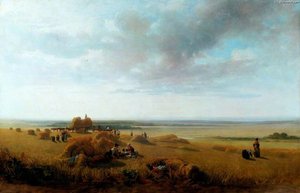
The Harvesters is a work by the English painter Peter De Wint. Born in 1784 in Stone, Staffordshire, England, De Wint established himself as a significant figure in the tradition of British landscape painting. His practice often focused on the rural topography of the English countryside, capturing the rhythms of agricultural life through both oil and watercolor.

6
Caernarvon Castle (1836) (1889) -ja Peter de Wint

Caernarvon Castle

1836 · Watercolor · Birmingham Museum and Art Gallery, Birmingham

There is a certain stillness in this 1836 watercolor that invites a quiet contemplation of the passage of time. The scene presents Caernarvon Castle, a massive, vertical presence that anchors the composition on the left. It sits along a waterfront, its rugged masonry rendered with a sense of weathered permanence. Above, an expansive, overcast sky dominates the upper half of the work, casting a diffused light that softens the edges…

7
Harvest Scene (1834) (1889) -ja Peter de Wint

Harvest Scene

1834 · Watercolor · Birmingham Museum and Art Gallery, Birmingham

is a watercolor painting by the English painter Peter De Wint. Created in 1834, the work captures a quiet moment of rural life. It presents a vast, open landscape where the earth meets an expansive sky. The scene focuses on the stillness of a pastoral setting, where the light of a late afternoon or an overcast day settles over the fields.

8
Sheltering from the Sun (1835) (1889) -ja Peter de Wint

Sheltering from the Sun

1835 · Watercolor · Birmingham Museum and Art Gallery, Birmingham

The landscape unfolds in Sheltering from the Sun, a watercolor that captures a quiet moment of rest within the natural world. Created by Peter De Wint in 1835, this work presents a scene of pastoral stillness. The artist focuses on the simple, heavy presence of cattle seeking refuge, grounding the viewer in a specific, tranquil instance of rural life.

9
Lynmouth (1844) (1889) -ja Peter de Wint

Lynmouth

1844 · Watercolor · Birmingham Museum and Art Gallery, Birmingham

In Lynmouth, Peter De Wint captures a rugged, rocky gorge where the raw power of nature takes center stage. The scene unfolds around a cascading waterfall that surges through the heart of the landscape. Water rushes downward, its movement driving the eye through a deep perspective that pulls the viewer into the very depths of the ravine. Large, dark boulders sit heavy in the foreground, anchoring the scene before the…

Peter de Wint festményei, 11. helyezéstől 100. helyezésig

11A Meet In The Grounds Of Raby Castle (1889) -ja Peter de WintA Meet In The Grounds Of Raby Castle 12Figures Loading A Haycart, Beneath A Tree (1889) -ja Peter de WintFigures Loading A Haycart, Beneath A Tree 13Harvesting scene, cheddington (1889) -ja Peter de WintHarvesting scene, cheddington 14The Glebe Farm (1889) -ja Peter de WintThe Glebe Farm 15The Lake At Burghley House (1889) -ja Peter de WintThe Lake At Burghley House 16Coast Scene (1889) -ja Peter de WintCoast SceneYale Center for British Art 17Threshing Corn (1889) -ja Peter de WintThreshing Corn 18Llansantffraid-glan-conway, denbighshire (1889) -ja Peter de WintLlansantffraid-glan-conway, denbighshire 19Near Matlock (1889) -ja Peter de WintNear MatlockYale Center for British Art 20Moored Barges Near Lambeth Palace (1889) -ja Peter de WintMoored Barges Near Lambeth Palace 21Cornfield With A Windmill (1889) -ja Peter de WintCornfield With A Windmill 22Two Rustic Figures (1889) -ja Peter de WintTwo Rustic Figures 23Study For 'elijah' - (1889) -ja Peter de WintStudy For 'elijah' - 24Shepherd and flock on a bridge, near newark (1889) -ja Peter de WintShepherd and flock on a bridge, near newark 25Head Of A Girl- Probably A Study Of Mrs. De Wint (1889) -ja Peter de WintHead Of A Girl- Probably A Study Of Mrs. De Wint 26John Keats (1889) -ja Peter de WintJohn Keats 27Castle on a Hill with a Bridge below (1889) -ja Peter de WintCastle on a Hill with a Bridge belowBirmingham Museum and Art Gallery 28Study of Burdocks (1889) -ja Peter de WintStudy of BurdocksYale Center for British Art 29Barges on a River (1889) -ja Peter de WintBarges on a RiverMűvészeti Múzeum, Boston 30Sea Study (1889) -ja Peter de WintSea Study 31A Lake View, Possibly Buttermere From Crummock Water (1889) -ja Peter de WintA Lake View, Possibly Buttermere From Crummock Water 32Pond With Willow Tree And Ducks (1889) -ja Peter de WintPond With Willow Tree And Ducks 33Cattle Beneath A Tree (1889) -ja Peter de WintCattle Beneath A Tree 34A Cottage In A Wooded Landscpe (1889) -ja Peter de WintA Cottage In A Wooded Landscpe 35Landscape Study- A Haystack Near A Church (1889) -ja Peter de WintLandscape Study- A Haystack Near A ChurchYale Center for British Art 36Two Studies Of A Watermill (1889) -ja Peter de WintTwo Studies Of A Watermill 37Cattle Before Ludlow Castle, Shropshire (1889) -ja Peter de WintCattle Before Ludlow Castle, Shropshire 38Cattle On The Edge Of A Lane, A Church Beyond (1889) -ja Peter de WintCattle On The Edge Of A Lane, A Church Beyond 39A coastal landscape (1889) -ja Peter de WintA coastal landscape 40A Barge Near Mooring Posts (1889) -ja Peter de WintA Barge Near Mooring Posts 41Near Penrith (1889) -ja Peter de WintNear Penrith 42A Landscape With Harvesters In The Foreground (1889) -ja Peter de WintA Landscape With Harvesters In The Foreground 43Study of a timber wagon; loading the barge (1889) -ja Peter de WintStudy of a timber wagon; loading the barge 44Still Life With Broom (1889) -ja Peter de WintStill Life With Broom 45Plough Horses (1889) -ja Peter de WintPlough Horses 46Harvest Time- Cumberland (1889) -ja Peter de WintHarvest Time- CumberlandYale Center for British Art 47Cookham-on-thames, Berkshire (1889) -ja Peter de WintCookham-on-thames, Berkshire 48Ash Tree In Ashstead Park (1889) -ja Peter de WintAsh Tree In Ashstead ParkSzlovák Nemzeti Galéria 49Greenwich (1889) -ja Peter de WintGreenwich 50A Barn In A Wooded Landscape (1889) -ja Peter de WintA Barn In A Wooded Landscape 51Bardon Hill, Charnwood Forest, Leicestershire (1889) -ja Peter de WintBardon Hill, Charnwood Forest, Leicestershire 52Middleham, Yorkshire (1889) -ja Peter de WintMiddleham, Yorkshire 53Manor House And Church, Lytes Cary, Somerset (1889) -ja Peter de WintManor House And Church, Lytes Cary, Somerset 54Malmesbury Abbey (1889) -ja Peter de WintMalmesbury Abbey 55Borough Cathedral (1889) -ja Peter de WintBorough Cathedral 56Dunster, Somerset (1889) -ja Peter de WintDunster, SomersetFitzwilliam Museum 57A Yorkshire Road (1889) -ja Peter de WintA Yorkshire RoadYale Center for British Art 58A Mill In France (1889) -ja Peter de WintA Mill In France 59Bristol cathedral from the south (1889) -ja Peter de WintBristol cathedral from the south 60Harvest Time - (1889) -ja Peter de WintHarvest Time -Yale Center for British Art 61Gloucester (1889) -ja Peter de WintGloucester 62Chelsea Old Bridge, London (1889) -ja Peter de WintChelsea Old Bridge, London 63Achilles Statue, Hyde Park, London (1889) -ja Peter de WintAchilles Statue, Hyde Park, London 64Landscape With Willow Tree (1889) -ja Peter de WintLandscape With Willow Tree 65Haymaking On The Banks Of A Lincolnshire River (1889) -ja Peter de WintHaymaking On The Banks Of A Lincolnshire River 66Chester (1889) -ja Peter de WintChester 67A Study For 'the Ferry' - Snowdon From Llyn Padarn, North Wales (1889) -ja Peter de WintA Study For 'the Ferry' - Snowdon From Llyn Padarn, North Wales 68Woodland Scene (1889) -ja Peter de WintWoodland Scene 69Hay Wagons (1889) -ja Peter de WintHay Wagons 70Figures And A Horse And Cart On A Country Track (1889) -ja Peter de WintFigures And A Horse And Cart On A Country Track 71Extensive Landscape (1889) -ja Peter de WintExtensive LandscapeBirmingham Museum and Art Gallery 72A View Of Richmond, Yorkshire With A Footbridge In The Foreground (1889) -ja Peter de WintA View Of Richmond, Yorkshire With A Footbridge In The Foreground 73A Country Road With Traveller On Horseback (1889) -ja Peter de WintA Country Road With Traveller On Horseback 74A Cornfield (1889) -ja Peter de WintA Cornfield 75Landscape with haystacks (1889) -ja Peter de WintLandscape with haystacks 76The Ferry (1889) -ja Peter de WintThe Ferry 77Lincolnshire Cornfield Near Horncastle (1889) -ja Peter de WintLincolnshire Cornfield Near Horncastle 78A Wooded Track (1889) -ja Peter de WintA Wooded Track 79A Wooded Landscape With A Rainbow (1889) -ja Peter de WintA Wooded Landscape With A Rainbow 80A Country Road; And A Companion Work (1889) -ja Peter de WintA Country Road; And A Companion Work 81View Of Ludlow Castle (1889) -ja Peter de WintView Of Ludlow Castle 82Still Life With Rake (1889) -ja Peter de WintStill Life With Rake 83Building A Hayrick - (1889) -ja Peter de WintBuilding A Hayrick - 84Barden Tower, Yorkshire (1889) -ja Peter de WintBarden Tower, Yorkshire 85View Over Flat Country (1889) -ja Peter de WintView Over Flat Country 86A Haywagon In An Open Landscape (1889) -ja Peter de WintA Haywagon In An Open Landscape 87View Of Exeter (1889) -ja Peter de WintView Of Exeter 88The Farm Pond (1889) -ja Peter de WintThe Farm Pond 89Great Mitton, Lancashire, From The Ribble, With Longridge Fell Beyond (1889) -ja Peter de WintGreat Mitton, Lancashire, From The Ribble, With Longridge Fell Beyond 90Shipbuilding On The Yorkshire Coast (1889) -ja Peter de WintShipbuilding On The Yorkshire Coast 91Men Working On The Lincolnshire Heathland (1889) -ja Peter de WintMen Working On The Lincolnshire Heathland 92Harvesters In The Fields Above The Valley Of The Lune, Cumbria (1889) -ja Peter de WintHarvesters In The Fields Above The Valley Of The Lune, Cumbria 93Grasmere And Helm Crag, Cumbria (1889) -ja Peter de WintGrasmere And Helm Crag, Cumbria 94Loading a Haywain (1889) -ja Peter de WintLoading a Haywain 95Harvesting scene (1889) -ja Peter de WintHarvesting scene 96View Of Elizabeth Castle, St Helier, Jersey (1889) -ja Peter de WintView Of Elizabeth Castle, St Helier, Jersey 97Three Cart-horses In Traces (1889) -ja Peter de WintThree Cart-horses In Traces 98Harvesting, Probably On The Lincolnshire Cliff (1889) -ja Peter de WintHarvesting, Probably On The Lincolnshire Cliff 99Landscape With Cows And Barn (1889) -ja Peter de WintLandscape With Cows And Barn 100Two Men In Punts (1889) -ja Peter de WintTwo Men In Punts

Peter de Wint híres festményei, korszakonként

A témák, amelyek Peter de Wint figyelmét meghúzták

A négy leggyakorobban előforduló téma ebben az eredeti művekben, mindegyik a legkiválóbb példájával.

A műemlékek, amelyek Peter de Wint eredeti műveit őrzik

A 5 olyan múzeum, amely a legtöbb ezen az oldalon szereplő festményet őrzi.

Múzeum Város Peter de Wint művei Ebből a listából származó festmények
Yale Center for British Art, New HavenYale Center for British Art New Haven 22 Coast Scene, Near Matlock, Study of Burdocks
Birmingham Museum and Art Gallery, BirminghamBirmingham Museum and Art Gallery Birmingham 8 The Farmyard, Caernarvon Castle, Harvest Scene
Fitzwilliam MuseumFitzwilliam Museum 2 Dunster, Somerset
Művészeti Múzeum, Boston, BostonMűvészeti Múzeum, Boston Boston 1 Barges on a River
Szlovák Nemzeti Galéria, PozsonySzlovák Nemzeti Galéria Pozsony 1 Ash Tree In Ashstead Park

Peter de Wint, egy aláírott festmény évtizedenként

Művek évtizedenként

Váassz ki egy évtizedet, hogy megnézhesd az azt meghatározó eredetiműveket.

Peter de Wint festményei: a galéria válaszai

Melyik Peter de Wint festmény a leghíresebb?Fedje fel a választ

Bamburgh Castle. Ezt követi A View Of Lincoln From The South At Little Bargate és The Old Bridge.

Melyek Peter de Wint top 10 festménye?Fedje fel a választ

Bamburgh Castle, A View Of Lincoln From The South At Little Bargate, The Old Bridge, The Harvesters, The Farmyard, Caernarvon Castle, Harvest Scene, Sheltering from the Sun, Lynmouth és A Woman Sorting Washing. A fenti rangsor a művek évszamarát és a múzeumát jelzi.

Hány műve született Peter de Wint nevére?Fedje fel a választ

Katalógusunkban 224 mű található Peter de Wint alkotótól, 1815 és 1844 év közötti időszakból.

Hol találhatóak Peter de Wint leghíresebb eredeti művei?Fedje fel a választ

Leginkább Yale Center for British Art (New Haven), Birmingham Museum and Art Gallery (Birmingham) és Fitzwilliam Museum található. A fenti múzeumi táblázatban mindegyik felsorolásra került.

Mikor festette Peter de Wint le leghíresebb műveit?Fedje fel a választ

1830s alatt: a jelen laphonon található 100 műből 3 készült ebben az időszakban, köztük Caernarvon Castle.

Melyek Peter de Wint legkorábbi és legutóbbi híres művei?Fedje fel a választ

Ezen az oldalon a leghitelesebb The Farmyard (1815), a legutóbbi pedig Lynmouth (1844).

Mely témakörökkel foglaltaszkodott a legtöbbször Peter de Wint?Fedje fel a választ

Landscape (18), Scenes (7) és Atmospheric light (7), a jelen oldalon található 100 műművészeti alkotás között.

Melyik technikával foglalt leginkább Peter de Wint?Fedje fel a választ

Watercolor, a jelen oldalon található 100 műből 6 darab esetén.

Mely művészeti irányhoz tartozik Peter de Wint?Fedje fel a választ

Romanticism, ezen az oldalon található eredetiek alapján.

Mely Peter de Wint eredeti műveit őrzi a Yale Center for British Art?Fedje fel a választ

Coast Scene, Near Matlock és Study of Burdocks: a Yale Center for British Art, New Haven 7 művet őrzi ezen az oldalon.

Peter de Wint: a művész

Early Life and Training

Peter De Wint, born January 21, 1784, in Stone, Staffordshire, England, descended from a Dutch physician who had emigrated to New York—a lineage that instilled within him an appreciation for meticulous observation and artistic exploration. His father’s medical profession provided him with a grounding in scientific precision, yet Peter's own passions swiftly steered him toward the captivating realm of art. From a young age, he demonstrated considerable talent, capturing landscapes and portraits with remarkable sensitivity. Initially envisioned as a physician like his father, De Wint’s artistic inclinations proved irresistible. In 1802, he relocated to London, embarking on a transformative journey that would forge him into one of Britain's most celebrated watercolorists. This pivotal decision marked the commencement of an apprenticeship with John Raphael Smith, a renowned mezzotint engraver and portrait painter—a partnership crucial for honing his drawing skills and mastering the techniques of printmaking. The apprenticeship wasn’t merely about technical proficiency; it fostered exposure to artistic discourse and established connections within London's vibrant art community. Recognizing De Wint’s burgeoning talent, Smith generously granted him freedom after he produced eighteen impressive oil paintings—a testament to his dedication and artistic promise. Subsequently, De Wint pursued formal training under John Varley, a prominent watercolorist who championed Dr. Monro’s informal academy for young artists. This environment nurtured collaboration with luminaries like Turner and Girtin, shaping De Wint's artistic vision and cementing his place within the influential Romantic movement.

Artistic Style and Development

De Wint quickly gained recognition for his landscapes at the Royal Academy in 1807—a decisive step toward establishing himself as a respected artist. His canvases breathed with an ethereal quality, capturing fleeting moments of light and atmosphere with breathtaking accuracy. This distinctive style was characterized by a masterful command of watercolor technique, achieved through a remarkably restrained palette – typically consisting of just ten pigments. He meticulously selected ivory-tinted Creswick paper, ensuring that his paintings possessed a luminous translucence and unparalleled delicacy. Beyond watercolors, De Wint demonstrated versatility in oil painting, producing evocative depictions of rural scenes and portraits alike. His approach prioritized capturing the essence of nature—the subtle nuances of light, color, and texture—rather than striving for dramatic grandeur. This understated elegance became his hallmark, distinguishing him from many of his contemporaries.

Key Themes and Subjects

A significant portion of De Wint’s oeuvre revolved around landscapes inspired by his frequent visits to Lincolnshire—a region he regarded as embodying the sublime beauty of England. His paintings depicted idyllic scenes of haymaking, quaint rural cottages nestled amidst rolling hills, and expansive vistas that conveyed a profound connection to the natural world. These images resonated deeply with Romantic sensibilities, reflecting an admiration for untamed wilderness and an appreciation for the grandeur of God’s creation. Furthermore, De Wint produced portraits—including a celebrated depiction of John Keats—demonstrating his ability to convey psychological depth and emotional resonance within his subjects. His artistic endeavors were driven by a desire to capture not merely appearances but also inner character—a testament to his profound understanding of human experience.

Legacy and Historical Significance

Alfred William Rich famously asserted that De Wint “ever came nearer painting a perfect picture than did Peter de Wint,” encapsulating the enduring admiration for his artistic genius and unwavering commitment to excellence. His influence extended far beyond his own lifetime, shaping the trajectory of subsequent British landscape painters and contributing significantly to the development of English watercolor art. Today, De Wint’s works reside in prestigious collections worldwide—including Tate Britain, the Victoria and Albert Museum, and The Collection (Lincoln)—serving as enduring symbols of artistic achievement and historical significance. His legacy continues to inspire artists and scholars alike, ensuring that Peter De Wint's contribution to British art remains vividly remembered for generations to come.