The Renaissance Visionary of Bern: The Life and Legacy of Niklaus Manuel
In the vibrant tapestry of the sixteenth-century Northern Renaissance, few figures loom as large or as multifaceted as Niklaus Manuel. Born in Berlin around 1484, this extraordinary individual was far more than a mere painter; he was a mercenary soldier, a writer, and a pivotal figure in the civic life of Bern. His life was a whirlwind of movement and intellect, bridging the gap between the brutal realities of European warfare and the refined humanist ideals of the Renaissance. As a central character in the artistic landscape of Switzerland, Manuel’s work serves as a profound window into an era defined by spiritual struggle, political upheaval, and a burgeoning fascination with the human condition.
The foundation of Manuel’s technical mastery can be traced back to his formative years in Basel, where he underwent rigorous training under the legendary Hans Holbein the Younger. This apprenticeship was transformative, instilling in him a meticulous devotion to realism and a sophisticated command of chiaroscuro. From Holbein, Manuel inherited an eye for the minute details of nature and the human form, as well as the ability to use light and shadow to imbue his subjects with psychological depth. This connection to the humanist tradition allowed him to move beyond simple ornamentation, instead creating works that prioritized observation and an accurate, almost visceral, representation of the world around him.
A Mastery of Symbolism and Narrative
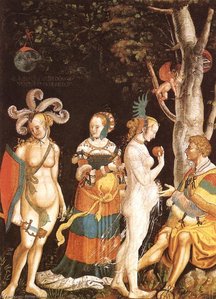
Manuel’s artistic output is characterized by a remarkable versatility, ranging from deeply religious altarpieces to biting satirical compositions. His ability to weave complex theological narratives with humanist symbolism allowed him to capture the dualities of his age—the sacred and the profane, the eternal and the mortal. One of his most hauntingly beautiful themes was the exploration of mortality, often expressed through intricate landscapes and symbolic figures. In works such as his Allegory of Death, he utilizes the image of a nude woman holding a skull to evoke profound meditations on transformation and the inevitability of the end, set against an intricately detailed backdrop that showcases his command over environmental storytelling.
Beyond the contemplative, Manuel possessed a talent for depicting intense, dynamic struggle. His Temptation of Saint Anthony stands as a testament to his ability to utilize the emerging Mannerist style, employing rich colors and intense detail to portray demonic temptation and spiritual warfare. This capacity for drama was perhaps most famously realized in his monumental mural, the Danse Macabre, at the Dominican Abbey in Bern. Although this masterpiece was tragically lost to history in 1660, its influence lived on through contemporary copies, reminding viewers of his ability to command large-scale compositions that spoke to the collective consciousness of the Bernese people.
Historical Significance and Artistic Endurance
The significance of Niklaus Manuel extends far beyond the borders of Switzerland. He represented a unique breed of Renaissance man—an artist whose brush was as active in the halls of governance and the battlefields of Europe as it was in the quiet studios of Basel. His portraits, such as those found in the Historisches Museum Bern, reveal a master capable of capturing the dignity and symbolic weight of the nobility, using dramatic lighting to elevate his subjects into icons of their era.
Ultimately, Manuel’s legacy is defined by his role as a bridge. He bridged the gap between the late Gothic traditions and the burgeoning Renaissance; he bridged the distance between the soldier's grit and the scholar's grace; and most importantly, he bridged the human experience with the divine through his art. His works remain essential touchstones for understanding the cultural metamorphosis of the sixteenth century, offering a glimpse into a world where art, politics, and spirituality were inextricably entwined.