A Life in Color and Form
Mattheus Johannes Maria Wiegman lived a life deeply connected to the textures of his surroundings. Born in 1886, he was part of a family of artists, including his brother Jan. While his early years involved much drawing, it was in 1906 that he truly began to focus on painting. His path took him from the industrial atmosphere of Rotterdam to the studios of Amsterdam, where he studied at the Royal Academy of Arts. He eventually found a home in Bergen, becoming a central figure in what would be known as the Bergen School.
His work was never confined to a single medium. While many recognize him for his paintings, he possessed a versatile hand that could move between different scales and materials. He worked as a draftsman, muralist, and stained glass artist. His creative output even extended to the smaller, more delicate tasks of creating posters, book covers, and mosaics. In later years, much of his time was spent in France, though his roots remained firmly planted in the Dutch landscape.
The Language of Expression
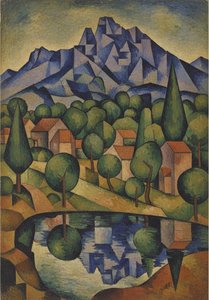
Wiegman’s approach to art was shaped by a careful study of light and tone. He looked toward the influence of Cézanne, adopting a tonal method that brought a certain warmth to his compositions. His subject matter remained grounded in the tangible world, focusing on figures, landscapes, and still lifes. There was a quiet strength in how he handled these subjects, often using thick applications of paint or working on surfaces like chipboard to achieve specific effects.
His artistic development saw him move through various stages of expressionism. He was able to translate the weight of a figure or the atmosphere of a landscape into something deeply felt. This ability to communicate through color and form allowed his work to reach international audiences, appearing in exhibitions from Venice to São Paulo and Chicago. Even when working on large-scale religious themes through frescoes and stained glass, he maintained this focus on the essential character of his subjects.
A Lasting Presence
The breadth of Wiegman's career is visible in the variety of places where his work resides today. His pieces have been held in collections such as the Stedelijk Van Abbemuseum and the Art Institute of Chicago. The following aspects define his contribution to the art of his time:
- The Bergen School: He was a leading figure in this Dutch expressionist movement, helping to shape its aesthetic direction.
- Versatility of Medium: His ability to transition from oil paintings to mosaics and stained glass windows demonstrated a rare technical range.
- International Reach: Through participation in the Venice Biennale and other major exhibitions, his vision moved far beyond the borders of the Netherlands.
By the time he passed away in 1971, Wiegman had left behind a body of work that captured the shifting moods of the early twentieth century. His paintings, ranging from intimate portraits like Clown to expansive landscapes, continue to be studied for their structural integrity and tonal depth.