Early Life and Artistic Foundations
Julian Alden Weir, born August 30, 1852, at West Point, New York, was steeped in art from his earliest days. His father, Robert Walter Weir, a respected painter and drawing professor at the United States Military Academy, instilled within young Julian not just an appreciation for beauty but also a deep understanding of artistic technique. The Weir home itself became a vibrant studio—a space filled with the tools of creation, overflowing with inspiration and echoing with the voices of artists. This nurturing environment extended to his elder brother, John Ferguson Weir, who would later become a celebrated landscape artist in his own right. Julian’s formal training began at the National Academy of Design in New York City around 1870, providing him with a solid foundation in traditional methods and styles. However, it was his journey to Paris in 1873 that truly ignited his artistic development—a pivotal moment that would reshape his entire approach to painting. Studying under Jean-Léon Gérôme at the École des Beaux-Arts exposed him to the rigorous standards of academic art, demanding meticulous detail and a mastery of classical forms. Yet, it was through friendships forged with artists like Jules Bastien-Lepage that Weir began to broaden his perspective, exploring the possibilities beyond the confines of strict tradition. Initially, Weir harbored a strong skepticism towards the emerging Impressionist movement, dismissing its perceived lack of structure and form as “horrible.” This early resistance—a reaction against what he saw as a chaotic abandonment of established principles—would prove to be a crucial turning point in his artistic evolution, ultimately leading him to embrace the very style he had initially rejected.The Connecticut Years and Artistic Transformation
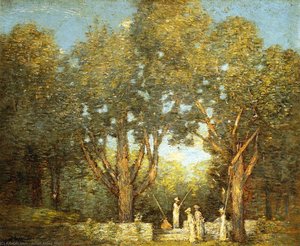
A significant shift in Weir’s life occurred with his marriage to Anna Dwight Baker in 1883 and their subsequent move to Branchville, Connecticut. Seeking respite from the bustling art world of New York City, he purchased a farm there—a decision that would profoundly influence his artistic focus. This rural setting, far removed from the pressures of urban life, became more than just a retreat; it transformed into a wellspring of inspiration. The tranquil landscapes—the rolling hills, the quiet streams, and the ever-changing light—began to subtly shape his artistic vision. While he continued to produce portraits and still lifes in a traditional style during this period, there was an undeniable shift occurring beneath the surface. He found himself increasingly drawn to capturing the fleeting effects of light, the subtle nuances of color, and the overall atmosphere of the Connecticut countryside. Around 1891, this inclination blossomed into a full-fledged embrace of Impressionism—a movement that had initially seemed so objectionable. Influenced by fellow artists like John Twachtman and Theodore Robinson, Weir began experimenting with broken brushstrokes, vibrant palettes, and an emphasis on subjective perception—a departure from the meticulous realism he had previously favored. This wasn’t a sudden abandonment of his earlier training; rather, it was a sophisticated synthesis of academic skill with the innovative spirit of the new movement, resulting in a uniquely personal style. He also demonstrated considerable talent as an engraver, particularly through his skillful use of aquatint techniques, adding another layer to his artistic repertoire.A Leading Voice in American Art
By the late 19th century, Julian Alden Weir had firmly established himself as a prominent figure within the burgeoning American art scene. He played a crucial role in forming “The Ten,” a group of ten independent-minded painters who sought to challenge the dominance of traditional institutions like the National Academy of Design and forge their own artistic path. This collective—including artists such as Childe Hassam, Willard Leroy Metcalf, and Edmund Tarbell—represented a significant step towards artistic autonomy and helped shape the direction of American painting during this period. Weir’s leadership within “The Ten” was characterized by his commitment to fostering a spirit of collaboration and experimentation. He wasn't merely an observer; he actively encouraged his fellow artists to push boundaries, explore new techniques, and develop their own unique voices. In 1912, Weir was elected the first president of the Association of American Painters and Sculptors—a testament to the respect he had earned from both progressive and conservative factions within the art community. He later served as president of the National Academy of Design itself, demonstrating his enduring influence on the landscape of American art. His key works from this period—such as *On the Shore* (1892), a vibrant coastal scene brimming with light and movement; *New England Barnyard* (1904), a charming depiction of rural life that captures the essence of small-town America; and *Upland Pasture* (1905)—exemplify his mastery of Impressionistic techniques and his ability to evoke a sense of place and atmosphere.Legacy and Enduring Influence
Julian Alden Weir’s contributions extend far beyond his individual paintings. He played a pivotal role in bridging the gap between traditional academic painting and the innovative spirit of Impressionism, paving the way for future generations of American artists. His dedication to fostering artistic independence through “The Ten” challenged established norms and helped create a more vibrant and diverse art landscape. Today, Weir Farm National Historic Site in Branchville, Connecticut, stands as a poignant reminder of his life and work—a carefully preserved farm that offers visitors a glimpse into the world that inspired him. Preserved as it was during his time, the farm provides an intimate connection to the landscapes he so lovingly depicted, allowing us to appreciate the beauty and tranquility that fueled his artistic vision. Weir’s family’s artistic legacy – stemming from his father Robert Walter Weir, a Hudson River School painter – further cements Julian Alden Weir's place within the broader narrative of American art history. He died in New York City on December 8, 1919, leaving behind a body of work that continues to captivate and inspire, reminding us of the power of art to capture the beauty and essence of the world around us.- Key Works: *On the Shore* (1892), *New England Barnyard* (1904), *Upland Pasture* (1905)
- Artistic Style: Impressionism, Tonalism
- Associations: “The Ten,” National Academy of Design
Kérdések és válaszok
Honnan származik Julian Alden Weir?
Julian Alden Weir Egyesült Államok-ban született.
Mennyire népszerűek Julian Alden Weir művei?
Julian Alden Weir műveire vonatkozó statisztikusok a művész Statisztikák oldalán érhetőek el.
Julian Alden Weir műveit műkorok szerint is böngészhetem?
Julian Alden Weir alkotásainak különböző stílusirányzatai a művész Összes művészeti irányzat oldalán tekinthetők meg, ahol a műalkotások stílus szerint csoportosítva láthatóak.