John Edward Brett portréja

John Edward Brett festményei: A 45 leghíresebb alkotás, egy galéria szemével

Frissítve: november 2026 · rangsorolva népszerűségi pontszámunk alapján (minden mű keresései, látogatásai és megrendelései alapján) · 48 mű John Edward Brett alkotása a katalógusunkban

Röviden

A galéria szerint John Edward Brett leghíresebb festménye a Lady with a Dove: Madame Loeser (1864), amelynek eredeti példája a Tate Gallery múzeumában található, London városában. Forest Cove, Cardigan Bay (1883) és Cape Cornwall from Whitesand Bay (1872) kiegészítik azt a triót, amelyet minden szem felismer. A katalógusunkban szereplő 48 művész John Edward Brett alkotásából a galéria az alábbi 45 leghíresebbet mutatja be, amelyek mind egyedi originális művek, a készítés évszámával, a múzeum megnevezésével és a különlegességük leírásával.

1830 – 1902 Pre-raphaelite A legtöbb mű: Tate Gallery

A galéria top 10 John Edward Brett festménye

1
Lady with a Dove: Madame Loeser (1864) (1889) -ja John Edward Brett

Lady with a Dove: Madame Loeser

1864 · Oil On Canvas · Tate Gallery, London

The gaze meets Lady with a Dove: Madame Loeser, a portrait that holds its subject in a quiet, suspended moment. Painted by John Edward Brett in 1864, the work presents a woman caught in a stillness that feels both intimate and profound. This oil on canvas captures a specific presence, one that remains part of the esteemed Tate collection.

2
Forest Cove, Cardigan Bay (1883) (1889) -ja John Edward Brett

Forest Cove, Cardigan Bay

1883 · Oil · Amgueddfa Cymru, Cardiff

The sun hangs high over Cardigan Bay, casting a bright, clear light across a scene of quiet activity. Along the shoreline, the beach is alive with the presence of people, each figure caught in a moment of leisure as they enjoy the warmth of the day. The water meets the land in a gentle rhythm, while several boats drift upon the surface—some resting near the shallow shore and others appearing…

3
Cape Cornwall from Whitesand Bay (1872) (1889) -ja John Edward Brett

Cape Cornwall from Whitesand Bay

1872 · Oil On Panel · Fitzwilliam Museum

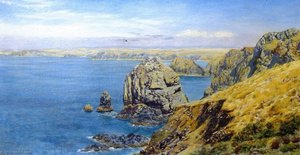
The oil on panel painting depicts a rocky shoreline where large boulders are scattered across the foreground and middle ground. These stones meet a sandy beach that extends toward the ocean. The water appears calm, meeting the horizon under a light that provides depth to the scene. In the distance, several small figures are positioned along the shore, appearing as minute details against the scale of the landscape. The composition…

4
Landscape (1852) (1889) -ja John Edward Brett

Landscape

1852 · Oil · Fitzwilliam Museum

The composition centers on a river flowing through a landscape of dense vegetation and trees. On the banks, various trees line the water's edge, their forms casting shadows upon the surface. Two horses occupy the middle ground; one is positioned toward the left side of the frame, while the second is situated further back near the center of the scene. A single figure stands at the right edge of the…

5
Val di Cogne, Switzerland (1858) (1889) -ja John Edward Brett

Val di Cogne, Switzerland

1858 · Watercolor

The mountains of Val di Cogne rise with a quiet authority, their slopes draped in a dense mantle of trees that cling to the rugged terrain. Sunlight filters through the atmosphere, casting a soft glow over a landscape that feels caught in a moment of profound stillness. High above the valley floor, two birds drift through the open sky, their presence adding a sense of life to the vast, airy…

6
Preliminary watercolor sketch for 'The Glacier of Rosenlaut] (1856) (1889) -ja John Edward Brett

Preliminary watercolor sketch for 'The Glacier of Rosenlaut]

1856 · Watercolor

The mountains rise with a quiet, heavy presence, their snow-capped peaks catching a pale, ethereal light that seems to shimmer across the paper. In this preliminary watercolor sketch, the world feels caught in a moment of profound stillness. Pine trees stand as dark, sharp silhouettes against the pale slopes, their needles rendered with a delicate touch that suggests the crispness of mountain air. Below the towering heights, the ground is…

7
Norbury on the Mole (1862) (1889) -ja John Edward Brett

Norbury on the Mole

1862 · Oil

The landscape unfolds as a quiet study of English pastoral life. In the foreground, a lush field stretches toward a distant line of trees, its surface populated by grazing cows and two horses positioned at the periphery. A farmhouse sits tucked into the bottom left corner, anchoring the composition within a settled, agricultural reality. Above, a heavy sky filled with clouds casts a soft, diffused light across the scene, establishing…

8
The Stonebreaker (1857) (1889) -ja John Edward Brett

The Stonebreaker

1857 · Oil On Canvas · Walker Art Gallery, Liverpool

In this oil on canvas, a young boy sits amidst a landscape of flint and grass. He is positioned in a sunlit clearing near Box Hill, in the Surrey region of England. The boy is engaged in the manual labor of breaking stones, specifically flints, which were used for mending roads. He sits upon a pile of these grey and white stones, holding a hammer in his hand. A dog…

9
The Glacier of Rosenlaui (1856) (1889) -ja John Edward Brett

The Glacier of Rosenlaui

1856 · Oil On Canvas · Tate Britain, London

In this 1856 oil on canvas, we find ourselves standing before the raw, unyielding architecture of the Swiss Alps. The scene is dominated by the immense presence of the Glacier of Rosenlaui, a landscape that feels both ancient and immediate. Large, weathered rocks and boulders occupy the foreground, their surfaces rendered with a heavy, tactile quality that suggests the immense pressure of the ice above. These stones, painted in warm…

10
Florence from Bellosguardo (1863) (1889) -ja John Edward Brett

Florence from Bellosguardo

1863 · Oil · Tate Gallery, London

The city of Florence unfolds beneath a gaze from Bellosguardo. From this elevated vantage, the urban landscape rises in a dense collection of old buildings, towers, and domes. The skyline is a jagged silhouette of stone and clay against the sky. In the foreground, the soft, green presence of trees anchors the composition, offering a natural frame to the architectural sprawl below. The scene is alive with a quiet, constant…

John Edward Brett festményei, 11. helyezéstől 45. helyezésig

John Edward Brett híres festményei, korszakonként

A témák, amelyek John Edward Brett figyelmét meghúzták

A négy leggyakorobban előforduló téma ebben az eredeti művekben, mindegyik a legkiválóbb példájával.

A műemlékek, amelyek John Edward Brett eredeti műveit őrzik

A 8 olyan múzeum, amely a legtöbb ezen az oldalon szereplő festményet őrzi.

Múzeum Város John Edward Brett művei Ebből a listából származó festmények
Tate Gallery, LondonTate Gallery London 2 Lady with a Dove: Madame Loeser, Florence from Bellosguardo
Fitzwilliam MuseumFitzwilliam Museum 2 Cape Cornwall from Whitesand Bay, Landscape
Amgueddfa Cymru, CardiffAmgueddfa Cymru Cardiff 1 Forest Cove, Cardigan Bay
Walker Art Gallery, LiverpoolWalker Art Gallery Liverpool 1 The Stonebreaker
Tate Britain, LondonTate Britain London 1 The Glacier of Rosenlaui
Sheffield City Art Galleries, SheffieldSheffield City Art Galleries Sheffield 1 Mount Etna from Taormina, Sicily
Barber Institute of Fine Arts, BirminghamBarber Institute of Fine Arts Birmingham 1 Kennack Sands, Cornwall
Russell, BournemouthRussell Bournemouth 1 The Land's End, Cornwall

John Edward Brett, egy aláírott festmény évtizedenként

Művek évtizedenként

Váassz ki egy évtizedet, hogy megnézhesd az azt meghatározó eredetiműveket.

John Edward Brett festményei: a galéria válaszai

Melyik John Edward Brett festmény a leghíresebb?Fedje fel a választ

Lady with a Dove: Madame Loeser (1864), Tate Gallery, London. Ezután Forest Cove, Cardigan Bay (1883) és Cape Cornwall from Whitesand Bay (1872) következik.

Hány éves volt John Edward Brett, amikor elkészítette a(t): Lady with a Dove: Madame Loeser?Fedje fel a választ

34 éves: Lady with a Dove: Madame Loeser 1864-ből származik, John Edward Brett pedig 1830-ben született.

Melyek John Edward Brett top 10 festménye?Fedje fel a választ

Lady with a Dove: Madame Loeser, Forest Cove, Cardigan Bay, Cape Cornwall from Whitesand Bay, Landscape, Val di Cogne, Switzerland, Preliminary watercolor sketch for 'The Glacier of Rosenlaut], Norbury on the Mole, The Stonebreaker, The Glacier of Rosenlaui és Florence from Bellosguardo. A fenti rangsor a művek évszamarát és a múzeumát jelzi.

Hány műve született John Edward Brett nevére?Fedje fel a választ

Katalógusunkban 48 mű található John Edward Brett alkotótól, 1850 és 1891 év közötti időszakból.

Hol találhatóak John Edward Brett leghíresebb eredeti művei?Fedje fel a választ

Leginkább Tate Gallery (London), Fitzwilliam Museum és Amgueddfa Cymru (Cardiff) található. A fenti múzeumi táblázatban mindegyik felsorolásra került.

Mikor festette John Edward Brett le leghíresebb műveit?Fedje fel a választ

1870s alatt: a jelen laphonon található 45 műből 22 készült ebben az időszakban, köztük Cape Cornwall from Whitesand Bay.

Melyek John Edward Brett legkorábbi és legutóbbi híres művei?Fedje fel a választ

Ezen az oldalon a leghitelesebb Head of a Young Boy (1850), a legutóbbi pedig The Isles of Skomer and Skokholm (1891).

Mely témakörökkel foglaltaszkodott a legtöbbször John Edward Brett?Fedje fel a választ

Water (19), Rocks (17) és Boats (14), a jelen oldalon található 45 műművészeti alkotás között.

Melyik technikával foglalt leginkább John Edward Brett?Fedje fel a választ

Oil, a jelen oldalon található 45 műből 22 darab esetén.

Mely művészeti irányhoz tartozik John Edward Brett?Fedje fel a választ

Pre-raphaelite és Romanticism, ezen az oldalon található eredetiek alapján.

Mely John Edward Brett eredeti műveit őrzi a Tate Gallery?Fedje fel a választ

Lady with a Dove: Madame Loeser és Florence from Bellosguardo: a Tate Gallery, London 2 művet őrzi ezen az oldalon.

John Edward Brett: a művész

John Edward Brett: A Pioneer of Scientific Landscape Painting

John Edward Brett (1830-1902) a britiai Pre-Raphaelite művészet meghatározó alakja, akit a természet világának apró részleteinek megapixelpontos megfigyelése és művészeti ábrázolása iránti rendíthetetlen elhivatottsága emelt ki a tömegből. Angliában, Lincolnshire megyében született, ahol korai évei során mély vonzalmat épített a geológia és a botanika iránt – ezek a szenvedélyek végreindulatul alakították művészeti látásmódját, és arra késztették, hogy kordele utolsó, egyik kiemelt tájfestőjévé váljon. Ellentétben számos kortársával, akik az idealizált szépséget helyeztek előtérbe, Brett tudományos precizitással közelítette meg a természetet, apró részletekig dokumentálva a geológiai formationságokat és a növényfajokat példátlan pontossággal. Ez a tudományos részletesség nem csupán intellektuális törekvés volt; ez szolgált alapköve művészeti alkotásainak, meghatározva kompozícióit, és érezhető realizmussal töltve meg them. A művész fejlődése során a tudomány szeretette és a művészeti hajlamja szimbiózisba került. A Lincoln Art School után a londoni Royal Academy-ban csiszolta képességeit, miközben olyan művészek hatásait absorbeálta, mint Turner vagy Ruskin – akik a középkori művészet megújítását képviselték, és a naturalisztikus ábrázolás felé való visszatérést advocatedálták. Művészeti áttörése Cornwall környéki expedíciók során következett be, ahol társ Pre-Raphaelite művészekkel közösen részletes geológiai felméréseket végzett. A vadul fogott partvonal, a drámai gránitformációk és a vibráló növényzet lenyűgözte, ösztönözve őt, hogy bőséges mennyiségű, lélegzetelállító részletességgel kidolgozott tájfestményt alkosson. Egyedi stílusát a vastag impasto ecsetvonások jellemzik – egy olyan technika, amelyet szándékosan választott a kőzetek és a vegetáció textúrájának, fizikai valóságának közvetítésére. Glazírozási technikákat alkalmazva érte el a lelkjes színpalettákat, amelyek megörökítették a fény és a légkör finom árnyalatait, tükrözve Ruskin meggyőződését a „hely szelleme” megörökítésének fontosságáról.

Jelentős művek és művészeti sikerek

Brett életműve a témák rendkívüli gazdagát mutatja, tükrözve sokoldalú érdeklődését. Legsokkal inkább ünnepelt alkotásai közé tartozik a "Cape Cornwall from Whitesand Bay," a "Head of a Young Boy" és a "The Glacier of Rosenlaui" – melyek mindegyike bizonyíték a tájművészet mesteri tudására és a mély érzelmi rezonancia közvetítésére. A „Cape Cornwall” például a precíz geológiai ábrázolásának remekműve, amely elképesztő pontossággal foglalja össze Cornwall partvidékének pompáját. Hasonlóképpen a „Head of a Young Boy” portrétechnikai zsenialitását mutatja be a realizmus iránti elkötelezettségével párhuzlamban. Azonban az "The Glacier of Rosenlaui" az, amely végleg rögzítette himnuszát a vizionárius művész mintájábol – egy monumentális vászon, amely Európa gleccsi tájának szublimis szépségét ábrázolja, megtestesítve Ruskin esztétikai ideálait.

Örökség és történelmi jelentőség

John Edward Brett hozzájárulása a brit művészethez messze túlmutat egyéni festményein. Megvédte Ruskin esztétikai filozófiáját – a meggyőződést, miszerint a művészetnek erkölcsi oktatás eszközeként kellene szolgálnia és a természet világára való kontemplációt kellene ösztönöznie –, ezzel egy olyan meghatározó hangvévé válva, aki a művészeti gyakorlatban a tudományos megfigyelés mellett tesztálta meg. Tájainak apró részletekig kidolgozott ábrázolásai mélyen rezonáltak a viktoriánus közönséggel, elősegítve a geológiai tudomány iránti csodálatot, és megerősítve a Pre-Raphaelite mozgalom természetének hű ábrázolására való törekvését. Ma sem feltétlenül veszíték vonzerejüket művei, amelyek technikai brillanciáért és érzelmi mélységükért továbbra is csodálatot váltanak ki – tanúbizonyságul szolgáltatva az örökös hagyatékát, mint a tudományos tájművészet úttörője és a Ruskin-ideálok védelmezője.