


1


Frissítve: november 2026 · rangsorolva népszerűségi pontszámunk alapján (minden mű keresései, látogatásai és megrendelései alapján) · 137 mű James Stark alkotása a katalógusunkban
Röviden
James Stark hagyatékából a leghíresebb alkotás Sandling's Ferry. Röviddel ezután követik őket Landscape With A Cottage és Distant View Of Windsor. Katalógusunkban 137 mű található James Stark alkotótól; a galéria megőrizte a világ által leginkább csodált 100 darabot, melyeket a dátummal, a múzeummal és a történetükkel együtt mutatunk be.


 Landscape - A Woody Lane Near Hastings
12
 Canal Scene
13
 Sheep Washing
14
 The Road To The Farm
15
 View On The Yare Near Thorpe Church, Norfolk
16
 Road Scene At Intwood
17
 Landscape with Thatched CottageAuckland Art Gallery Toi o Tāmaki
18
 Forest landscape with a road and a riverVarsói Nemzeti Múzeum
19
 Hale Farm Water Meadows
20
 On Hale Farm Water Meadows
21
 Aylesford Church, Kent
22
 Figures Resting On A Wayside, Near Bradeston
23
 On The Farm
24
 Landscape -
25
 Cattle Grazing
26
 Magpie Island, Henley On Thames
27
 Figures In A Punt By A Cottage
28
 Cromer, Norfolk
29
 Counting The Sheep
30
 Woodland Landscape
31
 Cattle And Goats Resting By A Lake
32
 A Wooded Landscape With Countryfolk Resting By A Pond
33
 A Gypsy Encampment
34
 Eel Traps
35
 Haymaking
36
 Figures On A Path By A Stream, A Valley Beyond
37
 The Midday Break
38
 View Of Uxbridge, Middlesex
39
 Fish Ponds, Hastings
40
 Eel Catchers By The Sluice, Trump's Mill, North Wales
41
 Landscape -
42
 A View In The New Forest
43
 A shepherd and his flock by a brook at allswater, cumberland
44
 The Edge Of The Wood
45
 Milking The Cows
46
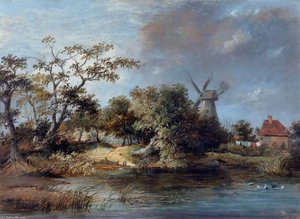 Ponds And A Windmill, Hastings
47
 Buckenham Common, Norfolk
48
 A Track To Home
49
 A Drover And His Flock In A Wooded Landscape
50
 Hay making; a horse study
51
 Landscape -
52
 Near NorwichFitzwilliam Museum
53
 View Across The Field To The Church
54
 The Forest Gate
55
 Sheep Dip
56
 Landscape On The Norfolk Coast
57
 Whitlingham From Old Thorpe Grove, Norfolk -
58
 Landscape -
59
 Encampment in a Wooded Landscape
60
 The Forest Oak
61
 View Of Richmond Park With Figures On A Path And Cattle Beyond
62
 Woody Landscape
63
 Windsor Great Park, Near Bears Rails
64
 Landscape And Trees
65
 Parkland Landscape With A Gardener By A Pond
66
 Landscape, A Country Road
67
 Rustic Scene
68
 Lock Scene
69
 A Dyke Head
70
 View In Windsor ForestNunnington Hall
71
 Marlborough Forest
72
 Cattle In The Woods
73
 A Barge On The Yare - Sunset
74
 The Edge Of A Wood -
75
 Sunlit Norfolk River Landscape
76
 Wooded landscape
77
 Woodland Scene
78
 Windsor Castle, Windsor And Maidenhead
79
 Landscape -
80
 A View From NorwichKelvingrove Art Gallery and Museum
81
 On The Yare - A Wooded River Landscape With Cattle, A Figure And A Cottage
82
 A Lane Near Norwich, Norfolk
83
 The Willow Stream
84
 The Road Through A Wood
85
 Landscape
86
 Figures On A Hay Barge With Windmills And A Church Beyond
87
 Road Through A Forest
88
 Gowbarrow ParkScottish National Gallery
89
 A Donkey In A Wood
90
 Road Scene At Intwood -
91
 Landscape With A Church
92
 Lake Scene, With Two Men Fishing
93
 Sheep Washing -
94
 Cattle Watering In A Wooded Landscape, With A Wherry Near Norwich
95
 Landscape With A Road Winding Through Trees With Figures
96
 Travellers On A Wooded Track
97
 Whitlingham From Old Thorpe Grove, Norfolk
98
 River Scene, Cattle In Foreground
99
 Landscape - (8)
100
 Cottage In A WoodBirmingham Museum and Art Gallery
A négy leggyakorobban előforduló téma ebben az eredeti művekben, mindegyik a legkiválóbb példájával.
A 7 olyan múzeum, amely a legtöbb ezen az oldalon szereplő festményet őrzi.
| Múzeum | Város | James Stark művei | Ebből a listából származó festmények |
|---|---|---|---|
 Auckland Art Gallery Toi o Tāmaki |
Auckland | 1 | Landscape with Thatched Cottage |
 Varsói Nemzeti Múzeum |
Varsó | 1 | Forest landscape with a road and a river |
 Fitzwilliam Museum |
1 | Near Norwich | |
 Nunnington Hall |
1 | View In Windsor Forest | |
 Kelvingrove Art Gallery and Museum |
Glasgow | 1 | A View From Norwich |
 Scottish National Gallery |
Edinburgh | 1 | Gowbarrow Park |
 Birmingham Museum and Art Gallery |
Birmingham | 1 | Cottage In A Wood |
Sandling's Ferry. Ezt követi Landscape With A Cottage és Distant View Of Windsor.
Sandling's Ferry, Landscape With A Cottage, Distant View Of Windsor, Faggot Gatherers By A Stream, A Wayside Encampment, Landscape -, A Wooded Landscape With Figures On A Track, A Cottage Beyond, Wood Gatherers, Figures And Animals Before Cottages In A Wooded Landscape és A Woody Landscape. A fenti rangsor a művek évszamarát és a múzeumát jelzi.
Katalógusunkban 137 mű található James Stark alkotótól.
Leginkább Auckland Art Gallery Toi o Tāmaki (Auckland), Varsói Nemzeti Múzeum (Varsó) és Fitzwilliam Museum található. A fenti múzeumi táblázatban mindegyik felsorolásra került.
Landscape (29), Wood (14) és Rural landscape (13), a jelen oldalon található 100 műművészeti alkotás között.
Norwich school, ezen az oldalon található eredetiek alapján.
The name James Stark might not be instantly familiar to all art enthusiasts, yet within the annals of British landscape painting, he stands as a pivotal figure – a cornerstone of the celebrated Norwich School. Born in 1794 in Norwich, England, Stark’s life was interwoven with the very fabric of Norfolk's picturesque countryside, a landscape that would become both his muse and his enduring legacy. His story is one of artistic apprenticeship, periods of intense creativity punctuated by financial hardship, and ultimately, a profound contribution to a uniquely British artistic movement.
Stark’s early years were shaped by the vibrant artistic community of Norwich. His father, Michael Stark, though primarily a dye manufacturer famed for his invention of ‘Norwich red,’ fostered an environment rich in intellectual curiosity. Young James received his formal education at Norwich School, where he forged a lifelong friendship with John Berney Crome. However, it was under the tutelage of the elder John Crome – a towering figure in Norfolk art – that Stark’s artistic journey truly began. The apprenticeship, commencing in 1811, proved formative, instilling in him a deep appreciation for observation and a meticulous approach to depicting the natural world. Early exhibitions showcased his burgeoning talent, attracting attention both locally and in London, where he briefly resided, absorbing influences from artists like William Collins and studying at the Royal Academy.
A turning point arrived with Stark’s return to Norwich around 1819, prompted by a period of ill health. This relocation proved serendipitous for his artistic development. Settling amidst the familiar landscapes of Norfolk, he dedicated himself to capturing its essence – the meandering rivers, the rolling fields, and the atmospheric skies that defined the region's character. Stark’s style, while initially reflecting the influence of Dutch masters with their emphasis on detail and atmospheric perspective, gradually evolved into something distinctly his own. He developed a remarkable ability to convey not just the visual appearance of the landscape but also its emotional resonance – the quiet tranquility of a riverside scene or the dramatic intensity of an approaching storm. This sensitivity is particularly evident in his ambitious project, *Scenery of the Rivers of Norfolk*, published as a series of etchings in 1834. Though financially challenging to produce, this work stands as a testament to Stark’s skill and ambition, showcasing the beauty of Norfolk's waterways through both painting and engraving.
Stark’s contribution extends far beyond individual artworks; he was an integral part of the Norwich School – a collective of artists who championed a distinctly regional approach to landscape painting. Unlike the grand, idealized landscapes favored by some contemporary painters, the Norwich School focused on depicting the immediate surroundings with honesty and fidelity. Stark embodied this ethos, capturing the essence of Norfolk’s rural life and its unique atmosphere. His works are characterized by their realism, their attention to detail, and a subtle but powerful sense of place. He wasn't merely painting landscapes; he was documenting a way of life, preserving a visual record of Norfolk’s past for future generations.
James Stark passed away in 1859, leaving behind a body of work that continues to resonate with viewers today. His paintings are treasured by museums and private collectors alike, offering a glimpse into the artistic landscape of 19th-century England and the enduring beauty of Norfolk’s countryside. More than just a skilled painter, Stark was a chronicler of his time – an artist who captured not only the visual splendor of his surroundings but also the spirit of a region and its people. His legacy lives on as a testament to the power of observation, the importance of regional identity in art, and the enduring appeal of landscapes that speak directly to the soul.


