A Victorian Visionary: The Life and Art of Henrietta Rae
Henrietta Emma Ratcliffe Rae, a name often accompanied by the quiet reverence reserved for artists who defied expectations, emerged as a significant figure in the late Victorian art world. Born in London on December 30, 1859, into a family steeped in artistic tradition—her father, James Ward, was an accomplished animal painter, and her mother hailed from a lineage of sculptors—Rae navigated a path fraught with challenges for women seeking recognition in the predominantly male domain of fine art. Initially steered towards musical training to ensure financial stability, she soon discovered that her true calling lay not in vocal performance but in the visual realm. This shift wasn’t merely a change of course; it was an act of self-determination that would define her career and contribute to broader shifts within the artistic landscape. Her early education at Queen Square School (later the Royal Female School of Art) and Heatherley’s School of Art provided foundational skills, but it was her determined pursuit of admission to the prestigious Royal Academy Schools—an endeavor requiring multiple applications before finally succeeding in 1877—that truly signaled her commitment. There, under the tutelage of luminaries like Sir Lawrence Alma-Tadema, Frank Dicksee, and William Powell Frith, she honed her technique and began to forge a distinctive artistic voice.
Classical Echoes and Literary Inspirations
Rae’s artistic focus gravitated towards classical, allegorical, and literary subjects—a deliberate choice that allowed her to explore themes of mythology, romance, and human emotion with both technical skill and symbolic depth. Her canvases breathed life into scenes drawn from ancient tales and celebrated works of literature, often featuring strong female figures embodying courage, vulnerability, or tragic fate.
Elaine Guarding the Shield of Lancelot (1885), inspired by Tennyson’s poignant poem, exemplifies this approach, capturing a moment of quiet devotion and anticipation. The composition is meticulously detailed, reflecting Alma-Tadema's influence, while the emotional intensity of the scene—the young Elaine’s unwavering gaze—demonstrates Rae’s unique artistic sensibility. Perhaps her most enduring work, however, is
The Lady with the Lamp (1891). This iconic portrayal of Florence Nightingale at Scutari transcended its immediate subject matter to become a powerful symbol of compassion, dedication, and the vital role of women in nursing—an image that continues to resonate today. The painting’s subdued palette, carefully chosen lighting, and the nurse's gentle expression all contribute to its profound emotional impact. Other notable paintings, such as
Eurydice Sinking Back to Hades (1886), which garnered acclaim at international exhibitions in Paris and Chicago, and
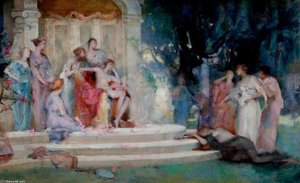
Psyche at the Throne of Venus (1894)—a monumental work featuring thirteen figures—demonstrate her mastery of composition, color, and narrative storytelling. Rae’s style was demonstrably influenced by Alma-Tadema's meticulous attention to detail and classical compositions, yet she infused her works with a unique sensibility that set them apart.
Breaking Barriers and Achieving Recognition
The path to artistic recognition for Henrietta Rae was not without its obstacles. The Victorian era presented significant hurdles for women artists, including limited access to life drawing classes—deemed unsuitable for female students—and pervasive societal biases. Rae actively circumvented these restrictions by seeking alternative opportunities for practice and relentlessly pursuing her artistic goals. She began exhibiting her work at the Royal Academy’s yearly exhibitions as early as 1881, steadily building a reputation within the art world. Her consistent exhibition record, coupled with participation in prestigious galleries like the Grosvenor Gallery, broadened her reach and acclaim. A pivotal moment arrived in 1896 when she was elected an associate member of the Royal Academy—a remarkable achievement for a woman artist at that time, signifying a formal recognition of her talent and contribution to the artistic community. This elevation paved the way for her full academicianship in 1922, solidifying her position within the established art world and marking a historic milestone for female artists. Beyond her personal achievements, Rae demonstrated a commitment to supporting fellow women artists, actively organizing exhibitions showcasing their work and advocating for greater opportunities within the profession. Her service on the Hanging Committee for a major public exhibition in Liverpool in 1893 further underscored her influence and expertise.
A Lasting Legacy
Henrietta Rae’s career stands as a testament to talent, perseverance, and a pioneering spirit. She not only created beautiful and thought-provoking works of art but also challenged societal norms and paved the way for future generations of female artists. Her ability to seamlessly blend classical training with a distinctive artistic vision resulted in paintings that continue to captivate audiences with their beauty, skill, and historical significance.
The Lady with the Lamp, in particular, remains an enduring symbol of compassion and dedication, its image reproduced countless times and forever associated with Florence Nightingale’s selfless service. Rae's commitment extended beyond her art; she was a vocal supporter of feminist causes, including women’s suffrage, demonstrating a belief in social justice that informed both her artistic practice and her personal life. Her story serves as an inspiring reminder of the power of determination, the importance of representation, and the enduring legacy of artists who dare to challenge convention.
Selected Works
- The Lady with the Lamp (1891)
- Elaine Guarding the Shield of Lancelot (1885)
- Eurydice Sinking Back to Hades (1886)
- Psyche at the Throne of Venus (1894)
- Sir Richard Whittington Dispensing His Charities (1900)
- Procris
- Mariana(c.1905)