A Life Bathed in Light: The Journey of Henri Edmond Cross
Henri Edmond Cross, born Henri-Edmond-Joseph Delacroix in 1856 in the northern French town of Douai, was an artist whose life and work were inextricably linked to a pursuit of light, color, and a harmonious vision of existence. His story is one of artistic evolution, driven by both personal circumstance and a fervent embrace of avant-garde ideals. The son of an adventurous father and a British mother, Cross’s early years saw a relocation to Lille, where his budding talent was recognized and nurtured by Dr. Auguste Soins, a patron who provided crucial financial support for lessons with the esteemed Carolus-Duran. This foundational training instilled in him a respect for classical technique—a grounding that would later be brilliantly subverted as he ventured into the revolutionary world of Neo-Impressionism. Even early on, a desire to forge his own artistic identity led him to adopt “Cross” as part of his name, and eventually fully transition to "Henri-Edmond Cross" in 1886, distancing himself from both the celebrated Eugène Delacroix and another contemporary artist sharing the same surname. This act was symbolic of a larger ambition: to define a unique artistic voice amidst a rapidly changing art world.From Realism to Radiant Divisionism
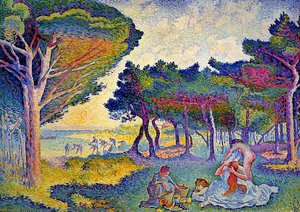
Cross’s initial artistic explorations leaned towards the Realist tradition, manifesting in portraits and still lifes that demonstrated technical skill but lacked a distinctive spark. He began with depictions of everyday life, capturing the faces and scenes of his native Douai with meticulous detail. However, the Parisian art scene of the 1880s was abuzz with new ideas, and Cross found himself increasingly drawn to the revolutionary principles of Neo-Impressionism—a movement spearheaded by Georges Seurat and Paul Signac. This encounter proved transformative. The scientific approach to color theory, the meticulous application of tiny, distinct brushstrokes (or “points”) designed to create optical mixing, resonated deeply with his artistic sensibilities. Simultaneously, recurring bouts of rheumatism led him to seek solace in the warmer climate of southern France, beginning in 1883 and culminating in a permanent settlement in Saint-Clair in 1891. The radiant light and vibrant landscapes of this region became integral to his artistic vision. He didn’t simply replicate Seurat's pointillism; instead, he evolved it, favoring larger, more mosaic-like brushstrokes that retained the luminosity of divided color while allowing for greater expressive freedom. This “second generation” Neo-Impressionism was characterized by its bold chromatic intensity and dynamic compositions—a style that would become his signature.Anarchist Ideals and Utopian Visions
Beyond technical innovation, Cross’s work was deeply informed by a strong sense of social and political idealism—specifically, anarchist beliefs. This conviction wasn't overtly propagandistic; rather, it manifested in his depictions of idyllic rural scenes, portraying harmonious coexistence between humanity and nature as an alternative to the perceived corruption and alienation of modern urban life. His paintings weren’t merely aesthetic exercises but visual statements advocating for a more equitable and peaceful world. The influence of this ideology is subtly woven into the fabric of his compositions, imbuing them with a sense of utopian longing. Works like *Before the Storm* and *The Farm, Evening* are not simply representations of nature; they are allegories for a just society—the vibrant colors and dynamic brushwork evoking energy and optimism, suggesting transformation and renewal. He sought to capture a world where humanity lived in balance with its surroundings, free from the constraints of industrialization and social hierarchy.The Development of His Style & Key Works
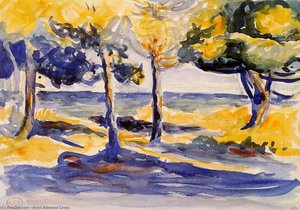
Cross’s artistic style underwent a significant evolution throughout his career. Initially, he employed a more rigid adherence to Seurat's pointillist technique, creating works dominated by precise, geometric patterns of color. However, as he spent increasing time in southern France and developed a deeper understanding of light and atmosphere, his approach became looser and more expressive. He began to incorporate larger brushstrokes, allowing for greater textural variation and a richer sense of depth. This shift is particularly evident in his later landscapes, which are characterized by their luminous colors, dynamic compositions, and evocative mood. Key works such as *Before the Storm*, with its dramatic skies and hints of anarchist themes, *The Washerwoman*, showcasing his mastery of Pointillism and divisionism, and *The Farm, Evening*, a serene depiction of rural life embodying his utopian vision, exemplify this evolution. These paintings demonstrate not only technical skill but also a profound engagement with the world around him—a desire to capture its beauty, complexity, and inherent contradictions.Legacy and Influence on Modern Art
Henri-Edmond Cross’s artistic journey culminated in a significant body of work that profoundly impacted the course of modern art. His first individual exhibition at the Galerie Druet in 1905, followed by a retrospective organized by Félix Fénéon at the Galerie Bernheim-Jeune in 1908, cemented his reputation as a leading figure in Neo-Impressionism. However, his influence extended far beyond this movement. His bold use of non-local color—applying colors not according to their natural appearance but for expressive effect—and his willingness to distort forms paved the way for the radical experimentation of Fauvism. Artists like Henri Matisse and André Derain were deeply inspired by Cross’s work, recognizing in it a liberation from traditional constraints and a pathway towards greater artistic freedom. He demonstrated that color could be used not merely to represent reality but to evoke emotion and create a purely visual experience. He died of cancer in Saint-Clair in 1910, leaving behind a legacy that continues to resonate with artists and art lovers today. His paintings remain powerful testaments to the transformative potential of color, light, and form—and to the enduring power of art as a vehicle for social and political expression.Gyakran Ismételt Kérdések
Hány Henri-Edmond Cross alkotása tekinthető meg a katalógusban?
A 133 műalkotás darab alkotást Henri-Edmond Cross részéről a Összes műalkotás oldalon tekintheti meg.
Hol és 어느 해 született Henri-Edmond Cross?
Henri-Edmond Cross Douai városban született, 1856 évben.
Hogyan fejlődött Henri-Edmond Cross művészete az idő múlásával?
Henri-Edmond Cross Krónika oldala egy görgetésre alapozott idővonal, amely a művész alkotásait kronologikus sorrendben, a pályafelvétetei szerinti fejezetekbe csoportosítva mutatja be.