A Winter Vision of American Impressionism
Guy Carleton Wiggins stands as a prominent figure in the landscape painting tradition of early 20th-century America, particularly celebrated for his masterful depictions of New York City and Connecticut winters. Born on February 23, 1883, in Brooklyn, his artistic journey was deeply rooted in a familial legacy of creativity; his father, Carleton Wiggins, was an accomplished artist who provided his son with his first essential training. This early immersion in the world of color and form laid the groundwork for a career that would eventually capture the ethereal beauty of snowy vistas with remarkable accuracy and emotional resonance.
Wiggins’s formal education was marked by prestigious associations that shaped his technical prowess. He received rigorous training at the National Academy of Design, where he studied alongside the legendary George Inness. This relationship proved formative, instilling within him a deep appreciation for tonal color palettes and expressive brushwork. Seeking to expand his horizons, Wiggins traveled to Paris, immersing himself in the heart of the burgeoning Impressionist movement. It was here that he honed the skills necessary to translate the fleeting nuances of light and atmosphere onto canvas, a pursuit that would become the hallmark of his mature style.
The Atmosphere of the Urban Snowscape
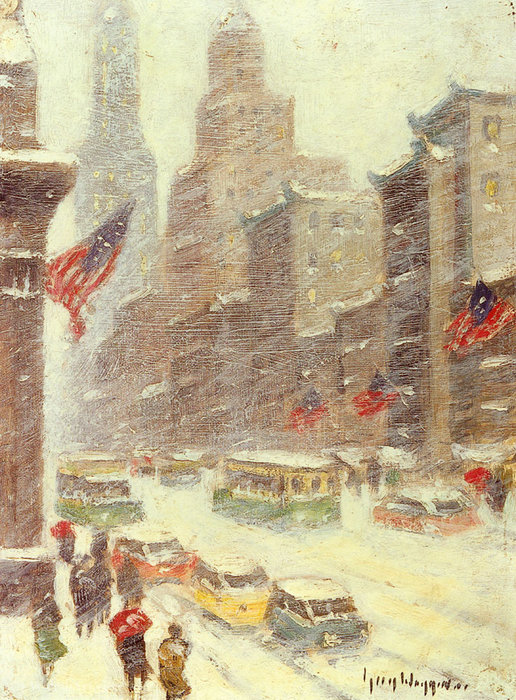
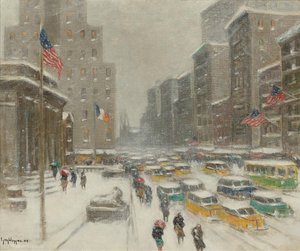
Upon returning to New York City, Wiggins established himself as both a respected artist and an influential teacher. He became particularly renowned for his ability to transform the bustling, often harsh urban environment into a serene, dreamlike landscape. His work frequently focused on the iconic streets of Manhattan, capturing landmarks such as Columbus Circle, Fifth Avenue, and Wall Street during the height of winter. Rather than seeking photographic precision, Wiggins utilized broad, flowing lines and rich, low-toned hues to convey the quietude that descends upon a city blanketed in snow.
His technique was profoundly shaped by the Impressionist principles championed by masters like Claude Monet and Pierre Auguste Renoir. He embraced a method that prioritized the sensation of a moment, favoring loose brushstrokes and the delicate layering of colors to achieve luminous, shimmering effects. In his hands, the heavy textures of snow and the biting chill of the air became palpable, inviting the viewer to step into a world where the grit of the city is softened by a white, crystalline veil.
Legacy and the Old Lyme Art Colony
Beyond the urban landscapes of New York, Wiggins played a vital role in the American pastoral tradition. He became an influential member of the Old Lyme Art Colony, working alongside his son, Guy Carleton Wiggins Jr., to foster a vibrant artistic community dedicated to capturing the essence of rural Connecticut. This period of his life reflected a continued fascination with the natural world, often incorporating motifs such as cattle paintings, which were rendered with a sense of solidity and realism that balanced his more atmospheric Impressionist tendencies.
The historical significance of Wiggins's contribution to American art is cemented by his many accolades and professional milestones:
- Election to the National Academy of Design: Achieving this distinction in 1906 marked his official ascent into the upper echelons of the American art establishment.
- Leadership in Fine Arts: His tenure as the president of the Connecticut Academy of Fine Arts demonstrated his commitment to the growth and sustainment of the regional art scene.
- Mastery of Mood: He successfully bridged the gap between the academic traditions of his training and the emotive, light-driven goals of Impressionism, leaving behind a body of work that remains a timeless window into the American winter.
Today, the works of Guy Carleton Wiggins continue to resonate with collectors and art enthusiasts alike. His ability to find poetry in the frost and stillness in the city streets ensures his place as a definitive voice in the history of American landscape painting.