Giuliano Bugiardini portréja

Giuliano Bugiardini festményei: A 30 leghíresebb alkotás, egy galéria szemével

Frissítve: november 2026 · rangsorolva népszerűségi pontszámunk alapján (minden mű keresései, látogatásai és megrendelései alapján) · 30 mű Giuliano Bugiardini alkotása a katalógusunkban

Röviden

A galéria szerint Giuliano Bugiardini leghíresebb festménye a Scenes from the Story of Tobias (1500), amelynek eredeti példája a Berlin Állami Múzeumai múzeumában található, Berlin városában. Rape of Dinah (1535) és Madonna and Child Enthroned with Saints Mary Magdalen and John the Baptist (1523) kiegészítik azt a triót, amelyet minden szem felismer. A katalógusunkban szereplő 30 művész Giuliano Bugiardini alkotásából a galéria az alábbi 30 leghíresebbet mutatja be, amelyek mind egyedi originális művek, a készítés évszámával, a múzeum megnevezésével és a különlegességük leírásával.

1475 – 1554, Firenze High renaissance A legtöbb mű: Berlin Állami Múzeumai

A galéria top 10 Giuliano Bugiardini festménye

1
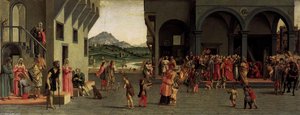
Scenes from the Story of Tobias (1500) (1889) -ja Giuliano Bugiardini

Scenes from the Story of Tobias

1500 · Oil On Canvas · Berlin Állami Múzeumai, Berlin

Giuliano Bugiardini's "Scenes from the Story of Tobias," painted in 1500, isn’t merely a depiction of a biblical narrative; it’s a vibrant snapshot of Renaissance life, brimming with social interaction and subtle symbolism. Housed within the hallowed halls of the Staatliche Museen in Berlin, this oil-on-wood masterpiece offers a captivating glimpse into a world where piety intertwined seamlessly with everyday existence. Measuring a substantial 60 x 159 cm, the painting…

2
Rape of Dinah (1535) (1889) -ja Giuliano Bugiardini

Rape of Dinah

1535 · Oil · Kunsthistorisches Museum, Bécs

The air in the plaza feels heavy with the sudden movement of bodies. In the center of the composition, a woman is gripped by men, her form a focal point of struggle against the rigid, geometric lines of the surrounding architecture. The scene is a collision of organic human limbs and the unyielding stone of a Renaissance cityscape. Deep reds and golds bleed into the shadows of the drapery, while…

3
Madonna and Child Enthroned with Saints Mary Magdalen and John the Baptist (1523) (1889) -ja Giuliano Bugiardini

Madonna and Child Enthroned with Saints Mary Magdalen and John the Baptist

1523 · Oil On Panel · Metropolitan Művészeti Múzeum, New York

The composition rests upon a stone throne, a heavy and classical foundation that anchors the figures in a geometric stability. At the center, the Virgin Mary sits with a quiet, sculptural volume, her form defined by the deep ultramarine of her mantle and the sharp vermilion of her gown. She holds the Christ Child, whose presence provides the apex of a perfect pyramid. Around them, the air feels still, held…

4
Madonna with Christ-child (1517) (1889) -ja Giuliano Bugiardini

Madonna with Christ-child

1517 · Oil On Panel · Bavári Állami Festırménygyűjtemények, Munchen

In Madonna with Christ-child by Giuliano Bugiardini, the focus rests entirely upon the intimate connection between mother and child. The two figures occupy the center of the frame, arranged in a stable, pyramidal structure that draws the eye inward toward their shared space. The Virgin is draped in a crimson robe, a deep red that meets the heavy, dark blue of her mantle. Gold lining traces the edges of her…

5
Mary with the child and the juvenile Johannes (1514) (1889) -ja Giuliano Bugiardini

Mary with the child and the juvenile Johannes

1514 · Oil On Panel · Gemäldegalerie, Berlin

The composition rests upon a stable, pyramidal structure, anchoring the figures within a quiet, sacred space. Mary sits as the central pillar, her form providing a sense of permanence amidst the soft contours of the scene. The light descends from the upper left, carving out the volume of her face and the heavy, rhythmic folds of her garments. Shadows pool in the recesses of the drapery, lending a three-dimensional weight…

6
The Virgin and Blessing Child, Young St. John and Angel (1510) (1889) -ja Giuliano Bugiardini

The Virgin and Blessing Child, Young St. John and Angel

1510 · Oil On Panel · Gemäldegalerie, Berlin

The Virgin Mary sits in a three-quarter view, her form a soft curve against the stillness of the composition. She cradles the Christ Child upon her lap, her hands a gentle cradle for the divine. To the left, an angel with visible wings gazes toward the children, a silent witness to the intimacy of the scene. In the lower foreground, the young St. John stands, his presence grounding the celestial…

7
St. John the Baptist in the Wilderness (1530) (1889) -ja Giuliano Bugiardini

St. John the Baptist in the Wilderness

1530 · Oil

A young man kneels in the silence of a rugged landscape. He is caught in a moment of profound listening, holding a small shell to his ear as if catching the whispers of the divine or the rush of distant waters. His body, rendered with the anatomical precision of the High Renaissance, shows the subtle tension of muscle and skin under a soft, diffused light. He wears only a simple…

8
St. John the Baptist in the Wilderness (1525) (1889) -ja Giuliano Bugiardini

St. John the Baptist in the Wilderness

1525 · Oil On Panel · Pinacoteca Nazionale di Bologna, Bologna

A single figure sits upon a craggy, ochre-colored rock formation within a landscape of muted earth tones. This man, identified as St. John the Baptist, is positioned centrally in a vertical composition. He is clad in a garment made of animal skin, rendered with a coarse, tactile texture that contrasts with the smoother rendering of his skin. His limbs are bent in a posture of quietude, and he holds a…

9
Virgin and child (1530) (1889) -ja Giuliano Bugiardini

Virgin and child

1530 · Oil On Panel · Art Gallery of South Australia, Adelaide

The painting titled Virgin and child is a work by the Italian Renaissance painter Giuliano Bugiardini. Created about 1530, this European painting depicts a religious subject through a vertical composition. The figures are positioned against a backdrop of classical stone architecture and a distant landscape. The scene focuses on the physical closeness of the Virgin Mary and the Christ Child.

10
Madonna and Child with St. John and an angel (1525) (1889) -ja Giuliano Bugiardini

Madonna and Child with St. John and an angel

1525 · Oil On Panel · Varsói Nemzeti Múzeum, Varsó

In Madonna and Child with St. John and an angel, Giuliano Bugiardini organizes the scene within a circular tondo format. The Virgin Mary is seated as the central focal point, providing a sense of stability to the entire arrangement. Around her, three smaller figures are positioned to create a balanced, pyramidal structure. This geometric arrangement directs the eye through the intimate connections between the figures, emphasizing a sense of maternal…

Giuliano Bugiardini festményei, 11. helyezéstől 30. helyezésig

Giuliano Bugiardini híres festményei, korszakonként

A témák, amelyek Giuliano Bugiardini figyelmét meghúzták

A négy leggyakorobban előforduló téma ebben az eredeti művekben, mindegyik a legkiválóbb példájával.

A műemlékek, amelyek Giuliano Bugiardini eredeti műveit őrzik

A 8 olyan múzeum, amely a legtöbb ezen az oldalon szereplő festményet őrzi.

Múzeum Város Giuliano Bugiardini művei Ebből a listából származó festmények
Berlin Állami Múzeumai, BerlinBerlin Állami Múzeumai Berlin 2 Scenes from the Story of Tobias, Scenes from the Story of Tobias
Metropolitan Művészeti Múzeum, New YorkMetropolitan Művészeti Múzeum New York 2 Madonna and Child Enthroned with Saints Mary Magdalen and John the Baptist, Adam; Eve
Gemäldegalerie, BerlinGemäldegalerie Berlin 2 Mary with the child and the juvenile Johannes, The Virgin and Blessing Child, Young St. John and Angel
Walters Art Museum, BaltimoreWalters Art Museum Baltimore 2 Madonna and Child, Portrait of a Bolognese Gentleman in a Fur-lined Coat
National Gallery of Art, WashingtonNational Gallery of Art Washington 2 Leonardo de' Ginori, Portrait of a Young Woman
Kunsthistorisches Museum, BécsKunsthistorisches Museum Bécs 1 Rape of Dinah
Bavári Állami Festırménygyűjtemények, MunchenBavári Állami Festırménygyűjtemények Munchen 1 Madonna with Christ-child
Pinacoteca Nazionale di Bologna, BolognaPinacoteca Nazionale di Bologna Bologna 1 St. John the Baptist in the Wilderness

Giuliano Bugiardini, egy aláírott festmény évtizedenként

Művek évtizedenként

Váassz ki egy évtizedet, hogy megnézhesd az azt meghatározó eredetiműveket.

Giuliano Bugiardini festményei: a galéria válaszai

Melyik Giuliano Bugiardini festmény a leghíresebb?Fedje fel a választ

Scenes from the Story of Tobias (1500), Berlin Állami Múzeumai, Berlin. Ezután Rape of Dinah (1535) és Madonna and Child Enthroned with Saints Mary Magdalen and John the Baptist (1523) következik.

Hány éves volt Giuliano Bugiardini, amikor elkészítette a(t): Scenes from the Story of Tobias?Fedje fel a választ

25 éves: Scenes from the Story of Tobias 1500-ből származik, Giuliano Bugiardini pedig 1475-ben született.

Melyek Giuliano Bugiardini top 10 festménye?Fedje fel a választ

Scenes from the Story of Tobias, Rape of Dinah, Madonna and Child Enthroned with Saints Mary Magdalen and John the Baptist, Madonna with Christ-child, Mary with the child and the juvenile Johannes, The Virgin and Blessing Child, Young St. John and Angel, St. John the Baptist in the Wilderness, St. John the Baptist in the Wilderness, Virgin and child és Madonna and Child with St. John and an angel. A fenti rangsor a művek évszamarát és a múzeumát jelzi.

Hány műve született Giuliano Bugiardini nevére?Fedje fel a választ

Katalógusunkban 30 mű található Giuliano Bugiardini alkotótól, 1500 és 1539 év közötti időszakból.

Hol találhatóak Giuliano Bugiardini leghíresebb eredeti művei?Fedje fel a választ

Leginkább Berlin Állami Múzeumai (Berlin), Metropolitan Művészeti Múzeum (New York) és Gemäldegalerie (Berlin) található. A fenti múzeumi táblázatban mindegyik felsorolásra került.

Mikor festette Giuliano Bugiardini le leghíresebb műveit?Fedje fel a választ

1520s alatt: a jelen laphonon található 30 műből 9 készült ebben az időszakban, köztük Madonna and Child Enthroned with Saints Mary Magdalen and John the Baptist.

Melyek Giuliano Bugiardini legkorábbi és legutóbbi híres művei?Fedje fel a választ

Ezen az oldalon a leghitelesebb Scenes from the Story of Tobias (1500), a legutóbbi pedig Francesco Guicciardini (1539).

Mely témakörökkel foglaltaszkodott a legtöbbször Giuliano Bugiardini?Fedje fel a választ

Woman (8), Child (8) és Drapery (5), a jelen oldalon található 30 műművészeti alkotás között.

Melyik technikával foglalt leginkább Giuliano Bugiardini?Fedje fel a választ

Oil On Panel, a jelen oldalon található 30 műből 12 darab esetén.

Mely művészeti irányhoz tartozik Giuliano Bugiardini?Fedje fel a választ

High renaissance és Renaissance, ezen az oldalon található eredetiek alapján.

Mely Giuliano Bugiardini eredeti műveit őrzi a Berlin Állami Múzeumai?Fedje fel a választ

Scenes from the Story of Tobias és Scenes from the Story of Tobias: a Berlin Állami Múzeumai, Berlin 2 művet őrzi ezen az oldalon.

Giuliano Bugiardini: a művész

A Life Shaped by the Florentine Renaissance

Giuliano Bugiardini a olasz reneszánsz egyik mélyható alakja, egy olyan festő, whose életműve és léte szorosan összefonódott a florentin kultúra vibráló szövetéivel. Utazása az művészetek központjában, a San Marco kolostor közelében található, Lorenzo de' Medici tiszteletes szobakertjében kezdődött, ahol valószínűleg megtalálta első ihletét. Ebben a termékeny környezetben, Bertoldo szobrász irányítása alatt ismerkedett meg először az korszak felhajlukló fényével. Formálódó éveket a kortárs mesterekkel való mély kapcsolódás határozott meg; az 1490-es évek elején lépett be Domenico Ghirlandaio műhelyébe, egy olyan időszakban, amely meghatározta technikai tudását, és olyan felfutó tehetségekkel ismerte meg, mint a fiatal Michelangelo.

Bugiardini pályafutását både együttműködés és függetlenség határozta meg. 1503-ra már önálló művésznek bizonyult, csatlakozva a florentin festők testvérlegéhez, a Compagnia di San Luca-hoz. Ezen időszak alatt jelentős üzleti partnerséget kötött Mariotto Albertinelli-vel, amely 1509-ig tartott. Hosszú pályája során Bugiardini maradandó barátságokat ápolt a művészettörténet egyik legmonumentálisabb alakjával. Michelangelo-val való kapcsolata különösen figyelemre méltó volt; nemcsak közös oktatásban vett részt, hanem Bugiardini portrékon keresztül is megörökítette a mester arcvonásait, és olyan műveken is dolgozott, ahol a nagy remekművész befolyása érezhető volt, például a Szent Katarina mártírtanára tervezett alakoknál.

Mastery of Sacred Narrative and Human Emotion

Bugiardini művészete a magas reneszánsz festészet jellemző sokoldalúságára és spirituális mélységére fellelhető bizonyíték. Bár elsősorban vallásos témák festője volt, képes volt a szent narratívákat emberi drámával és társadalmi realizmussal elébbütni, így művei a kápolnák falain is túl kitolódottak. A 1500-as évben készült Szeneök a Tobia történetéből című remekműben egy bibliai fortélyt egy vibráló, reneszánsz életképpé alakított át. E művészeten keresztül a részletek precíz uralmát figyelhetjük meg: a finom ruhádat textúráját, az építészeti pontosságot és azokat a finom, érzelmekkel teli mimikákat, amelyek életre keltik a karaktereket egy forgalmas, napsütötte udvarban.

Vallásos kompozícióiban gyakran alkalmazta a klasszikus piramidális felépítést az örök béke és stabilitás érzésének keltezésére. Olyan alkotásokban, mint a Szent Család Szent János-tiszteletben, Bugiardini a mély kegyelem és a családi intimitet pillanatait fogta meg. Technikai tudása a olajfesték kifinomult használatára épült, amely lehetővé tette számára a fény és a szín finom árnyalatainak megvalósítását, létrehozva az építettség és a forradalmi légköri mélység érzetét. Legyen szó a Madonna fenséges jelenlétéről vagy egy felvonulás összetett mozgásáról, ecsettéte a istenit, a szentét az emberi tapasztalás lencséin keresztül érthetővé téve.

Artistic Legacy and Technical Sophistication

Giuliano Bugiardini történelmi jelentősége abban rejlik, hogy hidat képezett a 15. század hagyományai és a 16. század dinamizmusának között. Képes volt nemcsak monumentális oltárképek, hanem intim portrék és mitológiai témák megalkotására is, ami olyan széles skálájú készséget démontrált, amely az egész Olaszország, köztük Bologna is, tiszteletet ajándékozott számára. Művészetét számos maradandó művészeti jegel határozta meg:

  • Reneszánsz realizmus: Kivételes képesség a fizikai világ ábrázolására, a drapériák bonyolult mintáitól kezdve a alakok és állatok valósághű anatómiájáig.
  • Narratív mélység: A képessége, hogy összetett bibliai vagy mitológiai történeteket vibráló, társadalmi pillanatképekké szőssen, amelyek a florentin társadalom szellemét tükrözik.
  • Szín és fény: Gazdag paletta a mély vörösökkel, vibráló kékekkel és földi tónusokkal, amelyeket ósonos rétegezéssel alkalmazott a textúra és a fényesség megteremtésére.
  • Klaszikus kompozíció: Az egyensúlyban lévő, geometrikus elrendezések használata, amely harmónia és spirituális állandóság érzését kelt a szent témákban.

Bár gyakran a kortsa viharos óriásai mögé húzódott a figyelem, Bugiardini hozzájárulása a reneszánszhoz tagadhatatlan. Olyan művész volt, aki képes volt megörökíteni a spirituális devóció lényegét, miközben egyidejűleg dokumentálta ideje társadalmi textúráit, szépség, precizitás és mély emberi kapcsolódás örökségét hagyva hátra.