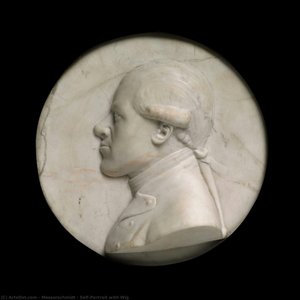
Franz Xaver Messerschmidt (1736-1783): Master sculptor of haunting 'Character Heads' – intensely expressive busts exploring human emotion & psychology. A unique precursor to Expressionism.
Franz Xaver Messerschmidt, born in the Bavarian village of Wiesensteig in 1736, occupies a singular and often unsettling position in the history of sculpture. He wasn’t merely a product of his time—a bridge between the opulent late Baroque and the emerging Neoclassical styles—but an artist who seemed to anticipate the emotional intensity of Expressionism nearly a century before its formal emergence. His life, marked by both artistic promise and increasing psychological turmoil, is inextricably linked to his most enduring legacy: the “Character Heads,” busts that capture human emotion in states of raw, almost unbearable intensity. Messerschmidt’s early training was steeped in family tradition; he first learned the craft under the tutelage of his uncle, Johann Baptist Straub, a sculptor working in Munich. This foundational period instilled in him a mastery of traditional techniques, which he further honed through apprenticeships with another uncle, Philipp Jakob Straub, in Graz, and later at the Academy of Fine Arts Vienna, where Jacob Schletterer guided his development. These early works demonstrate a clear proficiency in the prevailing Baroque style, particularly evident in commissions for Empress Maria Theresa—bronze busts and reliefs that adhered to the conventions of courtly representation favored by artists like Balthasar Ferdinand Moll. He was, initially, a sculptor very much *of* his time, skilled at portraying power and status with appropriate grandeur.Early Training & Baroque Commissions
Messerschmidt’s formative years were defined by familial influence and artistic apprenticeship. His uncle Johann Baptist Straub, a respected sculptor based in Munich, imparted invaluable knowledge of sculptural craftsmanship—a discipline that would shape Messerschmidt's entire career trajectory. This early instruction solidified his understanding of Baroque aesthetics, emphasizing anatomical accuracy and idealized beauty within the framework of aristocratic patronage. Subsequent apprenticeships with Philipp Jakob Straub in Graz and at Vienna’s Academy further refined his skills, exposing him to diverse artistic perspectives and fostering a critical engagement with prevailing stylistic trends. The commissions he undertook for Empress Maria Theresa—particularly monumental bronze busts and reliefs depicting imperial figures—served as exemplary demonstrations of Baroque sculptural technique and solidified his reputation as a skilled artist capable of fulfilling the demands of royal clientele. These works exemplify the grandeur and formality characteristic of the era, mirroring the artistic sensibilities championed by sculptors like Balthasar Ferdinand Moll.The Genesis of Disquiet: The Character Heads
Around 1769-1770, however, a profound shift began to occur in Messerschmidt’s artistic vision. While continuing to accept traditional portrait commissions—albeit with diminishing frequency—he embarked on the creation of what would become his defining work—the “Character Heads.” These were not portraits in the conventional sense; they weren't intended to flatter or commemorate. Instead, they depicted faces contorted in extreme emotional expressions: laughter bordering on hysteria, grief etched into every line, grimaces of anguish and despair. The origins of this dramatic departure are complex, interwoven with both artistic experimentation and a deepening personal struggle. Accounts from the time, particularly those provided by Friedrich Nicolai following a visit to Messerschmidt in 1781, reveal an artist obsessed with capturing the full spectrum of human emotion. Nicolai described Messerschmidt’s peculiar method: he would reportedly pinch his own lower ribs, observing the resulting facial contortions in a mirror and then attempting to replicate them in marble or bronze. This self-experimentation suggests a deliberate attempt to access and portray authentic emotional states, rather than relying on idealized representations. Furthermore, Messerschmidt believed he was striving to represent all 64 “canonical grimaces” of the human face, guided by principles derived from Hermetic teachings and a quest for a "universal balance" akin to the golden ratio. This ambition speaks to a deeper philosophical underpinning—a desire to understand and codify the fundamental expressions of humanity. However, alongside this intellectual pursuit, there was a growing sense of mental instability. Ernst Kris theorized that these experiments were linked to paranoid ideas and hallucinations that began to plague Messerschmidt in the 1770s, ultimately leading to his expulsion from the Academy of Fine Arts in 1774 despite having served as a teacher since 1769.A Revolutionary Approach: Exploring Emotion Beyond Idealization
Messerschmidt’s artistic breakthrough—the Character Heads—represented a radical departure from prevailing sculptural conventions. Rejecting the idealized beauty favored by Neoclassical artists, he prioritized emotional expression above all else. He meticulously studied human anatomy and facial musculature, dissecting cadavers to gain a deeper understanding of how emotions physically manifest themselves. This anatomical rigor was combined with an unprecedented level of psychological insight—Messerschmidt sought not merely to depict outward appearances but to convey the inner turmoil experienced by his subjects. His method of self-experimentation—pinching his ribs and observing facial contortions—was driven by a conviction that true artistic representation demanded confronting one's own vulnerabilities and accessing primal emotions. This approach foreshadowed the tenets of Expressionism, anticipating its focus on subjective experience and psychological drama decades before it emerged as a distinct artistic movement.Legacy & Recognition
Despite his turbulent personal life and initial obscurity following his expulsion from Vienna, Messerschmidt’s influence endured. In the 20th century, scholars and artists rediscovered his work, recognizing its profound contribution to sculptural history. The unsettling intensity of the Character Heads captivated audiences who were drawn to their exploration of human emotion—a realm previously neglected by traditional artistic standards. Today, Franz Xaver Messerschmidt is celebrated as a visionary sculptor whose pioneering approach challenged conventions and paved the way for future generations of artists seeking to express inner experience with uncompromising honesty. His legacy lies not only in the technical brilliance of his sculptures but also in their enduring power to provoke contemplation and illuminate the complexities of human psychology—a testament to the transformative potential of art.Gyakran Ismételt Kérdések
Hol és melyik országban született Franz Xaver Messerschmidt?
Franz Xaver Messerschmidt Wiesensteig városban, Németország országban született.
Milyen más nevét vagy álname""")vét használ még Franz Xaver Messerschmidt?
Franz Xaver Messerschmidt más néven is ismert: Messerschmidt.
Franz Xaver Messerschmidt műveit színspektrum szerint is felfedezhetem?
Franz Xaver Messerschmidt Színspektrum index oldala olyan felület, amely a művész alkotásait színek szerint csoportosítja.