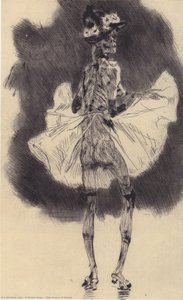
Félicien Rops portréja

A 46 legnevezesebb Félicien Rops festmény, egy galériaválaszték

Frissítve: november 2026 · rangsorolva népszerűségi pontszámunk alapján (minden mű keresései, látogatásai és megrendelései alapján) · 46 mű Félicien Rops alkotása a katalógusunkban

Röviden

Félicien Rops hagyatékából a leghíresebb alkotás The Entrance to the Ball (1858), amely a Namur városi musée provincial Félicien Rops gyűjteményében található. Röviddel ezután követik őket Satanic Self-Portrait (1860) és Head of an Old Antwerp Woman (1873). Katalógusunkban 46 mű található Félicien Rops alkotótól; a galéria megőrizte a világ által leginkább csodált 46 darabot, melyeket a dátummal, a múzeummal és a történetükkel együtt mutatunk be.

1833 – 1898, Namur Symbolism A legtöbb mű: musée provincial Félicien Rops

Félicien Rops legjobb 10 festménye: a galéria válogatása

1
The Entrance to the Ball (1858) (1889) -ja Félicien Rops

The Entrance to the Ball

1858 · Oil · musée provincial Félicien Rops, Namur

In "The Entrance to the Ball" by Félicien Rops, the composition is vertically oriented, drawing the eye upward through a narrow, compressed space. The perspective is set at eye level, adopting a side view that places us directly alongside the central figure. This man, perhaps a guest or a servant, is positioned in the foreground near a doorway. The entrance itself is marked by text, providing a specific point of…

2
Satanic Self-Portrait (1860) (1889) -ja Félicien Rops

Satanic Self-Portrait

1860 · Charcoal

Created about 1860, Satanic Self-Portrait by Félicien Rops presents a monochromatic study of the artist himself. The work captures a somber and introspective image of Félicien Rops, rendered in a limited palette of grayscale tones and subtle browns. He is depicted from the waist up, his head slightly bowed in a gesture of melancholy or deep thought. A large, draped garment covers his shoulders, adding a sense of weight to…

3
Head of an Old Antwerp Woman (1873) (1889) -ja Félicien Rops

Head of an Old Antwerp Woman

1873 · Oil On Canvas · musée provincial Félicien Rops, Namur

In the work Head of an Old Antwerp Woman by Félicien Rops, the composition is a medium close-up that focuses on the subject's head and upper torso. The subject is an aged woman positioned slightly off-center within the frame. She is depicted from a direct, eye-level view, creating an intimate proximity between the viewer and the subject. The background remains dark and indistinct, providing no specific details of a domestic…

4
The Lady with the Puppet and the Fan (1873) (1889) -ja Félicien Rops

The Lady with the Puppet and the Fan

1873 · Pastel · musée provincial Félicien Rops, Namur

In "The Lady with the Puppet and the Fan" by Félicien Rops, a vertical portrait captures a woman in profile. She occupies the left and center of the frame, her gaze fixed upon a small, colorful jester-like puppet held in her hand. The scene is set against a background of ochre, gold, and yellow. This warm backdrop provides a sharp contrast to the cool blues and teals of her attire.…

5
In the Wings (1878) (1889) -ja Félicien Rops

In the Wings

1878 · Oil

In the Wings by Félicien Rops presents a vertical, figurative scene executed in a Symbolist style. Created about 1878, the work captures a backstage or theatrical setting defined by a palpable sense of tension and voyeurism. The composition centers on two primary figures positioned within a dark, draped environment.

6
The incantation (1878) (1889) -ja Félicien Rops

The incantation

1878 · Print · musée provincial Félicien Rops, Namur

The incantation is a painting by Félicien Rops. Created about 1878, this work emerges from the artist's period of intense exploration into the shadows of the human psyche. It exists as a singular vision within his body of work, capturing a specific, heavy atmosphere through its deliberate composition.

7
The Lady with the Puppet (1884) (1889) -ja Félicien Rops

The Lady with the Puppet

1884 · Mixed Media

The Lady with the Puppet emerges from the creative mind of Félicien Rops, a Belgian artist who navigates the shadowy realms of Symbolism and Decadence. This specific piece exists as part of a small series of variations on a theme, where the artist explores recurring motifs through a lens of psychological depth. Within this collection, the work captures a singular, suspended moment of interaction between a woman and a miniature…

8
Eggnog (1879) (1889) -ja Félicien Rops

Eggnog

1879 · Pastel · musée provincial Félicien Rops, Namur

Eggnog by Félicien Rops is a small-scale, intimate figurative work created in 1879. The scene captures a private, domestic moment between two figures within an interior setting. A woman stands as a central vertical axis, dressed in light, possibly intimate, undergarments. She holds a small dish or cup, positioned as if in the act of serving. Opposite her, a man is seated in the foreground, providing a diagonal counterweight to…

9
The Farewells of Madness - Better to Bear Laughter Than Tears (1879) (1889) -ja Félicien Rops

The Farewells of Madness - Better to Bear Laughter Than Tears

1879 · Lithograph · musée provincial Félicien Rops, Namur

We are looking at The Farewells of Madness - Better to Bear Laughter Than Tears, a work produced by Félicien Rops around 1879. This piece emerged from the creative period of an artist who was born in 1833 in Namur, Belgium. Rops spent much of his life navigating the shifting intellectual currents of the late nineteenth century until his death in 1898.

10
Cherubim's Song (1879) (1889) -ja Félicien Rops

Cherubim's Song

1879 · Watercolor · musée provincial Félicien Rops, Namur

Cherubim's Song is a work by the Belgian artist Félicien Rops. Created about 1879, this piece belongs to a period in the artist's career where his output was closely associated with the Symbolism and Decadence movements. Rops was born in 1833 in Namur, Belgium, a location that remains central to his biographical history.

A Félicien Rops válogatás folytatódik: 11 – 46

A témák, amelyek Félicien Rops figyelmét meghúzták

A négy leggyakorobban előforduló téma ebben az eredeti művekben, mindegyik a legkiválóbb példájával.

A műemlékek, amelyek Félicien Rops eredeti műveit őrzik

A 5 olyan múzeum, amely a legtöbb ezen az oldalon szereplő festményet őrzi.

Múzeum Város Félicien Rops művei Ebből a listából származó festmények
musée provincial Félicien Rops, Namurmusée provincial Félicien Rops Namur 11 The Entrance to the Ball, Head of an Old Antwerp Woman, The Lady with the Puppet and the Fan
Antwerpeni Királyi Szépművészeti Múzeum, AntwerpenAntwerpeni Királyi Szépművészeti Múzeum Antwerpen 5 Landscape in the Ardennes, Beach, Bridge over the River Lesse
Kröller-Müller Múzeum, OtterloKröller-Müller Múzeum Otterlo 1 Death at the Ball
Ghent Művészeti Múzeum (MSK), GhentGhent Művészeti Múzeum (MSK) Ghent 1 Landscape in Sweden
Hammer Museum, Los AngelesHammer Museum Los Angeles 1 Cupid with a Tambourine

Félicien Rops évtizede folgtva: az eredeti művek, amelyek meghatározzák az egyes korzakot

Művek évtizedenként

Váassz ki egy évtizedet, hogy megnézhesd az azt meghatározó eredetiműveket.

Gyűjtői kérdések Félicien Rops festményeivel kapcsolatban

Melyik művel a(z) Félicien Rops a leghíresebb?Fedje fel a választ

The Entrance to the Ball (1858), musée provincial Félicien Rops, Namur. Ezután Satanic Self-Portrait (1860) és Head of an Old Antwerp Woman (1873) következik.

Hány éves volt Félicien Rops, amikor a The Entrance to the Ball készült?Fedje fel a választ

25 éves: The Entrance to the Ball 1858-ből származik, Félicien Rops pedig 1833-ben született.

Melyek a tíz leghíresebb Félicien Rops festmény?Fedje fel a választ

The Entrance to the Ball, Satanic Self-Portrait, Head of an Old Antwerp Woman, The Lady with the Puppet and the Fan, In the Wings, The incantation, The Lady with the Puppet, Eggnog, The Farewells of Madness - Better to Bear Laughter Than Tears és Cherubim's Song. A fenti rangsor a művek évszamarát és a múzeumát jelzi.

Hány festményet hagyott hátra Félicien Rops?Fedje fel a választ

Katalógusunkban 46 mű található Félicien Rops alkotótól, 1858 és 1898 év közötti időszakból.

Mely múzeumokban állnak Félicien Rops remekművei?Fedje fel a választ

Leginkább musée provincial Félicien Rops (Namur), Antwerpeni Királyi Szépművészeti Múzeum (Antwerpen) és Kröller-Müller Múzeum (Otterlo) található. A fenti múzeumi táblázatban mindegyik felsorolásra került.

Mely években festette Félicien Rops leghíresebb műveit?Fedje fel a választ

1880s alatt: a jelen laphonon található 46 műből 10 készült ebben az időszakban, köztük The Lady with the Puppet.

Mikszétek az első és az utolsó híres eredeti műve a(z) Félicien Rops alkotótól?Fedje fel a választ

Ezen az oldalon a leghitelesebb The Entrance to the Ball (1858), a legutóbbi pedig Snow at Thozée (1898).

Milyen témaköröket választott leggyakrabban Félicien Rops?Fedje fel a választ

Woman (10), Man (7) és Portrait (3), a jelen oldalon található 46 műművészeti alkotás között.

Melyik technikát alkalmazta leggyakrabban Félicien Rops?Fedje fel a választ

Pastel, a jelen oldalon található 46 műből 3 darab esetén.

Mely művészeti irányba tartozik Félicien Rops?Fedje fel a választ

Symbolism, ezen az oldalon található eredetiek alapján.

Mely Félicien Rops művei láthatóak a musée provincial Félicien Rops kiállتításán?Fedje fel a választ

The Entrance to the Ball, Head of an Old Antwerp Woman és The Lady with the Puppet and the Fan: a musée provincial Félicien Rops, Namur 11 művet őrzi ezen az oldalon.

Félicien Rops: életmű és életút

A Shadowy Visionary: The Life and Art of Félicien Rops

Félicien Victor Joseph Rops, born in 1833 in Namur, Belgium, emerged as a pivotal figure bridging the gap between Realism, Symbolism, and the burgeoning world of modern graphic storytelling. His life, steeped in both bourgeois comfort – his father was a prosperous textile manufacturer – and a restless artistic spirit, unfolded against a backdrop of rapid social and intellectual change. Early training at local academies provided a foundation, but it was his move to Brussels at twenty that truly ignited his creative trajectory. Though briefly enrolled at the Université Libre de Bruxelles, Rops found himself drawn inexorably towards the Académie de Saint-Luc, where he honed his skills not just in painting and drawing, but also in the art of satire through lithography. His early work quickly gained recognition in student magazines like *Le Crocodile* and *L'Uylenspiegel*, establishing him as a gifted caricaturist with a keen eye for societal foibles. These formative years weren’t merely about developing technical proficiency; they were about finding his voice, a voice that would soon become synonymous with challenging conventions and exploring the darker recesses of the human psyche.

Early Years and Artistic Foundations

Rops's childhood was marked by intellectual curiosity and exposure to progressive ideas – a stark contrast to the conservative religious dogma prevalent in Belgium at the time. He attended Notre Dame de la Paix de Namur, the Athénée Royal de Namur, and the Académie de Namur, receiving excellent schooling in both visual arts and literature. This early education instilled in him a lifelong fascination with observation and representation, shaping his artistic sensibilities from the outset. His father’s considerable wealth afforded him access to resources that nurtured his burgeoning talent, allowing him to pursue independent study alongside formal instruction. It was during these formative years that he began experimenting with drawing and etching, developing skills that would become central to his distinctive style. The influence of Honoré Daumier and Paul Gavarni – artists who championed social satire through lithography – proved particularly significant, shaping Rops’s artistic vision and informing his approach to visual storytelling.

Parisian Encounters and the Embrace of Darkness

The year 1862 marked a decisive turning point when Rops relocated to Paris, a city then pulsating with artistic innovation and intellectual ferment—a crucible for Symbolist thought. Recognizing the transformative potential of Parisian culture, he sought out mentors who would broaden his horizons and deepen his understanding of artistic technique. He encountered Félix Bracquemond and Jules Ferdinand Jacquemart, etchers who profoundly influenced his experimentation with intaglio techniques – etching and aquatint – fostering a mastery that would distinguish him from many of his contemporaries. Abandoning lithography around 1865, he dedicated himself wholeheartedly to mastering these more nuanced methods of printmaking, achieving unparalleled precision and expressive power. However, the most impactful encounter during this period was undoubtedly with Charles Baudelaire—a poet whose exploration of beauty within decay, of the allure of the forbidden, resonated deeply with Rops’s own burgeoning artistic sensibilities. This connection culminated in Rops creating the frontispiece for Baudelaire’s *Les Épaves*, a collection of poems censored from the infamous *Les Fleurs du Mal*. This collaboration wasn't merely illustrative; it was a meeting of minds, a shared exploration of themes that would define both artists' legacies. It propelled Rops towards an artistic path characterized by provocative subject matter – eroticism, satanic imagery, and sharp social critique – aligning him with the emerging Symbolist and Decadent movements.

A Master of Printmaking: Technique and Vision

Rops’s artistic style is immediately recognizable for its intricate detail, dramatic chiaroscuro—the interplay of light and shadow—and a haunting atmosphere that permeates his work. He wasn't simply depicting scenes; he was conveying psychological states, emotional intensities often veiled in ambiguity. His unwavering commitment to mastering printmaking techniques – particularly soft-ground etching and mezzotint – allowed him to translate these inner visions onto paper with breathtaking fidelity. Unlike many artists of his time who favored looser brushstrokes or pastel hues, Rops meticulously crafted each plate, employing a painstaking process that demanded both technical skill and artistic intuition. This dedication to craft resulted in images imbued with an unsettling beauty—a paradoxical blend of elegance and darkness—that continues to captivate audiences today. His prints often depict fantastical landscapes populated by grotesque figures and symbolic motifs, reflecting his fascination with mythology, folklore, and the subconscious mind.

Legacy and Influence

Rops’s influence extended far beyond the realm of printmaking, shaping the artistic landscape of his era and inspiring subsequent generations of artists. Edvard Munch and Max Klinger—artists who wrestled with existential anxieties and explored themes of trauma and repression—were profoundly affected by Rops's stylistic innovations and psychological depth. His willingness to confront taboo subjects—particularly eroticism and occultism—challenged societal conventions and paved the way for artists to push creative boundaries in ways that would not be fully realized until decades later. Furthermore, Rops’s pioneering role in comic storytelling—his contributions to *Le Crocodile* and *L'Uylenspiegel*, his exploration of sequential narratives—established him as a visionary forerunner of the modern graphic novel form. His enduring legacy resides not only in the beauty of his artwork but also in its profound engagement with the complexities of human experience, cementing his place as one of Belgium’s most celebrated artists and a pivotal figure in the Symbolist movement.

Notable Works

  • “Pornokratès” (1878): A chilling depiction of female power and transgression, showcasing Rops's mastery of soft-ground etching and capturing an unsettling psychological state.
  • “Satan Sowing Seeds” (from *Les Sataniques*, 1882): An iconic image embodying the Symbolist preoccupation with evil and demonic influence—executed with meticulous detail and dramatic chiaroscuro.
  • Illustrations for Jules Barbey d’Aurevilly's *Les Diaboliques*: Rops’s unsettling interpretations of Baudelaire’s dark prose exemplify his ability to translate literary themes into visual narratives.
Félicien Rops’s art is not merely a reflection of his time; it is a timeless exploration of the human condition, a shadowy vision that continues to haunt and inspire.