The Soul of the French Landscape: The Life and Legacy of Emmanuel de La Villeon
Emmanuel Victor Auguste Marie de La Villeon was far more than a mere chronicler of scenery; he was a poet of the canvas, a man whose brush captured the very breath of the French countryside. Born in 1858 into an illustrious Breton family in Fougères, his lineage was one of nobility and service, stretching from the naval ranks of his grandfather to the legendary companionship of Admiral de La Villeon with General de Lafayette. Yet, while his heritage was rooted in the grand histories of France, Emmanuel’s heart belonged to the quiet, unadorned rhythms of nature. His early years at a Jesuit boarding school in Vannes provided the fertile soil for this passion; it was amidst the margins of his Latin textbooks that he first traced the delicate silhouettes of trees, inspired by the pastoral verses of Virgil. This early encounter with classical poetry instilled in him a lifelong reverence for the organic world, a vocation he famously attributed to the ancient poet himself.
As he matured, the artist’s path led him from the rugged beauty of Brittany toward the vibrant artistic epicenter of Paris. Under the gentle guidance of his mother, who recognized the profound sensitivity in his sketches, he secured a place at the prestigious Académie Julian. It was here that his technical foundation was forged, moving through the stylistic currents of his era. His early explorations were deeply colored by the influence of the École de Barbizon, where the meticulous realism and muted palettes of masters like Jean-François Millet offered a template for capturing the essence of rural life. However, as the nineteenth century gave way to the twentieth, de La Villeon’s work began to absorb the luminous qualities of Post-Impressionism. He possessed a rare ability to balance the structured observation of his academic training with a more fluid, atmospheric approach, allowing light to dance across the surfaces of his landscapes with a newfound vitality.
A Tapestry of Light and Memory
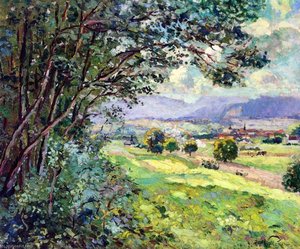
The true magic of de La Villeon’s oeuvre lies in its profound sense of serenity and the way it invites the viewer into a state of meditative reflection. His subjects—ranging from the tranquil riverside scenes of La guinguette au bord de la Seine to the shadowed, peaceful depths of In the Woods at Nièvre—are characterized by an unwavering dedication to the quietude of the moment. He did not merely paint landscapes; he painted the feeling of being present within them. His technique often utilized visible brushstrokes that contributed to an atmospheric beauty, creating a sense of movement in the wind-swept leaves and a shimmering quality in the water. This mastery of light allowed him to bridge the gap between the tangible reality of the Nièvre region and a more ethereal, dreamlike perception of the world.
Beyond his landscapes, de La Villeon’s work often touched upon themes of remembrance and the enduring nature of the pastoral ideal. His paintings serve as windows into a vanished era of French life, preserving the dignity of the rural landscape against the encroaching tides of industrialization. To study his work is to experience a succession of moments that unfold with the same harmony found in his personal life—a life he managed to balance between the duties of his station and the solitary pursuits of the dreamer.
Artistic Movements: His evolution spanned from the realism of the Barbizon School to the expressive light of Post-Impressionism.
Key Themes: The pursuit of tranquility, the intersection of nature and poetry, and the preservation of rural French identity.
Notable Locations: The Nièvre region, the banks of the Seine, and the ancestral landscapes of Brittany.
Through his dedication to capturing the subtle nuances of light and shadow, Emmanuel de La Villeon secured a lasting significance in the history of French landscape painting. He remains a singular figure whose work continues to resonate with anyone seeking solace in the beauty of the natural world, reminding us that even in the most fleeting moment, there is a profound and eternal peace to be found.
A OriginalUniqueArt.com szerkesztősége által
Művészeti kvíz
Minden kérdésre csak egy helyes válasz létezik.
Kérdés 1:
What artistic movement is Emmanuel de La Villéon primarily associated with?
Kérdés 2:
Where was Emmanuel de La Villéon born?
Kérdés 3:
What is Emmanuel de La Villéon known for?
Kérdés 4:
Which museum houses a significant collection of Emmanuel de La Villéon’s artworks?
Kérdés 5:
What inspired Emmanuel de La Villéon to explore landscape painting?
Fedezze fel Goya 25 leglenyűgözőbb mesterművét! Ismerje meg a spanyol festő életművét, portréit és ikonikus képeit. Vásároljon prémium minőségű reprodukciókat a OriginalUniqueArt.com-on, és teremtsen egyedi otthoni dekorációt klasszikus művészettel! Explore the full collection online.
Fedezze fel a romantikus tájképfestészet 10 legikonikusabb műalkotását! Caspar David Friedrich, J.M.W. Turner és más mesterek festményeinek története – inspiráló olajfestmények otthonába. OriginalUniqueArt.com: múzeumi minőségű reprodukciók és egyedi dekorációk online.
Discover the vibrant world of Ágatha Ruiz de la Prada, a leading figure in contemporary Spanish art. Explore her eclectic style, emotional depth & legacy – a must-read for discerning collectors.