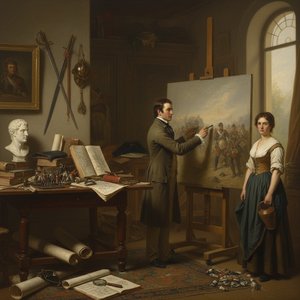
Émile Friant - A Life Rooted in Realism
Émile Friant, born April 16th, 1863 in Dieuze, France, emerged as a pivotal figure bridging the gap between 19th-century realism and the burgeoning artistic movements of the early 20th century. His life story is one deeply intertwined with the political and social upheavals of his time—the Franco-Prussian War profoundly shaping his formative years; the family’s flight to Nancy following the annexation of Dieuze by Prussia instilled in him a sense of displacement that perhaps fueled his dedication to capturing the essence of French life and identity within his art. Though initially steered towards a scientific path, Friant's innate artistic talent quickly asserted itself, nurtured first by private tutors and then under the guidance of Louis-Théodore Devilly in Nancy. Devilly’s emphasis on direct observation and meticulous detail laid the foundation for Friant’s signature style—a realism imbued with emotional depth and psychological insight. Even a youthful self-portrait, “Le Petit Friant,” at just fifteen years old, garnered attention and secured him permission to pursue formal studies in Paris, marking the beginning of his ascent within the art world.Early Years and Artistic Formation
Friant’s early life was marked by significant upheaval—the Franco-Prussian War disrupted his childhood tranquility, forcing his family to relocate to Nancy amidst considerable anxiety. This experience instilled a profound appreciation for resilience and adaptability that would permeate his artistic sensibilities throughout his career. Recognizing his burgeoning talent at a young age, Friant benefited from the patronage of Madame Parisot, who fostered his artistic ambitions by enrolling him in the École des Beaux-Arts de Nancy—a bastion of artistic innovation during the Art Nouveau period. Under Devilly’s tutelage, Friant honed his skills in drawing and painting, mastering techniques rooted in meticulous observation and capturing the subtleties of human emotion. Notably, Devilly championed a style that prioritized direct engagement with nature—a principle that would become central to Friant's artistic vision. His formative years were further enriched by friendships forged with fellow artists—Victor Prouvé, Aimé Morot, and Jules Bastien-Lepage—who shared his passion for realism and encouraged him to explore new creative horizons.Parisian Training and Salon Recognition
At fifteen, Friant embarked on a transformative journey to Paris, enrolling in Alexandre Cabanel’s atelier—a bastion of academic painting that nevertheless challenged Friant's preconceptions about artistic excellence. While Cabanel instilled discipline and technical proficiency, Friant simultaneously sought inspiration from Impressionist masters like Gêrome and Meissonier—artists who championed a radically different approach to portraying the world. He found solace in the camaraderie of fellow artists—Morot, Prouvé, Bastien-Lepage—who shared his commitment to naturalism and encouraged him to pursue independent artistic endeavors. His early Salon submissions—including “The Prodigal Son” and “Studio Interior”—demonstrated a remarkable aptitude for narrative painting and an ability to convey profound emotional resonance. A second-place finish in the Prix de Rome competition solidified his reputation as a prodigious talent, propelling him toward continued success at subsequent Salon presentations where he consistently achieved high honors—a testament to Devilly’s guidance and Friant's unwavering dedication to artistic exploration.The Flowering of His Artistic Style: Portraits and Landscapes
Friant’s artistic style evolved over time—influenced by his travels to Holland, Italy, Malta, and Tunisia—embracing a distinctive palette infused with vibrant hues and capturing the spirit of exotic locales. He achieved particular renown as a portrait painter—capturing not merely physical likeness but also the inner character and psychological state of his subjects with unparalleled sensitivity. His portraits of actors Ernest and Benoit Coquelin—particularly “La Toussaint”, which earned him a Gold Medal at the 1889 Universal Exhibition—became iconic representations of French artistic culture during the Belle Époque. Beyond portraiture, Friant produced evocative landscapes—infused with meticulous detail and imbued with an emotional depth that mirrored his profound connection to the natural world. His paintings exemplify the tenets of Naturalism—a movement characterized by a commitment to scientific observation and portraying everyday life with unflinching honesty—reflecting the broader intellectual currents shaping France at the turn of the century.Legacy and Recognition
Émile Friant’s artistic legacy rests firmly on his unwavering devotion to realism—a style he embraced while simultaneously transcending its limitations. He stands as one of the last great naturalists, preserving a tradition of meticulous observation and emotional honesty in an era increasingly dominated by stylistic experimentation. His innovative use of photography as a preparatory tool—a practice gaining traction among artists of his time—demonstrates an engagement with technological advancements and a desire for accuracy in representation. Friant’s contributions were recognized with promotion to Commander in the Legion of Honor and membership in the Institut de France—the highest honors bestowed upon artists in France—affirming his enduring influence on French art history. His tragic death in 1932—falling from a height in Paris—brought an abrupt end to a remarkable career, but his paintings continue to captivate audiences with their beauty, sensitivity, and timeless relevance.Gyakran Ismételt Kérdések
Létezik-e összes olyan témáról, amelyet Émile Friant festett, összefoglaló?
A Témakör-atlasz oldalon Émile Friant művei témánként bö phậníthetők be.
Megvizsgálhatom Émile Friant színhasználatát az összes művében?
Émile Friant színek használata a ez a weboldal oldalon található műveiben a művész Paletta Genom oldalán tanulmányozható.
Hogyan tekinthetném meg minden Émile Friant által készített művet?
Émile Friant minden alkotása a ez a weboldal oldalán megtekinthető az alkotó Összes műalkotás oldalán.