Edward Armitage portréja

A 27 legnevesebbebb Edward Armitage festmény, mindegyik egyedistens

Frissítve: november 2026 · rangsorolva népszerűségi pontszámunk alapján (minden mű keresései, látogatásai és megrendelései alapján) · 29 mű Edward Armitage alkotása a katalógusunkban

Röviden

The Festival of Esther (1865) az a Edward Armitage festmény, amely a legtöbb tekintetet felvonja; az eredeti mű a Royal Academy of Arts gyűjteményében található, London. Ezután a tekintet The Woman Taken in Adultery (1860) és Saint Simon (1862) elemre irányul. A Edward Armitage 29 műve közül a katalógusunkban megtalálható 27 legnépesebb alkotás, melyeket az év, a múzeum és az örökévalóságának okai kísérnek.

1817 – 1896, London Academic art A legtöbb mű: Auckland Art Gallery Toi o Tāmaki

A galéria szemével: Edward Armitage legjobb 10 festménye

1
The Festival of Esther (1865) (1889) -ja Edward Armitage

The Festival of Esther

1865 · Oil On Canvas · Royal Academy of Arts, London

The scene unfolds within the grand, storied atmosphere of The Festival of Esther, a work that invites us into a moment of communal celebration. Painted by Edward Armitage, this oil on canvas captures a specific instance of gathering and shared joy. Some observers recognize this same scene through its alternative title, Esther's Banquet, a name that highlights the central importance of the feast being shared by the figures gathered around…

2
The Woman Taken in Adultery (1860) (1889) -ja Edward Armitage

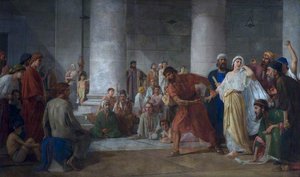
The Woman Taken in Adultery

1860 · Oil On Canvas

In "The Woman Taken in Adultery" by Edward Armitage, the viewer is immediately drawn into a complex and crowded arrangement of figures. The composition centers upon a woman who is surrounded by a dense group of people, creating a sense of immediate tension. At the heart of this confrontation, a man holds a scroll, presenting it as he faces her. This central interaction is framed by the weathered ruins of…

3
Saint Simon (1862) (1889) -ja Edward Armitage

Saint Simon

1862 · Oil On Canvas

The profile of a man emerges from the shadows, his face turned toward an unseen light. He is Saint Simon, captured in a moment of quiet, heavy contemplation. His shoulder-length black hair falls in soft, dark waves, framing a countenance that carries the weight of profound thought. Clad in white, his garment catches the light, creating a stark contrast against the textured, abstract background that surrounds him. There is a…

4
Dawn of the first Easter Sunday (1872) (1889) -ja Edward Armitage

Dawn of the first Easter Sunday

1872 · Oil · Auckland Art Gallery Toi o Tāmaki, Auckland

The morning light breaks across the scene in Dawn of the first Easter Sunday, a work that captures a moment of profound revelation. This oil painting, created by the English Victorian-era painter Edward Armitage, invites the viewer into a sacred stillness. The air feels heavy with the weight of the unfolding event, as if the very atmosphere holds its breath in anticipation of what is to be witnessed.

5
Deputation to Faraday (1873) (1889) -ja Edward Armitage

Deputation to Faraday

1873 · Oil On Canvas · A Royal Society, London

The air in the room feels heavy with the weight of deliberation as four men gather around a large mahogany table. In this formal portrait, titled Deputation to Faraday, Edward Armitage captures a moment of profound stillness and purpose. The subjects sit in a triangular arrangement, their presence commanding the space with a quiet, serious authority. They are caught in the midst of an official meeting, perhaps discussing the very…

Edward Armitage híres festményei, 11 és 27 között

A témák, amelyek Edward Armitage figyelmét meghúzták

A négy leggyakorobban előforduló téma ebben az eredeti művekben, mindegyik a legkiválóbb példájával.

A műemlékek, amelyek Edward Armitage eredeti műveit őrzik

A 8 olyan múzeum, amely a legtöbb ezen az oldalon szereplő festményet őrzi.

Múzeum Város Edward Armitage művei Ebből a listából származó festmények
Auckland Art Gallery Toi o Tāmaki, AucklandAuckland Art Gallery Toi o Tāmaki Auckland 3 Dawn of the first Easter Sunday, Blind Beggar of Assisi, Sea urchins
Walker Art Gallery, LiverpoolWalker Art Gallery Liverpool 2 Julian the Apostate Presiding at a Conference of Sectarians, Serf Emancipation
Hastings Library, HastingsHastings Library Hastings 2 A Dream of Fair Women (diptych, panel 2), A Dream of Fair Women (diptych, panel 1)
Laing Art Gallery, Newcastle upon TyneLaing Art Gallery Newcastle upon Tyne 2 The Cities of the Plain, Souvenir of Scutari
Royal Collection, LondonRoyal Collection London 2 The Pontoon on Virginia Water, 5 July 1853, The Battle of Meanee, 17 February 1843
Royal Academy of Arts, LondonRoyal Academy of Arts London 1 The Festival of Esther
A Royal Society, LondonA Royal Society London 1 Deputation to Faraday
Guildhall Art Gallery, LondonGuildhall Art Gallery London 1 Herod's Birthday Feast

Edward Armitage évtizedekig: egy egyedi eredeti mű minden évtizedben

Művek évtizedenként

Váassz ki egy évtizedet, hogy megnézhesd az azt meghatározó eredetiműveket.

Edward Armitage festményei: kérdések a galériának

Mi a leghíresebb műve Edward Armitagenek?Fedje fel a választ

The Festival of Esther (1865), Royal Academy of Arts, London. Ezután The Woman Taken in Adultery (1860) és Saint Simon (1862) következik.

Milyen életkorában alkotta meg Edward Armitage a(z) The Festival of Esther műszt?Fedje fel a választ

48 éves: The Festival of Esther 1865-ből származik, Edward Armitage pedig 1817-ben született.

Melyik tíz festménye Edward Armitage a leghíresebb?Fedje fel a választ

The Festival of Esther, The Woman Taken in Adultery, Saint Simon, Dawn of the first Easter Sunday, Deputation to Faraday, Julian the Apostate Presiding at a Conference of Sectarians, The Death of Marmion, The Death of Nelson, The Christian Martyr és Christ Calling the Apostles James and John. A fenti rangsor a művek évszamarát és a múzeumát jelzi.

Hány mű alkotása ismert Edward Armitage nevében?Fedje fel a választ

Katalógusunkban 29 mű található Edward Armitage alkotótól, 1842 és 1882 év közötti időszakból.

Hol tekinthetők meg a leghíresebb Edward Armitage eredetijeit?Fedje fel a választ

Leginkább Auckland Art Gallery Toi o Tāmaki (Auckland), Walker Art Gallery (Liverpool) és Hastings Library (Hastings) található. A fenti múzeumi táblázatban mindegyik felsorolásra került.

Melyik időszakban alkotta Edward Armitage a leghíresebb festményeit?Fedje fel a választ

1860s alatt: a jelen laphonon található 27 műből 10 készült ebben az időszakban, köztük The Festival of Esther.

Melyik híres Edward Armitage festmény a legkorábbi, és melyik a legutóbb készült?Fedje fel a választ

Ezen az oldalon a leghitelesebb The Death of Marmion (1842), a legutóbbi pedig Self Portrait (1882).

Milyen témakörket kedvelt Edward Armitage?Fedje fel a választ

Woman (3), Birth and death (3) és Women (3), a jelen oldalon található 27 műművészeti alkotás között.

Milyen anyagokkal festett leggyakrabban Edward Armitage?Fedje fel a választ

Oil On Canvas, a jelen oldalon található 27 műből 5 darab esetén.

Mely művészeti irányba tartozik Edward Armitage műve?Fedje fel a választ

Academic art, ezen az oldalon található eredetiek alapján.

Milyen Edward Armitage eredeti műveket láthatok a Auckland Art Gallery Toi o Tāmaki kiállításaiban?Fedje fel a választ

Dawn of the first Easter Sunday, Blind Beggar of Assisi és Sea urchins: a Auckland Art Gallery Toi o Tāmaki, Auckland 3 művet őrzi ezen az oldalon.

Edward Armitage: a művész portréja

Early Life and Family Roots

Edward Armitage, born in London on May 20th, 1817, emerged from a background steeped in the burgeoning industrial wealth of Yorkshire. Though his initial years were spent within the capital’s confines, his lineage was firmly anchored in the north of England, specifically to the Armitage family of Farnley Hall, just south of Leeds. His father, James Armitage, was a prominent ironmaster, one of seven sons descended from a line that had acquired Farnley Hall in 1799. This familial foundation—a blend of established land ownership and entrepreneurial spirit—would subtly shape the artist’s trajectory, providing both opportunity and a degree of independence.

The Armitage family's involvement extended beyond ironworks; his brother, Thomas Rhodes Armitage, notably founded the Royal National Institute of the Blind, demonstrating a commitment to social betterment. This sense of purpose, though not directly artistic, resonates within the often-grand and morally weighty themes that would come to define Edward’s work. He was connected through family to several notable figures including Robert Armitage (MP) and Robert Selby Armitage.

Artistic Formation in Paris

Recognizing his son's inclination towards art, James Armitage supported Edward’s pursuit of formal training, leading him to Paris in 1837. The École des Beaux-Arts became the crucible where young Armitage honed his skills under the tutelage of Paul Delaroche, a history painter at the zenith of his fame. Delaroche's influence proved profound; he instilled in Armitage a meticulous draughtsmanship, a dedication to historical accuracy, and a penchant for dramatic narrative—qualities that would become hallmarks of his style.

Armitage wasn’t merely a student but an active participant in Delaroche’s ambitious projects. He was selected as one of four assistants tasked with the monumental fresco *Hémicycle* within the Palais des Beaux-Arts, even reputedly serving as a model for the head of Masaccio—a testament to his developing physical presence and artistic aptitude. His early Parisian works, such as *Prometheus Bound* (1842), already hinted at the power he would later wield, earning praise for its skillful execution but also noted for an almost “brutally energetic” quality.

The Westminster Palace Competitions and Early Success

Returning to London in 1843, Armitage entered a period of intense competition with the ambitious project to decorate the new Palace of Westminster. Following the devastating fire of 1834, Queen Victoria’s consort, Prince Albert, spearheaded an initiative to adorn the rebuilt Houses of Parliament with frescoes depicting scenes from British history and literary masterpieces—Spenser, Shakespeare, and Milton being key sources of inspiration.

The ensuing cartoon competitions were fiercely contested. Armitage quickly distinguished himself, securing first prizes for *The Landing of Julius Caesar in Britain* (1843) and later for *The Spirit of Religion* (1845). While these designs weren’t ultimately realized as frescoes—a consequence of the technical challenges inherent in the London climate—they established his reputation and led to commissions for two significant works within the Poets' Gallery: *The Thames and its Tributaries* (from Pope) and *The Death of Marmion* (from Scott). These early successes, coupled with the Queen’s purchase of his large-scale oil painting *The Battle of Meeanee* (1847), cemented Armitage’s position within the Victorian art world.

A Career Defined by Historical Grandeur

Following a period of study in Rome, Armitage consistently exhibited at the Royal Academy from 1848 until 1893. His oeuvre became characterized by large-scale historical and biblical paintings—works that demanded both technical skill and an understanding of complex narratives. *Retribution* (1858), now housed in the Leeds Museum, stands as a particularly striking example; its allegorical depiction of the suppression of the Indian Mutiny, embodied in a colossal female figure grappling with a tiger, exemplifies his dramatic flair and moral seriousness.

His travels during the Crimean War informed paintings like *The Bottom of the Ravine at Inkerman* (1856) and *Souvenir of Scutari*, demonstrating an engagement with contemporary events. However, it was his ability to translate grand historical themes—such as *Samson* (1851) and *Hagar* (1852)—into visually compelling narratives that truly defined his artistic legacy.

Legacy and Historical Significance

Edward Armitage’s career unfolded within a Victorian art landscape increasingly fascinated by historical spectacle and moral allegory. While he consciously emulated the style of Paul Delaroche, his work also reflects a uniquely British sensibility—a blend of meticulous detail, dramatic composition, and a commitment to narrative clarity.

Though his frescoes proved vulnerable to the ravages of time, Armitage’s oil paintings continue to captivate viewers with their scale, ambition, and technical mastery. He represents a significant figure in Victorian art, bridging the gap between academic tradition and a growing interest in contemporary events. His dedication to “high purposes,” as one critic noted, irrespective of immediate reward, underscores his enduring appeal—a testament to an artist who sought not merely to depict history but to imbue it with meaning and moral weight.