The Life of Edgar Degas
Paris, 1834. A child is born into a moderately wealthy family to Hilaire-Germain-Edgar De Gas. The name he would eventually simplify to Edgar Degas marks the beginning of a life defined by the tension between social expectation and artistic obsession. He grows up within the sophisticated atmosphere of the French capital, a setting that will later serve as the backdrop for his observations of modern life.
The years pass in a blur of study and shifting interests. He moves from the structured environment of his upbringing toward the grit of the city's working spaces. He does not seek the sunlight of the outdoors, preferring the controlled, artificial light of the studio and the theater. His gaze settles on the dancers, the laundresses, and the racehorses of Paris, capturing the physical toll of labor and the fleeting movements of the stage. He remains a man of contradictions, often resisting the labels his contemporaries apply to him, insisting instead on his identity as a realist.
The end comes in Paris on 27 September 1917. He leaves behind a vast body of work that spans many decades, including:
- Procession on a road near Florence (about 1860)
- The Dancing Class (1874)
- The Absinthe Drinker (1876)
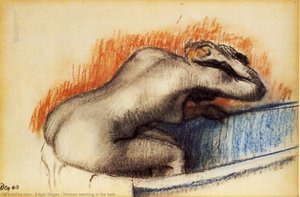
- The Tub (about 1886)
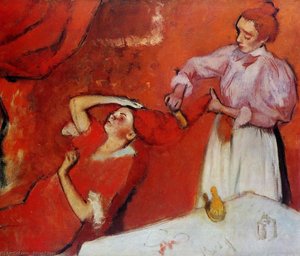
- Three Dancers in Red Costume (1896)
Early Life, Family and Training
Paris, 1834. The son of a banker and Célestine Musson De Gas, a Creole from New Orleans, Louisiana, Hilaire-Germain-Edgar De Gas enters a world of bourgeois stability. At eleven, he is enrolled at the Lycée Louis-le-Grand. The academic path is set, yet the boy’s focus drifts toward the halls of the Louvre. By 1853, having graduated from the Lycée with a baccalauréat in literature, he bypasses his father's expectations of a legal career. Instead, he registers as a copyist in the Louvre Museum, spending his hours tracing the lines of the masters.
The training intensifies at the École des Beaux-Arts in Paris. He moves through the rigors of classical instruction, honing a precision that would define his later work. In 1855, a meeting occurs that leaves a permanent mark on his development: he meets Jean-Auguste-Dominique Ingres. The encounter cements a respect for draftsmanship and the importance of the line, even as he begins to move toward the modern subjects that would eventually define his career.
Technique and Artistic Style
Degas rejects the label of Impressionist. He prefers the term "Realist," a choice that dictates his entire approach to the canvas. He avoids the outdoor landscape and the loose, flickering brushstrokes favored by his contemporaries. Instead, he retreats into the controlled environment of the studio. Here, he masters the human form through rigorous draftsmanship. He is a superb draftsman, possessing a specific, technical command over the depiction of movement. He does not wait for the sun to hit a subject; he constructs his scenes through careful study in pencil or pastel. This preparation allows him to freeze a fleeting moment of motion with anatomical precision.
Light in a Degas composition is rarely natural. He utilizes artificial light to emphasize the figures, creating a sense of theatricality and depth. One notable method is contre-jour, where he places his subject in shadow while the background remains brightly lit. This technique isolates the figure, pulling it forward from the environment. The result is a tension between the subject and the space they inhabit, often revealing the physical strain or the quiet, unposed reality of modern life.
- The Dance Class (1874)
- Interior (1868–1869)
- Madame de Rutte
Key Works and Subjects
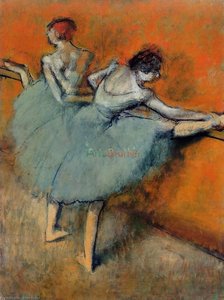
The stage and the stable dominate his visual world. More than half of his output focuses on dancers, capturing them in moments of rehearsal and performance. He moves between the grace of a pirouette and the physical strain of the dance class. Beyond the theater, he turns his gaze toward the speed of the racetrack, documenting racehorses and the jockeys who ride them. These subjects are not merely decorative; they are studies in tension and movement.
His reach extends into the private and the psychological. He produces portraits that reveal a complex inner life, often using unconventional angles to isolate his subjects. This focus on the human form is not limited to oil on canvas. He works through a variety of media, including prints, drawings, and wax sculptures. His ability to render the human figure is evident in his many studies of women, often focusing on the body in private, unobserved moments.
- The Dancing Class, about 1874
- The Dance Class, 1874
- The Ballet Class, 1874–1876
- Interior, 1868–1869
- Scene from the Steeplechase: The Fallen Jockey, 1866
Legacy and Lasting Impact
The shift in late 19th-century art finds a central figure in Degas. Though he resisted the label, his presence helped establish the foundations of Impressionism. He moved away from the rigid, historical subjects of the academy, choosing instead to document the grit and grace of modern Parisian life. This departure from tradition paved the way for future generations of artists to explore the unvarnished reality of the human condition.
His influence reaches far beyond the initial Impressionist circle. The structural innovations and unconventional compositions he developed left a mark on the trajectory of modern art. Specifically, his approach to form and movement can be seen in the later works of Pablo Picasso and Henri Matisse. He taught the art world to look at the world through asymmetrical angles and unexpected crops, turning the private, fleeting moments of a dancer or a laundress into permanent studies of motion.
- The Dance Class
- The Ballet Class
- Interior
Where to See the Works Today
The traces of Degas's observation remain scattered across major institutions, preserved in the quiet halls of Paris and beyond. In France, the Musée d'Orsay holds significant collections of his work, capturing the movement he spent a lifetime studying. The Louvre Museum also houses his art, while the Bibliothèque Nationale de France in Paris maintains his works within its archives. These collections offer a direct look at the technical precision and the study of form that defined his career.
Across the Atlantic, the reach of his vision extends into the United States. The Metropolitan Museum of Art in New York holds his paintings, providing a window into the modern life he depicted with such scrutiny. In Philadelphia, the Philadelphia Museum of Art contains his works, ensuring his influence remains accessible to international audiences. These sites act as physical anchors for his legacy, where the lines and light he mastered are still visible to the modern eye.
- The Dance Class (1874)
- Interior (1868–1869)
- The Tub 1 (1886)
- Dancers in Pink (1885)