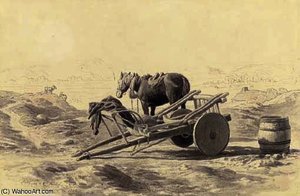
Cornelius Varley portréja

A 22 legnevezesebb Cornelius Varley festmény, egy galériaválaszték

Frissítve: november 2026 · rangsorolva népszerűségi pontszámunk alapján (minden mű keresései, látogatásai és megrendelései alapján) · 22 mű Cornelius Varley alkotása a katalógusunkban

Röviden

Cornelius Varley hagyatékából a leghíresebb alkotás Pastoral with Cattle and Figures in a Glade (1837), amely a Birmingham városi Birmingham Museum and Art Gallery gyűjteményében található. Röviddel ezután követik őket Portrait of J.M.W. Turner és Market place, hereford, (1803). Katalógusunkban 22 mű található Cornelius Varley alkotótól; a galéria megőrizte a világ által leginkább csodált 22 darabot, melyeket a dátummal, a múzeummal és a történetükkel együtt mutatunk be.

1781 – 1873, Mare Street A legtöbb mű: Birmingham Museum and Art Gallery

Cornelius Varley legjobb 10 festménye: a galéria válogatása

1
Pastoral with Cattle and Figures in a Glade (1837) (1889) -ja Cornelius Varley

Pastoral with Cattle and Figures in a Glade

1837 · Watercolor · Birmingham Museum and Art Gallery, Birmingham

In "Pastoral with Cattle and Figures in a Glade" by Cornelius Varley, the scene unfolds within a vertically oriented frame. Large, prominent tree trunks anchor the left and right foreground, acting as dark pillars that push the eye toward the center. This framing creates a sudden sense of depth, pulling the viewer into the quiet clearing. In the lower left, two human figures sit near the base of a massive…

2
Portrait of J.M.W. Turner (1889) -ja Cornelius Varley

Portrait of J.M.W. Turner

The portrait captures a man with a beard and mustache, his gaze fixed directly upon the viewer with a serious, steady expression. He is dressed in a white collar shirt, a detail that anchors the composition in a sense of formal dignity. The work possesses a vintage quality, its aged appearance suggesting a window into a bygone era. This likeness is not merely a traditional study but a product of…

A Cornelius Varley válogatás folytatódik: 11 – 22

A témák, amelyek Cornelius Varley figyelmét meghúzták

A négy leggyakorobban előforduló téma ebben az eredeti művekben, mindegyik a legkiválóbb példájával.

A műemlékek, amelyek Cornelius Varley eredeti műveit őrzik

A múzeum, amely ezen az oldalon szereplő festmények többségét őrzi.

Múzeum Város Cornelius Varley művei Ebből a listából származó festmények
Birmingham Museum and Art Gallery, BirminghamBirmingham Museum and Art Gallery Birmingham 2 Pastoral with Cattle and Figures in a Glade, Richmond, Surrey

Cornelius Varley évtizede folgtva: az eredeti művek, amelyek meghatározzák az egyes korzakot

Művek évtizedenként

Váassz ki egy évtizedet, hogy megnézhesd az azt meghatározó eredetiműveket.

Gyűjtői kérdések Cornelius Varley festményeivel kapcsolatban

Melyik művel a(z) Cornelius Varley a leghíresebb?Fedje fel a választ

Pastoral with Cattle and Figures in a Glade (1837), Birmingham Museum and Art Gallery, Birmingham. Ezután Portrait of J.M.W. Turner és Market place, hereford, (1803) következik.

Hány éves volt Cornelius Varley, amikor a Pastoral with Cattle and Figures in a Glade készült?Fedje fel a választ

56 éves: Pastoral with Cattle and Figures in a Glade 1837-ből származik, Cornelius Varley pedig 1781-ben született.

Melyek a tíz leghíresebb Cornelius Varley festmény?Fedje fel a választ

Pastoral with Cattle and Figures in a Glade, Portrait of J.M.W. Turner, Market place, hereford,, Cottages at Llanllyfni, North Wales,, Remains of Parton Hall, Staffordshire,, Richmond, Surrey, Bell's Improved Reaping Machine, The Ruins Of Purton Hall, Staffordshire, Old Farm Cottages és The Market Place, Ross, Herefordshire. A fenti rangsor a művek évszamarát és a múzeumát jelzi.

Hány festményet hagyott hátra Cornelius Varley?Fedje fel a választ

Katalógusunkban 22 mű található Cornelius Varley alkotótól, 1803 és 1837 év közötti időszakból.

Mely múzeumokban állnak Cornelius Varley remekművei?Fedje fel a választ

Leginkább Birmingham Museum and Art Gallery (Birmingham) található. A fenti múzeumi táblázatban mindegyik felsorolásra került.

Mely években festette Cornelius Varley leghíresebb műveit?Fedje fel a választ

1800s alatt: a jelen laphonon található 22 műből 2 készült ebben az időszakban, köztük Market place, hereford,.

Mikszétek az első és az utolsó híres eredeti műve a(z) Cornelius Varley alkotótól?Fedje fel a választ

Ezen az oldalon a leghitelesebb Market place, hereford, (1803), a legutóbbi pedig Pastoral with Cattle and Figures in a Glade (1837).

Milyen témaköröket választott leggyakrabban Cornelius Varley?Fedje fel a választ

Landscape (5), Buildings (4) és Markets (2), a jelen oldalon található 22 műművészeti alkotás között.

Mely Cornelius Varley művei láthatóak a Birmingham Museum and Art Gallery kiállتításán?Fedje fel a választ

Pastoral with Cattle and Figures in a Glade és Richmond, Surrey: a Birmingham Museum and Art Gallery, Birmingham 2 művet őrzi ezen az oldalon.

Cornelius Varley: életmű és életút

A Symphony of Light and Precision: The Life of Cornelius Varley

In the vibrant, shifting landscape of nineteenth-century Britain, few figures embodied the harmonious intersection of scientific inquiry and artistic expression as profoundly as Cornelius Varley. Born in the London suburb of Hackney in 1781, Varley was a man whose very existence seemed to bridge the gap between the empirical rigor of the laboratory and the ethereal beauty of the watercolor studio. His early life was shaped by the meticulous influence of his uncle, a skilled maker of scientific instruments, under whom Varley acquired a foundational understanding of optics and the natural sciences. This unique education instilled in him a lifelong fascination with how light interacts with the world—a preoccupation that would eventually define both his groundbreaking inventions and his delicate brushwork.

The artistic soul of Varley was deeply intertwined with the cultural currents of his time, most notably the burgeoning Romantic movement. He shared a profound intellectual and spiritual bond with the visionary William Blake, a friendship that nourished a mutual interest in the unseen forces of imagination and perception. While Blake explored the mystical realms of the mind, Varley sought to capture the tangible wonders of the physical world through a lens of extreme precision. This duality—the ability to see both the scientific structure of an object and its poetic essence—allowed him to navigate the art world with a singular, observant eye, making him much more than a mere painter of landscapes.

The Mastery of Watercolor and the Spirit of Observation

Varley’s artistic journey truly took flight around 1800, following an evocative expedition through the rugged terrains of Wales alongside his brother, the renowned watercolorist John Varley. This period of travel served as a crucible for his developing style; the dramatic topography and ancient architecture of the Welsh landscape demanded a level of detail that would become his hallmark. As he transitioned from a student of science to a professional artist, he became a foundational figure in the British watercolor tradition. In 1803, he stood among the original founders of the Water-Colour Society, an achievement that cemented his status within the prestigious circles of London’s art community.

His technique was characterized by a meticulous attention to detail that mirrored his scientific training. Whether depicting the architectural grandeur of historical monuments or the tranquil, flowing scenes of the River Thames, Varley approached the paper with the precision of an instrument-maker. His works often possess a clarity and luminosity that suggest a deep understanding of light refraction and atmospheric conditions. This was not merely decorative art; it was an act of documentation, where every stroke of pigment served to record the precise interplay of shadow and brilliance upon the landscape.

A Legacy of Innovation and Scientific Contribution

Beyond the confines of the art gallery, Varley’s intellect left an indelible mark on the history of technology. He was a true polymath, utilizing his mastery of optics to invent the graphic telescope and the graphic microscope. These inventions were not mere curiosities but significant advancements that allowed for a more nuanced way of observing and projecting visual information. His ability to translate complex scientific principles into functional tools exemplifies the spirit of the age—a period where the boundaries between discovery and creation were beautifully blurred.

The historical significance of Cornelius Varley lies in his refusal to choose between the eye of the scientist and the heart of the artist. His life’s work stands as a testament to the idea that true understanding requires both measurement and emotion. Through his contributions to the Royal Academy, his leadership in scientific societies, and his enduring watercolor masterpieces, he helped shape the visual language of the Victorian era. He remains a celebrated figure for those who find beauty in the precise, and truth in the painted light.