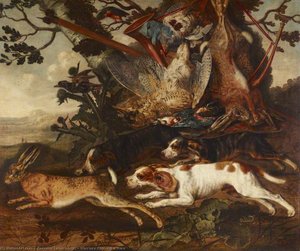
Cornelis Lelienbergh portréja

A 29 legnevesebbebb Cornelis Lelienbergh festmény, mindegyik egyedistens

Frissítve: november 2026 · rangsorolva népszerűségi pontszámunk alapján (minden mű keresései, látogatásai és megrendelései alapján) · 31 mű Cornelis Lelienbergh alkotása a katalógusunkban

Röviden

Still Life with Game Birds (1670) az a Cornelis Lelienbergh festmény, amely a legtöbb tekintetet felvonja; az eredeti mű a The Holburne Museum gyűjteményében található, Bath. Ezután a tekintet Still life with hare and black rooster (1659) és Dead Game Birds (1653) elemre irányul. A Cornelis Lelienbergh 31 műve közül a katalógusunkban megtalálható 29 legnépesebb alkotás, melyeket az év, a múzeum és az örökévalóságának okai kísérnek.

1626 – 1676, The Hague A legtöbb mű: Rijksmuseum

A galéria szemével: Cornelis Lelienbergh legjobb 10 festménye

1
Still Life with Game Birds (1670) (1889) -ja Cornelis Lelienbergh

Still Life with Game Birds

1670 · Oil On Canvas · The Holburne Museum, Bath

Still Life with Game Birds is an oil on canvas work by Cornelis Lelienbergh. Executed in 1670, the painting belongs to the Dutch Golden Age tradition of specialized still life. The artist, Cornelis Lelienbergh, was a prominent figure in the 17th-century Netherlands, known for his meticulous attention to the textures of feathers and organic matter.

2
Still life with hare and black rooster (1659) (1889) -ja Cornelis Lelienbergh

Still life with hare and black rooster

1659 · Oil On Canvas · Rijksmuseum, Amsterdam

A vertical arrangement defines this 1659 oil on canvas, where the remnants of a hunt are positioned against a dark, indistinct background. A wooden stick leans diagonally against a rustic table, supporting a dead hare that hangs by its limbs. On the table surface, a dark, deceased rooster lies alongside various vegetables. The lighting originates from a single side source, casting deep shadows and creating a sense of three-dimensional depth…

5
Dead Hare and Birds (1661) (1889) -ja Cornelis Lelienbergh

Dead Hare and Birds

1661 · Oil On Canvas · Museum Boijmans Van Beuningen, Rotterdam

A large, limp hare lies horizontally across the foreground, its body a heavy presence in the stillness. To its right, several dead birds are clustered, their forms tangled in the quiet aftermath of a hunt. The scene is a study in the stillness of mortality. A strong directional light enters from the upper right, catching the coarse texture of the rabbit's pelt and the smooth, delicate sheen of white feathers.…

6
Still life with a brass pail (1652) (1889) -ja Cornelis Lelienbergh

Still life with a brass pail

1652 · Oil On Canvas · Gemäldegalerie, Berlin

Still life with a brass pail is a work by Cornelis Lelienbergh. The artist, born in 1626, produced this piece in 1652. It belongs to the tradition of Dutch Golden Age still life painting, a period marked by a rigorous focus on the physical properties of objects and the interplay of light.

7
Still Life with Doves Hanging from an Iron Hook (1660) (1889) -ja Cornelis Lelienbergh

Still Life with Doves Hanging from an Iron Hook

1660 · Oil On Canvas · Nationalmuseum, Stockholm

Cornelis Lelienbergh’s Still Life with Doves Hanging from an Iron Hook presents a somber arrangement of dead birds suspended from a metal hook. The composition centers on a cluster of birds, creating a heavy, downward-pulling focal point. This central subject is set against a dark, indistinct background that offers no sense of place or horizon. The perspective is a direct, eye-level view, forcing a close encounter with the limp forms…

8
Still Life with Black Rooster and two Rabbits, Cornelis Lelienbergh, 1659 (1659) (1889) -ja Cornelis Lelienbergh

Still Life with Black Rooster and two Rabbits, Cornelis Lelienbergh, 1659

1659 · Oil On Canvas · Rijksmuseum, Amsterdam

In this 1659 composition, Cornelis Lelienbergh invites us into a moment of stillness that follows the intensity of the hunt. The scene is centered upon a black rooster, its dark plumage contrasting sharply against the pale, neutral background. Beside it, two rabbits lie in a niche, their forms resting in a state of profound repose. There is a certain weight to the subjects, a physical presence that speaks to the…

9
Still Life with Woodpecker and Snipes, Cornelis Lelienbergh, 1655 (1655) (1889) -ja Cornelis Lelienbergh

Still Life with Woodpecker and Snipes, Cornelis Lelienbergh, 1655

1655 · Oil · Rijksmuseum, Amsterdam

A collection of dead birds rests against a stone plinth, their forms arranged with a heavy, quiet stillness. A woodpecker, wings partially unfurled, dominates the left side of the composition, its posture contrasting with the limp, inanimate weight of the snipes below. A knife lies near the lower edge, a sharp, metallic presence amidst the organic textures of feathers and flesh. In the upper right, a glass bottle catches the…

10
Still Life with Parrot and Snipes, Cornelis Lelienbergh, 1655 (1655) (1889) -ja Cornelis Lelienbergh

Still Life with Parrot and Snipes, Cornelis Lelienbergh, 1655

1655 · Oil · Nationalmuseum, Stockholm

The painting is a still life featuring a bird with its head cut off, surrounded by other birds. The main bird appears to be a parrot, as it has a red tail feather. There are also two smaller birds in the scene, one on the left side and another on the right side of the image. The main bird is located towards the center of the image, while the other…

Cornelis Lelienbergh híres festményei, 11 és 29 között

A témák, amelyek Cornelis Lelienbergh figyelmét meghúzták

A négy leggyakorobban előforduló téma ebben az eredeti művekben, mindegyik a legkiválóbb példájával.

A műemlékek, amelyek Cornelis Lelienbergh eredeti műveit őrzik

A 8 olyan múzeum, amely a legtöbb ezen az oldalon szereplő festményet őrzi.

Múzeum Város Cornelis Lelienbergh művei Ebből a listából származó festmények
Rijksmuseum, AmsterdamRijksmuseum Amsterdam 3 Still life with hare and black rooster, Still Life with Black Rooster and two Rabbits, Cornelis Lelienbergh, 1659, Still Life with Woodpecker and Snipes, Cornelis Lelienbergh, 1655
Bavári Állami Festırménygyűjtemények, MunchenBavári Állami Festırménygyűjtemények Munchen 2 Dead Game Birds, Dead Rooster
Nationalmuseum, StockholmNationalmuseum Stockholm 2 Still Life with Doves Hanging from an Iron Hook, Still Life with Parrot and Snipes, Cornelis Lelienbergh, 1655
National Trust, CambridgeNational Trust Cambridge 2 Harriers Chasing a Hare, Spaniels Chasing a Hare
The Holburne Museum, BathThe Holburne Museum Bath 1 Still Life with Game Birds
Museum Boijmans Van Beuningen, RotterdamMuseum Boijmans Van Beuningen Rotterdam 1 Dead Hare and Birds
Gemäldegalerie, BerlinGemäldegalerie Berlin 1 Still life with a brass pail
National Museum of Art, Architecture and Design, OsloNational Museum of Art, Architecture and Design Oslo 1 Game

Cornelis Lelienbergh évtizedekig: egy egyedi eredeti mű minden évtizedben

Művek évtizedenként

Váassz ki egy évtizedet, hogy megnézhesd az azt meghatározó eredetiműveket.

Cornelis Lelienbergh festményei: kérdések a galériának

Mi a leghíresebb műve Cornelis Lelienberghnek?Fedje fel a választ

Still Life with Game Birds (1670), The Holburne Museum, Bath. Ezután Still life with hare and black rooster (1659) és Dead Game Birds (1653) következik.

Milyen életkorában alkotta meg Cornelis Lelienbergh a(z) Still Life with Game Birds műszt?Fedje fel a választ

44 éves: Still Life with Game Birds 1670-ből származik, Cornelis Lelienbergh pedig 1626-ben született.

Melyik tíz festménye Cornelis Lelienbergh a leghíresebb?Fedje fel a választ

Still Life with Game Birds, Still life with hare and black rooster, Dead Game Birds, Dead Rooster, Dead Hare and Birds, Still life with a brass pail, Still Life with Doves Hanging from an Iron Hook, Still Life with Black Rooster and two Rabbits, Cornelis Lelienbergh, 1659, Still Life with Woodpecker and Snipes, Cornelis Lelienbergh, 1655 és Still Life with Parrot and Snipes, Cornelis Lelienbergh, 1655. A fenti rangsor a művek évszamarát és a múzeumát jelzi.

Hány mű alkotása ismert Cornelis Lelienbergh nevében?Fedje fel a választ

Katalógusunkban 31 mű található Cornelis Lelienbergh alkotótól, 1652 és 1670 év közötti időszakból.

Hol tekinthetők meg a leghíresebb Cornelis Lelienbergh eredetijeit?Fedje fel a választ

Leginkább Rijksmuseum (Amsterdam), Bavári Állami Festırménygyűjtemények (Munchen) és Nationalmuseum (Stockholm) található. A fenti múzeumi táblázatban mindegyik felsorolásra került.

Melyik időszakban alkotta Cornelis Lelienbergh a leghíresebb festményeit?Fedje fel a választ

1650s alatt: a jelen laphonon található 29 műből 8 készült ebben az időszakban, köztük Still life with hare and black rooster.

Melyik híres Cornelis Lelienbergh festmény a legkorábbi, és melyik a legutóbb készült?Fedje fel a választ

Ezen az oldalon a leghitelesebb Still life with a brass pail (1652), a legutóbbi pedig Still Life with Game Birds (1670).

Milyen témakörket kedvelt Cornelis Lelienbergh?Fedje fel a választ

Feathers (6), Dark background (4) és Birds (4), a jelen oldalon található 29 műművészeti alkotás között.

Milyen anyagokkal festett leggyakrabban Cornelis Lelienbergh?Fedje fel a választ

Oil On Canvas, a jelen oldalon található 29 műből 7 darab esetén.

Milyen Cornelis Lelienbergh eredeti műveket láthatok a Rijksmuseum kiállításaiban?Fedje fel a választ

Still life with hare and black rooster, Still Life with Black Rooster and two Rabbits, Cornelis Lelienbergh, 1659 és Still Life with Woodpecker and Snipes, Cornelis Lelienbergh, 1655: a Rijksmuseum, Amsterdam 3 művet őrzi ezen az oldalon.

Cornelis Lelienbergh: a művész portréja

A Glimpse into the World of Cornelis van Lelienbergh

Cornelis van Lelienbergh, a name perhaps less immediately recognizable than some of his Dutch Golden Age contemporaries, nevertheless occupies a significant and fascinating niche within the pantheon of 17th-century artists. Born in the Netherlands in 1626, Lelienbergh’s life coincided with a period of unprecedented artistic flourishing, a time when the newly independent Dutch Republic embraced realism, portraiture, and landscape painting with remarkable fervor. While biographical details remain somewhat sparse – a common challenge for artists outside the very highest echelons of fame – his surviving works offer compelling insights into his skill, stylistic development, and the world he inhabited. He died in 1676, leaving behind a legacy that continues to captivate art enthusiasts today.

Early Life and Artistic Training

The specifics of Lelienbergh’s early training are not fully documented, but it is reasonable to assume he began his artistic journey within the established guild system prevalent in Dutch cities. The Netherlands at this time was a hotbed of specialized painting schools and workshops, each with its own distinct approach. It's likely that he apprenticed under a local master, honing fundamental skills in drawing, composition, and color mixing before specializing in portraiture and landscape—the genres for which he would become known. The influence of Flemish painters is strongly apparent in his work, suggesting potential exposure to their techniques either through direct study or the circulation of paintings within the robust art market of the Low Countries. This connection to Flanders is particularly notable in his handling of light and texture, as well as a certain psychological depth present in his portraits.

A Master of Portraiture and Landscape

Lelienbergh’s artistic output primarily centered around two key areas: portraiture and landscape painting. His portraits are not grand statements of power or status, but rather intimate depictions of individuals from the middle classes – merchants, scholars, and members of prosperous families. He possessed a remarkable ability to capture not just physical likeness, but also something of his sitters’ inner character. His landscapes, often featuring serene scenes of Dutch countryside, demonstrate a keen observation of nature combined with a sophisticated understanding of atmospheric perspective. These are not idealized visions; they reflect the actual topography and light conditions of the Netherlands, imbued with a quiet sense of realism. He frequently incorporated figures into his landscapes, adding narrative elements and a human scale to the vastness of the natural world.

Influences and Stylistic Development

The artistic climate of the Dutch Golden Age was one of constant exchange and innovation. Lelienbergh’s work reveals influences from several prominent painters. The aforementioned Flemish tradition, particularly artists like David Teniers the Younger, is evident in his detailed rendering of figures and genre scenes. He also shows an affinity for the works of Pieter de Molyn, a contemporary known for his elegant portraits and refined technique. However, Lelienbergh was not merely an imitator; he synthesized these influences into a distinctive style characterized by its subtle color palette, meticulous brushwork, and psychological sensitivity. Over time, his landscapes became increasingly sophisticated, moving beyond simple topographical representations to explore the emotional impact of light and atmosphere. His ability to balance realism with a poetic sensibility sets him apart.

Legacy and Historical Significance

While Lelienbergh may not be as widely celebrated as Rembrandt or Vermeer, his work offers valuable insights into the lives and values of 17th-century Dutch society. His portraits provide a glimpse into the burgeoning middle class, while his landscapes celebrate the beauty and tranquility of the Netherlands countryside. Today, his paintings are held in prominent museum collections, including the Museum Smidt Van Gelder in Knokke-Heist, Belgium, where they continue to be studied and admired. His contribution lies not in groundbreaking innovation, but in a masterful execution of established genres, imbued with a quiet dignity and psychological depth that resonates with viewers centuries later. The enduring appeal of his work speaks to the timeless power of realistic representation and the human desire to capture moments of beauty and meaning in art.
  • Known for portraits & landscapes
  • Flemish influence is apparent in his handling of light.
  • His paintings are held in prominent museum collections, including Museum Smidt Van Gelder.