Andreas Vesalius portréja

A 9 legnevezesebb Andreas Vesalius festmény, egy galériaválaszték

Frissítve: november 2026 · rangsorolva népszerűségi pontszámunk alapján (minden mű keresései, látogatásai és megrendelései alapján) · 9 mű Andreas Vesalius alkotása a katalógusunkban

Röviden

Andreas Vesalius hagyatékából a leghíresebb alkotás Anatomy (1543), amely a Párizs városi Bibliothèque Nationale de France gyűjteményében található. Röviddel ezután követik őket Dissected human body (1543) és Title page (1543). Katalógusunkban 9 mű található Andreas Vesalius alkotótól; a galéria megőrizte a világ által leginkább csodált 9 darabot, melyeket a dátummal, a múzeummal és a történetükkel együtt mutatunk be.

1514 – 1564, Brussels A legtöbb mű: Bibliothèque Nationale de France

Andreas Vesalius legjobb 10 festménye: a galéria válogatása

1
Anatomy (1543) (1889) -ja Andreas Vesalius

Anatomy

1543 · Engraving · Bibliothèque Nationale de France, Párizs

The image presents a detailed anatomical study of the human male figure, rendered in black and white through precise linework. The composition centers on the muscular anatomy, displaying the intricate arrangement of muscles, tendons, and bones. A frontal view is utilized, with the perspective appearing somewhat flattened, though depth is indicated through the layering of tissues and subtle shading. The lines are predominantly linear and precise, forming complex patterns to…

2
Dissected human body (1543) (1889) -ja Andreas Vesalius

Dissected human body

1543 · Engraving · Bibliothèque Nationale de France, Párizs

In the 1543 engraving titled Dissected human body by Andreas Vesalius, the internal architecture of man is laid bare. The central figure is a skeleton, stripped of its skin to reveal the intricate layering of muscles and the placement of internal organs. This anatomical study presents a body in a state of profound exposure. The figure remains upright, tethered to a vertical pole or post that anchors the composition. It…

3
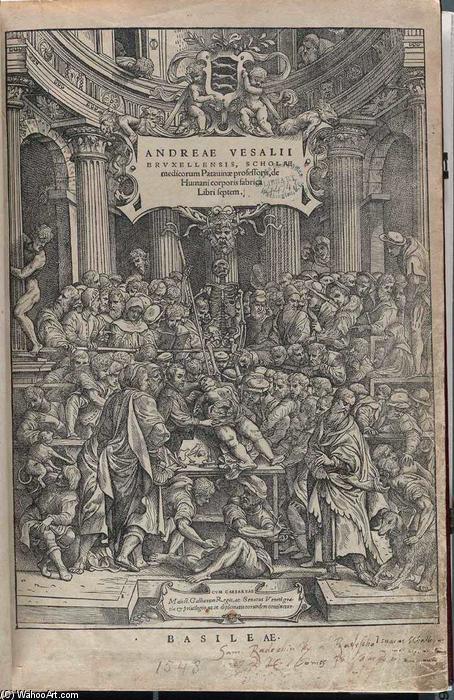
Title page (1543) (1889) -ja Andreas Vesalius

Title page

1543 · Woodcut · National Library of Medicine, Washington, D.C.

This work is the Title page by Andreas Vesalius. It functions as the introductory element for the 1543 first edition of the publication titled De Humani Corporis Fabrica Libri Septem. The page serves as the formal entry point to this specific anatomical volume, establishing the identity of the author and the subject matter through its printed text and accompanying imagery.

4
De humani corporis fabrica libri septem, N*.1.1(A) (1555) (1889) -ja Andreas Vesalius

De humani corporis fabrica libri septem, N*.1.1(A)

1555 · Woodcut · Cambridge University Library, Cambridge

The work titled De humani corporis fabrica libri septem, N*.1.1(A) by Andreas Vesalius emerged from a period of intense anatomical study. The artist, Andreas Vesalius, was born in Brussels, Belgium, in 1514. His professional focus centered on the direct observation of human structures through dissection. This specific edition of the work dates to 1555. It follows the earlier 1543 publication of the same title. The production of these anatomical records…

5
Skeleton (1600) (1889) -ja Andreas Vesalius

Skeleton

1600 · Engraving · Vilnius University Library, Vilnius

We are looking at Skeleton, a work attributed to Andreas Vesalius. This piece is dated about 1600. It offers a quiet, structural view of the human form, captured through the precise hand of an artist who fundamentally changed how we perceive the internal architecture of the body.

6
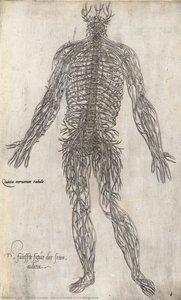
Nervous system of the human body (1600) (1889) -ja Andreas Vesalius

Nervous system of the human body

1600 · Ink On Paper · Vilnius University Library, Vilnius

Nervous system of the human body by Andreas Vesalius offers a detailed anatomical illustration of the human nervous system. Created about 1600, the work focuses on the intricate network of nerves, blood vessels, and skeletal structures. The subject matter is purely scientific, prioritizing the exploration of human anatomy through a meticulous rendering of biological systems. It depicts a nude male figure with an exaggeratedly large head and limbs, overlaid with…

A témák, amelyek Andreas Vesalius figyelmét meghúzták

A négy leggyakorobban előforduló téma ebben az eredeti művekben, mindegyik a legkiválóbb példájával.

A műemlékek, amelyek Andreas Vesalius eredeti műveit őrzik

A 4 olyan múzeum, amely a legtöbb ezen az oldalon szereplő festményet őrzi.

Múzeum Város Andreas Vesalius művei Ebből a listából származó festmények
Bibliothèque Nationale de France, PárizsBibliothèque Nationale de France Párizs 2 Anatomy, Dissected human body
Vilnius University Library, VilniusVilnius University Library Vilnius 2 Skeleton, Nervous system of the human body
National Library of Medicine, Washington, D.C.National Library of Medicine Washington, D.C. 1 Title page
Cambridge University Library, CambridgeCambridge University Library Cambridge 1 De humani corporis fabrica libri septem, N*.1.1(A)

Andreas Vesalius év évtizedéja: az egyes éveket meghatározó eredeti művek

A válogatás Andreas Vesalius pályafutását követi 13 évig, 1543től 1555ig, az egyes évek legkiválóbb eredeti műveit megőrizve.

Művek évszáma szerint

Váasszon egy évet az eredetiek megtekintéséhez.

Gyűjtői kérdések Andreas Vesalius festményeivel kapcsolatban

Melyik művel a(z) Andreas Vesalius a leghíresebb?Fedje fel a választ

Anatomy (1543), Bibliothèque Nationale de France, Párizs. Ezután Dissected human body (1543) és Title page (1543) következik.

Hány éves volt Andreas Vesalius, amikor a Anatomy készült?Fedje fel a választ

29 éves: Anatomy 1543-ből származik, Andreas Vesalius pedig 1514-ben született.

Hány festményet hagyott hátra Andreas Vesalius?Fedje fel a választ

Katalógusunkban 9 mű található Andreas Vesalius alkotótól, 1543 és 1555 év közötti időszakból.

Mely múzeumokban állnak Andreas Vesalius remekművei?Fedje fel a választ

Leginkább Bibliothèque Nationale de France (Párizs), Vilnius University Library (Vilnius) és National Library of Medicine (Washington, D.C.) található. A fenti múzeumi táblázatban mindegyik felsorolásra került.

Mely években festette Andreas Vesalius leghíresebb műveit?Fedje fel a választ

1543 alatt: a jelen laphonon található 9 műből 3 készült ebben az időszakban, köztük Anatomy.

Mikszétek az első és az utolsó híres eredeti műve a(z) Andreas Vesalius alkotótól?Fedje fel a választ

Ezen az oldalon a leghitelesebb Anatomy (1543), a legutóbbi pedig De humani corporis fabrica libri septem, N*.1.1(A) (1555).

Milyen témaköröket választott leggyakrabban Andreas Vesalius?Fedje fel a választ

Anatomy (4), Human body (3) és Renaissance art (2), a jelen oldalon található 9 műművészeti alkotás között.

Melyik technikát alkalmazta leggyakrabban Andreas Vesalius?Fedje fel a választ

Engraving, a jelen oldalon található 9 műből 3 darab esetén.

Mely Andreas Vesalius művei láthatóak a Bibliothèque Nationale de France kiállتításán?Fedje fel a választ

Anatomy és Dissected human body: a Bibliothèque Nationale de France, Párizs 2 művet őrzi ezen az oldalon.

Andreas Vesalius: életmű és életút

Andreas Vesalius: The Father of Modern Anatomy

Andreas Vesalius (1514 – 1564) stands as a monumental figure in the history of science and art, irrevocably altering our understanding of human anatomy and establishing a new paradigm for medical illustration. Born in Brussels, Belgium, Vesalius’s early life was marked by intellectual curiosity and a fascination with dissection—activities that would ultimately define his groundbreaking career. His father, Gerard Vesalius, was a physician who instilled in him a passion for observation and meticulous anatomical study, shaping the trajectory of Vesalius's scholarly pursuits.
  • Early Life & Education:
  • Academic Pursuits at Padua:
  • De Humani Corporis Fabrica: A Revolution in Illustration
  • Influence and Legacy
Padua University became Vesalius’s academic home, where he excelled as a student of medicine under Alessandro Vesalius (his uncle), furthering his commitment to anatomical investigation. It was during this time that he began to challenge the prevailing Galenic dogma—the dominant medical theory of his era—which relied heavily on speculation and lacked empirical evidence. Vesalius recognized the necessity for direct observation and dissection to accurately depict the human body, a conviction that fueled his determination to overturn established beliefs.

De Humani Corporis Fabrica: A Revolution in Illustration

Vesalius’s magnum opus, *De Humani Corporis Fabrica* ("On the Fabric of Human Body"), published in 1543, represents a watershed moment in anatomical history. This monumental atlas meticulously documented human anatomy through detailed drawings—the first truly accurate representations based on dissection—challenging centuries of inaccurate depictions propagated by Galen and Aristotle. Vesalius’s artistic skill was unparalleled; he painstakingly recreated cadavers with astonishing precision, capturing subtle muscular movements and skeletal structures with unprecedented realism. The illustrations themselves are considered masterpieces of Renaissance art, demonstrating a mastery of perspective, shading, and anatomical detail that surpassed anything seen before.
  • Detailed Anatomical Drawings:
  • Innovative Artistic Techniques:
  • Impact on Medical Knowledge:
Vesalius’s artistic techniques were revolutionary for their time, utilizing a combination of meticulous observation and innovative drawing methods. He employed the humanist perspective—a focus on human form and proportion—to elevate anatomical study to an art form itself. Vesalius's drawings weren't merely representations; they were expressions of intellectual curiosity and a profound respect for the complexity of human anatomy. The atlas swiftly gained acclaim among physicians and scholars across Europe, sparking debate and ultimately contributing to the gradual acceptance of empirical observation as a cornerstone of medical science.

Influence and Legacy

The impact of Vesalius’s work extended far beyond the immediate scientific community. *De Humani Corporis Fabrica* fundamentally reshaped anatomical education and spurred advancements in surgical techniques. Vesalius's insistence on dissection as a method of study established a precedent that endured for centuries, influencing generations of anatomists and physicians. Furthermore, his artistic legacy continues to inspire artists today—his drawings serve as enduring models of anatomical accuracy and aesthetic beauty. Vesalius’s contribution to both art and science cemented his place as “The Father of Modern Anatomy,” ensuring his name would forever be synonymous with the pursuit of knowledge through observation and artistic excellence.