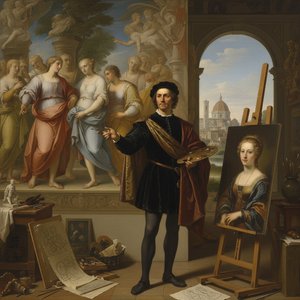
Early Life and Training
Andrea del Sarto, a name synonymous with the quiet elegance of Florentine High Renaissance art, was born in Florence on July 16, 1486, within a family deeply rooted in craftsmanship – his father, Agnolo, was a tailor (hence “del Sarto,” meaning “tailor’s son”). His early years were marked by an apprenticeship not to the grandest of artistic institutions, but rather to a goldsmith, a practical beginning for a young man destined for a career focused on meticulous detail and rich color. This initial training was followed by a period under the guidance of Gian Barile, a woodcarver and painter, providing him with foundational skills in both materials and technique. Crucially, however, his artistic development was profoundly shaped by the influence of masters like Leonardo da Vinci and Michelangelo – he spent considerable time studying their groundbreaking works, particularly their masterful use of *sfumato* and the dramatic interplay of light and shadow. This dedication to understanding the techniques of these giants would become a cornerstone of his own style.Artistic Career and Development
Andrea’s artistic journey truly began with a collaboration that established him as a rising talent: he joined forces with Franciabigio, another prominent Florentine painter, on the ambitious project of decorating the chapel of the Scalzo congregation in Florence. This marked the beginning of his long association with monochromatic frescoes – *grisaille* – a technique demanding exceptional control over color and tone. As time progressed, Andrea developed a distinctive style that blended the meticulous realism of the Renaissance with subtle hints of Mannerism, creating works characterized by their harmonious compositions, graceful figures, and innovative use of color. He joined the arte dei medici e degli speziali in 1508, further solidifying his position within Florence’s artistic circles. This period saw him experimenting with different approaches, refining his skills, and establishing himself as a respected artist capable of tackling both large-scale projects and intimate portraits.Notable Works and Commissions
Andrea del Sarto's legacy is largely defined by his monumental frescoes, particularly the *Cenacolo di Andrea del Sarto* (The Last Supper), a vast composition covering over 40 square meters at the Museo del Cenacolo in Florence. This masterpiece, executed between 1513 and 1517, showcases his mastery of perspective, color, and human form – it’s a testament to his ability to capture the drama and emotion of this pivotal biblical scene. Another significant work is *The Holy Family*, commissioned by Zanobi Strozzi for his villa in Rovezzano, now housed in the Pinacoteca Nazionale di Arte Antica in Rome. This painting exemplifies his characteristic elegance and refined style. Furthermore, he created a series of frescoes depicting the life of Saint John the Baptist for the loggia dei servi di Maria, demonstrating his early skill with monochromatic *grisaille*. Beyond these major works, Andrea’s output included numerous portraits and altarpieces, each reflecting his evolving artistic sensibilities.Legacy and Influence
Despite being somewhat overshadowed by the towering figures of Leonardo da Vinci, Michelangelo, and Raphael during his lifetime, Andrea del Sarto's work holds a unique significance in the history of art. His style – characterized by its balanced compositions, graceful figures, and subtle use of color – represents a crucial bridge between the High Renaissance and the emerging Mannerist movement. He wasn’t merely imitating his predecessors; he was synthesizing their influences into something distinctly his own. His legacy is evident not only in the numerous artworks he left behind but also in the influence he exerted on subsequent generations of artists. His dedication to color theory, his meticulous attention to detail, and his innovative approach to fresco painting continue to inspire admiration and study today. Andrea del Sarto’s story serves as a reminder that artistic greatness doesn't always follow a predictable path—it often emerges from quiet dedication, skillful observation, and a profound understanding of the art of representation.Kérdések és válaszok
Melyik városban és melyik országban született Andrea del Sarto?
Andrea del Sarto Firenze, Olaszország városában született.
Mely történelmi korszakban alkotott Andrea del Sarto?
Andrea del Sarto a Reneszánsz korszakban alkotott. Ez az időszak a művész tevékenységét a történelembe helyezi.
Mely Andrea del Sarto művei a legnézettebbek?
Andrea del Sarto műveire vonatkozó statisztikusok a művész Statisztikák oldalán érhetőek el.