Albert Koenig portréja

A 45 legnevesebbebb Albert Koenig festmény, mindegyik egyedistens

Frissítve: november 2026 · rangsorolva népszerűségi pontszámunk alapján (minden mű keresései, látogatásai és megrendelései alapján) · 45 mű Albert Koenig alkotása a katalógusunkban

Röviden

Deutsch Heidelandschaft mit Regenbogen (1921) az a Albert Koenig festmény, amely a legtöbb tekintetet felvonja. Ezután a tekintet Deutsch Heideschäfer (1925) és German heath landscape (1910) elemre irányul. A Albert Koenig 45 műve közül a katalógusunkban megtalálható 45 legnépesebb alkotás, melyeket az év, a múzeum és az örökévalóságának okai kísérnek.

1881 – 1944, Eschede A legtöbb mű: Albert-König-Museum

A galéria szemével: Albert Koenig legjobb 10 festménye

1
Deutsch Heidelandschaft mit Regenbogen (1921) (1889) -ja Albert Koenig

Deutsch Heidelandschaft mit Regenbogen

1921

In this 1921 landscape, we find ourselves standing within a tranquil German heathland. The scene is composed of a wide field, where the earth meets a sky heavy with clouds. Scattered across the terrain, several trees emerge from the ground, some positioned near the viewer and others receding into the distance to create a sense of depth. A soft rainbow arches through the atmosphere, providing a subtle focal point that…

2
Deutsch Heideschäfer (1925) (1889) -ja Albert Koenig

Deutsch Heideschäfer

1925 · Oil

An elderly man sits before us, his presence heavy with the weight of years and the warmth of a life lived in rhythm with the seasons. He wears a brown hat, its brim lined with soft fur, a practical necessity for a life spent outdoors. His eyes are closed, and a gentle smile rests upon his weathered face, suggesting a moment of profound peace or perhaps a pleasant memory drifting…

3
German heath landscape (1910) (1889) -ja Albert Koenig

German heath landscape

1910 · Oil

A dirt road cuts through the center of this 1910 landscape, guiding the eye through a serene German heath. Wildflowers line the path, flanking a terrain punctuated by scattered trees that recede into a soft background. Near the center, a lone figure moves along the track, a solitary presence amidst the expansive natural scenery. The composition emphasizes the stillness of the landscape, capturing a moment of quiet observation within the…

4
Harvest landscape in the foothills of the Harz Mountains (1920) (1889) -ja Albert Koenig

Harvest landscape in the foothills of the Harz Mountains

1920 · Oil On Canvas

The oil painting depicts a wide rural landscape situated in the foothills of the Harz Mountains. In the foreground, several large, textured haystacks occupy the lower plane, rendered in shades of ochre and warm brown. These forms create a sense of weight and solidity against the earth. The middle ground consists of cultivated fields, showing varying tones of green and brown that suggest recent agricultural activity. Beyond these fields, the…

5
The Rebellious Slave (1907) (1889) -ja Albert Koenig

The Rebellious Slave

1907 · Charcoal · Bomann-Museum, Celle

A muscular male figure dominates the vertical composition, captured in a dynamic, sculptural pose that suggests sudden movement or tension. The subject, rendered with intense anatomical precision, appears as a study of human form, perhaps a statue or a life model, viewed from a low-angle perspective to emphasize its monumental presence. Light enters from the upper left, carving deep shadows across the right side of the body and beneath the…

6
Reclining Nude (1910) (1889) -ja Albert Koenig

Reclining Nude

1910 · Oil · Albert-König-Museum, Südheide

The canvas holds a woman in a moment of stillness. She lies in a lateral pose, her body forming a long diagonal that cuts through the frame from the lower left to the upper right. This movement creates a quiet tension against the stillness of her limbs. Her skin appears pale and pinkish-white, a soft contrast to the deep reds and purples of the surface beneath her. In the upper…

8
Woman with Blue Bowl (Dorothea König in Profile) (1920) (1889) -ja Albert Koenig

Woman with Blue Bowl (Dorothea König in Profile)

1920 · Oil On Canvas · Albert-König-Museum, Südheide

A woman sits in a moment of stillness, her profile turned away from the viewer to face the light. She holds a blue bowl, its surface catching the glow, filled with the warm, rounded shapes of fruit. The scene feels suspended, a private instance of dignity captured in oil on canvas. Her skin possesses a soft, pinkish-white quality that contrasts against the deep, cool tones of the background. Every brushstroke…

Albert Koenig híres festményei, 11 és 45 között

A témák, amelyek Albert Koenig figyelmét meghúzták

A négy leggyakorobban előforduló téma ebben az eredeti művekben, mindegyik a legkiválóbb példájával.

A műemlékek, amelyek Albert Koenig eredeti műveit őrzik

A 2 olyan múzeum, amely a legtöbb ezen az oldalon szereplő festményet őrzi.

Múzeum Város Albert Koenig művei Ebből a listából származó festmények
Albert-König-Museum, SüdheideAlbert-König-Museum Südheide 12 Reclining Nude, Albert Oehm (1855–1919), Woman with Blue Bowl (Dorothea König in Profile)
Bomann-Museum, CelleBomann-Museum Celle 1 The Rebellious Slave

Albert Koenig évtizedekig: egy egyedi eredeti mű minden évtizedben

Művek évtizedenként

Váassz ki egy évtizedet, hogy megnézhesd az azt meghatározó eredetiműveket.

Albert Koenig festményei: kérdések a galériának

Mi a leghíresebb műve Albert Koenignek?Fedje fel a választ

Deutsch Heidelandschaft mit Regenbogen (1921). Ezt követi Deutsch Heideschäfer (1925) és German heath landscape (1910).

Milyen életkorában alkotta meg Albert Koenig a(z) Deutsch Heidelandschaft mit Regenbogen műszt?Fedje fel a választ

40 éves: Deutsch Heidelandschaft mit Regenbogen 1921-ből származik, Albert Koenig pedig 1881-ben született.

Melyik tíz festménye Albert Koenig a leghíresebb?Fedje fel a választ

Deutsch Heidelandschaft mit Regenbogen, Deutsch Heideschäfer, German heath landscape, Harvest landscape in the foothills of the Harz Mountains, The Rebellious Slave, Reclining Nude, Albert Oehm (1855–1919), Woman with Blue Bowl (Dorothea König in Profile), Reclining Nude with Green Blanket és Deutsch Bildnis eines jungen Mädchens. A fenti rangsor a művek évszamarát és a múzeumát jelzi.

Hány mű alkotása ismert Albert Koenig nevében?Fedje fel a választ

Katalógusunkban 45 mű található Albert Koenig alkotótól, 1907 és 1942 év közötti időszakból.

Hol tekinthetők meg a leghíresebb Albert Koenig eredetijeit?Fedje fel a választ

Leginkább Albert-König-Museum (Südheide) és Bomann-Museum (Celle) található. A fenti múzeumi táblázatban mindegyik felsorolásra került.

Melyik időszakban alkotta Albert Koenig a leghíresebb festményeit?Fedje fel a választ

1920s alatt: a jelen laphonon található 45 műből 18 készült ebben az időszakban, köztük Deutsch Heidelandschaft mit Regenbogen.

Melyik híres Albert Koenig festmény a legkorábbi, és melyik a legutóbb készült?Fedje fel a választ

Ezen az oldalon a leghitelesebb The Rebellious Slave (1907), a legutóbbi pedig Deutsch Landschaft (Blaues Land) (1942).

Milyen témakörket kedvelt Albert Koenig?Fedje fel a választ

Man (3), Person (2) és Trees (2), a jelen oldalon található 45 műművészeti alkotás között.

Milyen anyagokkal festett leggyakrabban Albert Koenig?Fedje fel a választ

Oil, a jelen oldalon található 45 műből 3 darab esetén.

Milyen Albert Koenig eredeti műveket láthatok a Albert-König-Museum kiállításaiban?Fedje fel a választ

Reclining Nude, Albert Oehm (1855–1919) és Woman with Blue Bowl (Dorothea König in Profile): a Albert-König-Museum, Südheide 12 művet őrzi ezen az oldalon.

Albert Koenig: a művész portréja

Albert Koenig: A Harmonious Vision of the Harz

Born in Esheide, Germany, in 1881 and passing away in Unterlüß in 1944, Albert Koenig’s artistic journey is a compelling narrative of quiet observation, meticulous technique, and a profound connection to the natural world. Initially drawn to the precision of instrument making – he apprenticed under Jean-Baptiste Vuillaume, a renowned violin maker – Koenig’s true passion lay in capturing the subtle harmonies of light and color, particularly within the evocative landscapes of his native Harz Mountains.

Koenig's early artistic development was largely self-directed. He eschewed formal academic training, preferring to study through direct observation and experimentation. This approach fostered a unique style characterized by a remarkable sensitivity to texture and atmosphere. Unlike many of his contemporaries who embraced bold, expressive brushstrokes, Koenig favored a more restrained palette and a deliberate layering of paint – often applied with a dry brush technique – to create an illusion of depth and luminosity. His works aren’t flamboyant displays of color; instead, they are carefully constructed studies in light, shadow, and the delicate interplay between them.

The Landscape of the Harz

Koenig's most celebrated subjects were undoubtedly the dramatic vistas of the Harz Mountains. This rugged region, with its dense forests, rolling hills, and mist-shrouded peaks, provided an endless source of inspiration. He wasn’t simply depicting these landscapes; he was attempting to translate their essence onto canvas – capturing not just what he saw, but also the feeling of being immersed within them. His paintings are imbued with a sense of tranquility and solitude, inviting the viewer to share in his contemplative gaze.

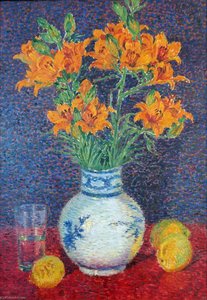
Early works like “Harvest Landscape in the Foothills of the Harz Mountains” (1920) demonstrate this approach perfectly. The composition is dominated by muted blues and greens, suggesting the cool dampness of the forest floor and the distant haze of the mountains. The brushstrokes are subtle yet deliberate, creating a sense of texture that mimics the rough bark of trees and the undulating contours of the hills. Later pieces, such as “Deutsch Feuerlilien und Zitronen” (1911), showcase his mastery of still life, transforming humble subjects – lilies and lemons – into miniature worlds of intricate detail and luminous color.

Technique and Influences

Koenig’s technical skill was rooted in a deep understanding of acoustics. His background as an instrument maker instilled in him a keen awareness of tonal qualities and the way light interacts with surfaces. This knowledge informed his approach to painting, encouraging him to experiment with layering techniques and creating subtle variations in color and texture. He meticulously studied the effects of light on water, stone, and foliage, striving to replicate these phenomena on canvas.

While he largely worked independently, Koenig’s art reveals echoes of Impressionism and Post-Impressionism. The emphasis on capturing fleeting moments of light and atmosphere aligns with the principles of these movements, but his work possesses a distinct German sensibility – a quiet introspection and a reverence for the natural world that sets it apart from its French counterparts.

Legacy and Recognition

Despite his considerable talent, Albert Koenig remained largely unknown during his lifetime. His paintings were primarily exhibited in regional galleries and museums within Germany, and he never achieved widespread commercial success. However, in recent decades, there has been a growing appreciation for his work – particularly among collectors of German landscape art. Today, his paintings are held by prestigious institutions such as the Kunsthalle Hamburg, the Kestner Museum in Hanover, and the Bremen Art Museum.

Koenig’s legacy lies not only in his beautiful paintings but also in his unwavering dedication to his craft and his profound connection to the landscapes of his homeland. He represents a quiet voice within German art history – an artist who sought to capture the essence of beauty through careful observation, meticulous technique, and a deep appreciation for the harmonies of nature.