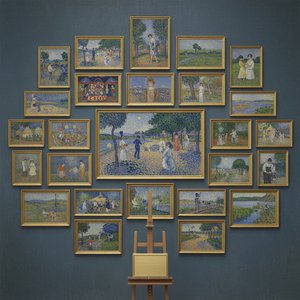
is pointillism impressionism?
Pointillism is not Impressionism, but rather a disciplined branch that emerged from it during the 1880s. While both movements studied how light interacts with the human eye, Pointillism replaced the spontaneous, emotional brushstrokes of Impressionism with a rigid, analytical technique based on scientific optical color theory and systematic patterns.
The relationship between these styles is one of evolution and reaction. Impressionism, which originated in France during the 1870s and 1880s, focused on capturing fleeting moments and movement through loose, visible brushstrokes. In contrast, Pointillism developed in 1886 as a more structured response, seeking to apply scientific principles to the depiction of light.
Key distinctions between the two approaches include:
- Impressionism: Characterized by open composition, emphasis on movement, and the use of short, broken brushstrokes to capture atmospheric effects.
- Pointillism: Defined by a mechanical technique using small, distinct dots of color applied in patterns to form an image.
how does pointillist technique differ from impressionist brushwork?
 Georges Seurat
Discover Georges Seurat (1859-1891), the pioneer of Pointillism & Neo-Impressionism! Explore 'A Sunday on La Grande Jatte' and his revolutionary color theory capturing modern life. Shop hand-painted reproductions!
Pointillist technique differs from Impressionist brushwork through the use of optical mixing rather than physical blending. While Impressionists used expressive strokes to create texture, Pointillists applied tiny, separate dots of pure color that the viewer's eye and mind combine into a fuller range of tones from a distance.
This method, often called Divisionism or chromoluminarism, relies on the principles of additive mixing, similar to how RGB colors function in computer monitors. Instead of blending pigments on a palette—a subtractive process that can result in muddy colors—artists like Georges Seurat (1859–1891) placed juxtaposed dots of color to achieve maximum luminosity and brilliance.
The technical execution involves specific differences in application:
- Pigment Application: Pointillists used small, discrete dots, whereas Impressionists used broader, more fluid strokes.
- Color Theory: Pointillism utilized scientific theories from scholars like Michel Eugène Chevreul and Ogden Rood to manage simultaneous contrast.
- Surface Texture: The meticulous dotting of Pointillism often comes at the expense of the traditional brushwork used to delineate texture in Impressionist works.
is neo-impressionism a subset of the impressionist movement?
 A Sunday Afternoon on the Island of La Grande Jatte
, Georges Seurat
Neo-Impressionism is a specialized successor to Impressionism that flourished from approximately 1886 to 1906. It adopted the Impressionist interest in light and color but rejected their spontaneous, naturalistic methods in favor of a measured, analytical approach grounded in the scientific study of optics and color theory.
The term "Neo-Impressionism" was first used by the art critic Félix Fénéon in 1886 to describe the works of Georges Seurat, Paul Signac, and their followers. This movement was officially presented to the public at the Salon des Indépendants in 1886. While it shared the Impressionist goal of capturing light, it sought a more permanent, structured truth through mathematical precision.
Notable artists within this specialized group include:
- Georges Seurat: A pioneer whose work, such as A Sunday Afternoon on the Island of La Grande Jatte (1886), established the movement's foundation.
- Paul Signac: A key figure and advocate who continued the Divisionist tradition in works like The Yellow Sail, Venice.
- Henri-Edmond Cross: An artist known for using the technique in landscapes such as Afternoon at Pardigon.
- Maximilien Luce: A painter who transitioned from Impressionism to adopt the more rigorous Neo-Impressionist style.
Frequently asked questions
When was Georges Seurat born?
Georges Seurat was born in Paris on December 2, 1859.
Who coined the term Neo-Impressionism?
The term Neo-Impressionism was first used by critic Félix Fénéon in 1886.
What is Pointillism similar to?
Pointillism is analogous to the four-color CMYK printing process.
Where and when was Paul Signac born?
Paul Signac was born in Paris in 1863.
Learn more
- 1859 – 1891Georges SeuratDiscover how Seurat's academic training birthed the scientific method of Pointillism.
- Georges Seurat · 1886A Sunday Afternoon on the Island of La Grande JatteExamine the definitive masterpiece of Neo-Impressionism and its revolutionary color application.
- 1863 – 1935Paul SignacLearn about the artist who expanded Pointillism into the broader Neo-Impressionist movement.

Sources
- Comparison of Impressionism and Pointillism techniques (artsandculture.google.com)
- Overview of the Post-Impressionist art movement (en.wikipedia.org)
- Glossary definition of Neo-Impressionism (tate.org.uk)
- Technical explanation of Divisionism and color separation (en.wikipedia.org)
- History and characteristics of Impressionism (en.wikipedia.org)
- Scholarly essay on Georges Seurat and Neo-Impressionism (metmuseum.org)
- Origins of the Neo-Impressionist movement (en.wikipedia.org)