Realism
The Reader (Honoré Daumier)
Honoré Daumier (1808–1879) megalkotta: The Reader. A Realism irányzathoz tartozik. Oil On Panel anyagból készült. Mérete 34 × 26 cm.
- Oil On Panel
- 34 × 26 cm

 Megtekintés

 Kézzel festett olajfestmény
 Küldés
 Megosztás
 Információs lap


 Letöltés
 Hasonló darabok
 X-ray felvétel
 Diavetítés
 Kérdések és válaszok

 Statisztika
The Reader röviden
- Cím
- The Reader
- Művész
- Honoré Daumier (1808–1879)
- A művész születési helye
- Marseille, Franciaország
- Műszaki adatok
- Oil On Panel
- Méretek
- 34 × 26 cm
- Mozgalom
- Realism
- Időszak
- 19th Century
- Téma
- man, book, reading, brown, ochre, red
Mit ábrázol a The Reader?
Identification of The Reader by Honoré Daumier
The quiet intensity of The Reader meets the viewer through the focused gaze of its subject. Painted by Honoré Daumier, this work captures a moment of profound stillness. The piece emerges from around c. 1857, a time when the artist's hand moved with a particular sense of purpose and weight. It exists as a painting, a physical presence that holds the light and shadow of a private, contemplative world.
Honoré Daumier brings a sense of lived experience to this study. The figure remains lost in the pages of a book, oblivious to the world outside the frame. There is a weight to the atmosphere, a feeling of solitude that settles over the scene. The work carries the mark of its creation, a tangible connection to the era of its origin.
This specific painting, The Reader, remains a significant part of the artist's visual language. It avoids the distractions of a grand setting to focus entirely on the human condition in a state of deep engagement. Through this work, the act of reading becomes a heavy, significant event, frozen in time for those who stop to look.
Composition and Visual Elements
The composition follows a vertical orientation, drawing the eye immediately to the man positioned slightly off-center. He sits in a moment of profound stillness, his gaze directed steadily downwards toward the open book held in his hands. This downward focus creates a tight, intimate space around his head and shoulders. Behind him, a blurred object, perhaps a cushion or a potted plant, rests in the background, providing a sense of depth without pulling attention away from the central figure.
Soft, diffused light falls from an unseen source above and to the left, casting gentle shadows across the man's face. This lighting emphasizes his features and the texture of the pages before him, while the shallow perspective keeps the viewer's focus firmly on the interaction between the reader and his text. The atmosphere feels quiet and heavy with contemplation.
The color palette relies on a somber arrangement of earthy tones. Deep browns, ochres, and muted reds dominate the scene, grounding the subject in a warm but melancholic environment. These colors wrap around the figure, reinforcing the sense of solitude and the weight of the thoughts contained within the book.
Technique and Physical Materials
The oil paint clings to the panel with a palpable, heavy presence. Each stroke carries the weight of the artist's hand, applied with a loose and expressive energy that refuses to settle into stillness. You can see the evidence of layering, where colors are built upon one another to create a sense of depth and substance. These layers blend into one another, creating soft transitions that suggest the subtle shifts of light across a surface.
A visible roughness defines the texture of the work. The brushstrokes remain unpolished and direct, leaving a tactile quality that speaks to the immediacy of the moment. This ruggedness gives the surface a physical life, where the paint does not merely sit upon the panel but seems to emerge from it. The interplay of these thick applications and the careful blending of tones creates a surface that feels both spontaneous and deeply considered.
The Reader nagy felbontású képei

Felfüggesztett szerzői jogok: a művész 1879-ben halt meg.
Egyéb méretek, kivágások és idézetforrás →Honoré Daumier, The Reader. Felfüggeszthető jogforrás
The Reader kapcsán felmerülő kérdések megválaszolva
Milyen technikával készült a „The Reader”, Honoré Daumier alkotása?
Honoré Daumier a Oil On Panel technikát alkalmazta a "The Reader" alkotáshoz. A technika határozza meg az eredeti mű anyagösszetételt.
Mekkora méretű az eredeti "The Reader"?
A „The Reader”, Honoré Daumier alkotása dokumentált méretei 34 x 26 cm. A reprodukciók más méretben is megrendelhetők, az eredeti arányok megtartásával.
Mit ábrázol a „The Reader”, Honoré Daumier alkotása?
A „The Reader”, Honoré Daumier alkotása alkotás témái közé tartozik a man, book, reading, brown, ochre, red, shoulders, face. Ezek együtt foglalják össze a mű tárgyát.
A „The Reader”, Honoré Daumier alkotása jogtalanul védett (public domain)?
A „The Reader”, Honoré Daumier alkotása szerzői jogi státusza: a mű közösségi tulajdon – a szerzői jog lejártt. Ez határozza meg, hogy a kép másolatai szabadon készíthetők-e.
Ki készítette a(t): "The Reader"?
A „The Reader” műtémét Honoré Daumier alkotójának tulajdonítják.
Mely művészeti irányba tartozik a „The Reader”, Honoré Daumier alkotása?
A "The Reader" a Realism egyik alkotása. A művészeti irány meghatározza azt a művészeti hagyományt, amelybe a mű beágyazódik.
Honoré Daumier pályájának mely időszakához tartozik a „The Reader”?
A "The Reader" Honoré Daumier pályájának a Mature Period szakaszába tartozik. Ez a besorolás összekapcsolja a művet a művész fejlődésével.
A Honoré Daumier alkotása, a "The Reader", a jogi szabadhasználatban (public domain) áll-e, és miért?
Honoré Daumier alkotása, a "The Reader", közösségi tulajdon – a szerzői jog lejártt státuszban van. A szerzői jogi védelem a művész halálától számítod, Honoré Daumier pedig 1879 évben hunyt meg.
Hogyan illeszkedik a "The Reader" Honoré Daumier témáiba és stílusába?
A "The Reader" Honoré Daumier Realism korszakának alkotása, melynek témakörében rubens' chiaroscuro, realism, social and political critique, lithography and painting, human condition is feltűlik.
A művészről: Honoré Daumier

1808–1879, Franciaország
Honoré Daumier
A Life Etched in Satire: The World of Honoré Daumier Honoré-Victorin Daumier’s life unfolded against the backdrop of a rapidly changing France, a nation grappling with revolution and social upheaval. Born in Marseille in 1808, his early years were steeped in the traditions of his family—a lineage of glaziers and artisans—but his spirit yearned for something beyond the confines of his humble beginnings. His father, a poet who had experienced both success and disappointment in Paris, instilled in him a love for literature and a keen awareness of social injustices. This early exposure to the complexities of human experience would profoundly shape Daumier’s artistic vision.
Honoré Daumier részletesen Honoré Daumier legkiemelkedőbb művei
Honoré Daumier további művei
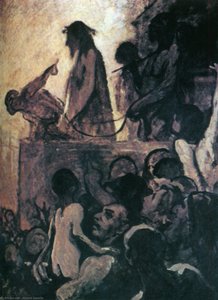 Nous voulons Barabbas (Ecce Homo)1852
 The Third-class Carriage1860
 Unknown, maybe Hippolyte Lucien-Joseph Lucas (1807-1878), a Journalist, maybe P.Mendez de Vigo (1790-1860) a Spanish General, but Most Probably the Count Pelet de la Lozere (1785-1871), a Politician1833
 Ratapoil (front view)1850

Esszék a The Reader körül
 The Art of the Gaze: A Collector's Guide to Mastering Portrait Composition and Emotional DepthMaster the nuances of portrait composition with our expert guide for collectors. Discover how light, gaze, and texture create emotional dep…
 Spontaneity and Matter: Distinguishing CoBrA from Art InformelMaster the differences between CoBrA and Art Informel with our expert guide. Learn to identify these post-war movements today.
 Ink and Light: How Impressionist Painters Captured the Act of ReadingExplore how masters like Renoir and Vermeer captured the intimacy of reading. Discover the profound link between literature and fine art.