Váltás nyomtatványra
 Összes részlet megjelenítése







































 A bármely oldalsó méretét túlszálaló 105 cm (kb. 41 hüvelyk) meghaladó műalkotások vagy reprodukciók esetében a keret összeszerelhető készletként, szétszerelve kerül szállításra. Ez a módszer biztosítja a biztonságos szállítást, és megakadályozza a szállítás során fellépő sérüléseket.


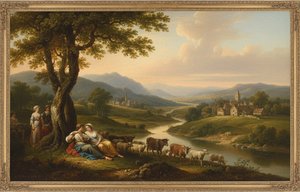
David Cox’s Pastoral Vision: Landscape with Sheep
David Cox's "Landscape with Flock of Sheep" stands as a quintessential example of Romantic landscape painting—a genre deeply rooted in the burgeoning fascination with nature and emotion that characterized the early 19th century. Executed around 1830, this oil on canvas captures a serene tableau of rural England, transporting viewers to a tranquil hillside scene bathed in diffused sunlight. The artwork’s enduring appeal lies not merely in its picturesque beauty but also in its masterful depiction of mood and atmosphere—a testament to Cox's distinctive artistic approach.Composition & Technique: Embracing Impressionistic Brushstrokes
Cox skillfully employs a balanced compositional arrangement, placing the shepherd and his flock slightly off-center within the expansive vista. This subtle asymmetry draws the eye across the canvas, guiding it into the distant rolling hills and hazy sky—elements that contribute significantly to the painting’s sense of depth and perspective. The artist's technique is characterized by loose, expressive brushstrokes—a hallmark of Cox’s style and a deliberate departure from academic conventions. Visible pigment particles dance across the surface, simulating grass textures and foliage, creating an impressionistic effect that prioritizes capturing fleeting moments of light and color. Layers of paint build up to produce soft transitions between hues, enhancing the overall luminescence and conveying a palpable feeling of freshness.Historical Context & Romantic Ideals
“Landscape with Flock of Sheep” emerged during the Romantic period—a movement that championed imagination, emotion, and individualism as responses to Enlightenment rationalism. Artists like Cox sought inspiration in untamed wildernesses, portraying them not just as objects of observation but as conduits for spiritual experience. The painting reflects Romantic ideals of sublime beauty—the awe-inspiring grandeur of nature perceived as both powerful and benevolent. Cox’s depiction aligns with the broader Romantic preoccupation with capturing the emotional resonance of landscapes, mirroring the movement's belief in art's ability to elevate the human spirit.Symbolism & Emotional Resonance: Harmony and Nostalgia
Beyond its visual splendor, “Landscape with Flock of Sheep” carries symbolic weight. The shepherd represents pastoral virtue—a connection to the land and a reverence for simple rural life—values central to Romantic thought. The flock embodies fertility and abundance, symbolizing prosperity and contentment. Cox’s muted color palette—dominated by greens, browns, and blues—creates an atmosphere of tranquility and serenity. The diffused lighting evokes a hazy afternoon sun, fostering a mood of nostalgia for an idealized past—a sentiment deeply ingrained in the Romantic sensibility. Ultimately, the artwork invites contemplation on humanity's relationship with nature and its capacity to inspire feelings of peace and wonder.A Legacy of Impressionistic Beauty
David Cox’s “Landscape with Flock of Sheep” remains a celebrated masterpiece of Romantic landscape painting. Its innovative technique—characterized by loose brushstrokes and luminous color—established Cox as a pioneer of Impressionism, influencing subsequent generations of artists. Today, reproductions of this evocative artwork continue to captivate audiences worldwide, serving as reminders of the enduring power of art to convey emotion and capture the sublime beauty of the natural world.Kérdések és válaszok
Ki a "Landscape with Sheep" mögött álló művész?
A "Landscape with Sheep" alkotója David Cox. A mű David Cox nevére van katalógusozva.
Melyik szín tűnik ki leginkább a(z) "Landscape with Sheep" alkotásból?
A(z) Clay (#866e45) a(z) „Landscape with Sheep”, David Cox alkotása domináns színe.
Mennyire fényes „Landscape with Sheep”, David Cox alkotása?
A „Landscape with Sheep”, David Cox alkotása alkotás Bright Balance fényerőséggel rendelkezik. A fényerő azt mutatja meg, hogy a színek mennyire tűnnek visszafényesnek.
Több információ erről a festményről
 Megtekintés
 Küldés
 Megosztás
 Részletek
 Útmutató

 Letöltés
 Hasonló darabok
 X-ray felvétel
 Diavetítés
 Kérdések és válaszok
 Statisztika