Wifredo Lam: a művész portréja
Wifredo Lam – A Crossroads of Cultures: The Life and Art of Wifredo Lam
Wifredo Óscar de la Concepción Lam y Castilla, known simply as Wifredo Lam, was a painter who embodied the complexities of cultural identity in the 20th century. Born in Sagua La Grande, Cuba, in 1902, his very lineage spoke to the island’s layered history – a father descended from Chinese immigrants and a mother tracing her roots back to Spanish conquistadors and enslaved Africans. This multicultural heritage wasn't merely biographical detail; it became the wellspring of his artistic vision, fueling a unique style that fused European modernism with Afro-Cuban spirituality and symbolism. Lam’s early life was marked by an initial pursuit of law in Havana, but even amidst legal studies, he found himself drawn to the natural world, spending time at the botanical gardens – a foreshadowing of the organic forms that would later dominate his canvases. Formal artistic training followed at the Escuela de Bellas Artes in Havana and then in Madrid under Fernando Álvarez de Sotomayor y Zaragoza, where he absorbed traditional techniques while simultaneously beginning to question their limitations.
Early Life and Influences
Wifredo Lam’s formative years were shaped by a profound encounter with his family’s heritage. His father, Enrique Lam-Yam, was a Chinese immigrant from Canton (Guangdong province) who arrived in Cuba as part of the late-19th-century wave of Chinese laborers and merchants. Lam’s mother, Ana Serafina Catilla, descended from both Spanish conquistadors and enslaved Africans—a lineage that instilled within him an awareness of Cuba’s colonial past and its enduring legacy of racial inequality. From a young age, Lam was surrounded by the vibrant culture of Sagua La Grande, where he witnessed firsthand the traditions of Afro-Cuban religion, particularly Santería. This exposure to ritual ceremonies and spiritual practices profoundly influenced his artistic sensibility, fostering an interest in symbolism and allegory that would permeate his oeuvre throughout his life. His fascination with Goya’s unflinching depictions of social injustice—particularly *The Third of May 1808*—served as a catalyst for his own artistic explorations, prompting him to confront pressing political issues through visual language.
Formal artistic training commenced at the Escuela de Bellas Artes in Havana and subsequently at the Academy of Fine Arts in Madrid under Fernando Álvarez de Sotomayor y Zaragoza. During his time in Madrid, Lam absorbed traditional techniques while simultaneously challenging their conventions—a characteristic that would define his approach to art for decades to come. He was particularly captivated by the fantastical worlds envisioned by Hieronymus Bosch and Pieter Bruegel the Elder, artists who dared to populate their paintings with grotesque figures and unsettling narratives—influences that would contribute significantly to Lam’s distinctive visual style. These early encounters instilled a deep appreciation for symbolism and allegory, shaping his artistic vision and informing his subsequent explorations of cultural identity.
European Encounters and Artistic Transformation
Lam’s time in Spain proved transformative, propelling him toward the vanguard of European modernism. He spent countless hours studying the masterpieces housed within the Prado Museum—particularly Velázquez’s portraits and Goya’s dramatic landscapes—absorbing stylistic innovations that would reshape his artistic practice. His engagement with Picasso was decisive; the two artists forged a lifelong friendship during Lam’s stay in Madrid, fostering intellectual exchange and inspiring mutual admiration. Picasso introduced Lam to fellow avant-garde luminaries—Joan Miró, André Breton, Henri Matisse, Óscar Domínguez—creating a fertile environment for experimentation and artistic dialogue. This period witnessed Lam's embrace of Cubist principles, as he sought to dismantle traditional perspectival conventions and represent objects from multiple viewpoints simultaneously—a stylistic choice that would become synonymous with his artistic signature. Simultaneously, Lam was drawn to Surrealism’s exploration of the subconscious mind and its rejection of rational thought—influences that would manifest in his dreamlike imagery and fragmented compositions.
The Birth of a Unique Style: Hybrid Figures and Afro-Cuban Symbolism
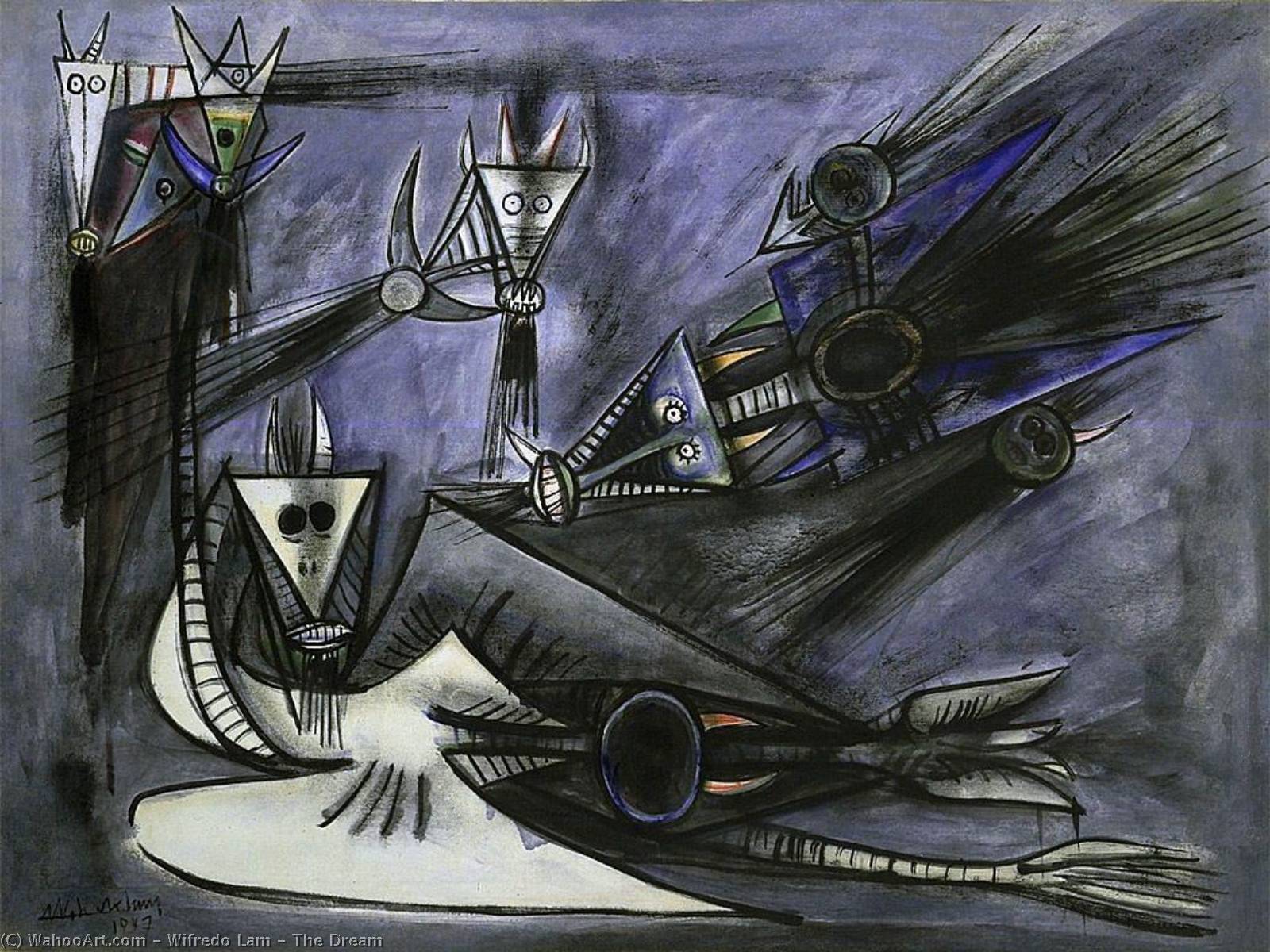
Lam's artistic breakthrough occurred during his relocation to Paris in 1938, coinciding with the onset of World War II. There he encountered the epicenter of Surrealist creativity—André Breton’s Villa Air Bel—where he connected with fellow artists and writers who championed radical experimentation and challenged conventional aesthetic standards. He participated in collaborative projects such as *Cadavre Exquis*, a game designed to liberate the unconscious mind from conscious control—a practice that solidified his commitment to Surrealist principles. His artistic exploration was further enriched by encounters with Pablo Picasso, Diego Rivera, and Federico García Lorca—artists who shared Lam’s conviction that art could serve as a vehicle for social critique and cultural transformation. During this period, Lam developed his distinctive visual language—characterized by hybrid figures—drawing inspiration from both European modernism and Afro-Cuban spirituality. These figures blended human, animal, and vegetal forms in unsettling juxtapositions—a stylistic choice that reflected Lam’s fascination with Santería rituals and the symbolism of Yoruba deities. The monumental painting *La Jungla* (1943), arguably his magnum opus, exemplifies this artistic vision—representing a complex allegory of colonial oppression interwoven with vibrant depictions of Cuban flora and fauna. It stands as a testament to Lam's ability to synthesize disparate influences into a singular aesthetic expression.
## Legacy and Recognition
Wifredo Lam’s artistic legacy extends far beyond the canvases he created during his lifetime. He championed the cause of cultural liberation—challenging colonial narratives and advocating for the recognition of Afro-Cuban identity—a stance that resonated deeply with artists and intellectuals across continents. His work continues to inspire generations of creatives who seek to explore themes of social justice, spirituality, and resistance—solidifying Lam’s place as one of the most influential figures in 20th-century art history. He remains a beacon of artistic innovation and cultural dialogue—a testament to the transformative power of art to transcend boundaries and illuminate the complexities of human experience.