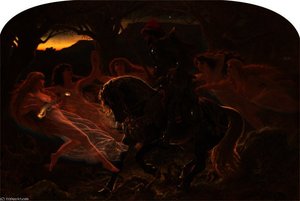
Joseph Noel Paton portréja

A 45 legnevezesebb Joseph Noel Paton festmény, egy galériaválaszték

Frissítve: november 2026 · rangsorolva népszerűségi pontszámunk alapján (minden mű keresései, látogatásai és megrendelései alapján) · 46 mű Joseph Noel Paton alkotása a katalógusunkban

Röviden

Joseph Noel Paton hagyatékából a leghíresebb alkotás Hesperus, the Evening Star, Sacred to Lovers (1857). Röviddel ezután követik őket Puck and Fairies, from "A Midsummer Night's Dream" (1850) és Michelangelo's dream. Katalógusunkban 46 mű található Joseph Noel Paton alkotótól; a galéria megőrizte a világ által leginkább csodált 45 darabot, melyeket a dátummal, a múzeummal és a történetükkel együtt mutatunk be.

1821 – 1901, Dunfermline Pre-raphaelite A legtöbb mű: Scottish National Gallery

Joseph Noel Paton legjobb 10 festménye: a galéria válogatása

1
Hesperus, the Evening Star, Sacred to Lovers (1857) (1889) -ja Joseph Noel Paton

Hesperus, the Evening Star, Sacred to Lovers

1857 · Oil On Board

A man kneels before a woman in a secluded natural setting, their figures framed by the dense foliage of trees. He holds her hands in a gesture of devotion, his gaze fixed upon her as she looks down at him. The scene is quiet, set within a clearing where the soft light of the evening begins to settle. A single star hangs in the sky above them, casting a subtle…

2
Puck and Fairies, from "A Midsummer Night's Dream" (1850) (1889) -ja Joseph Noel Paton

Puck and Fairies, from "A Midsummer Night's Dream"

1850 · Oil On Board · Yale Center for British Art, New Haven

The forest breathes with a secret life as the moonlight filters through a dense canopy of tangled vegetation. In this intimate clearing, the air feels heavy with the scent of damp earth and the hum of unseen magic. Puck leans over the scene from the upper right, his large, rounded form casting a watchful presence over the delicate gathering below. The sprites move with a fluid, organic grace, their soft…

3
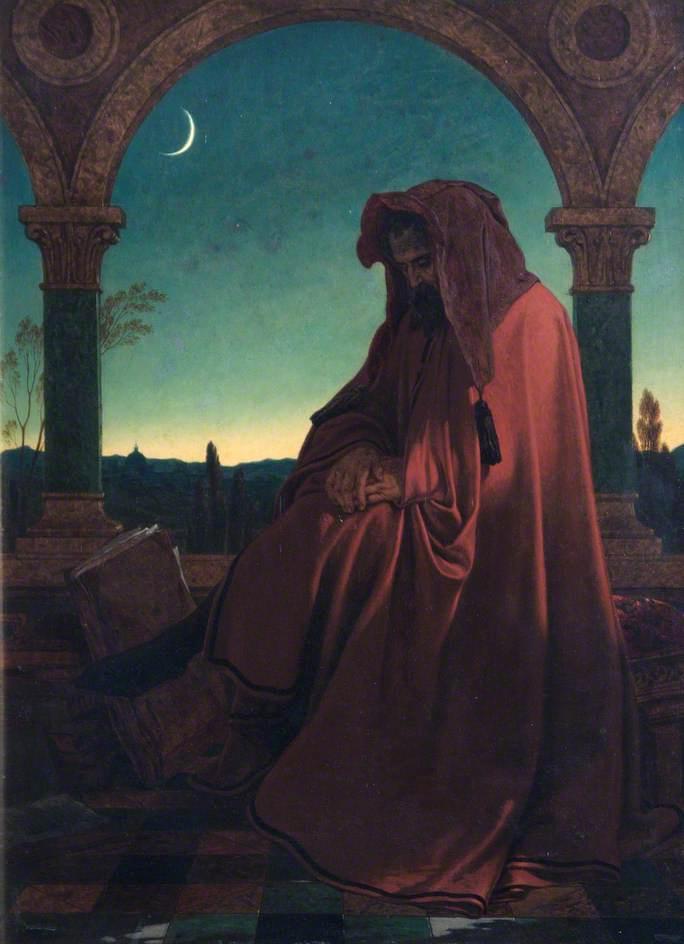
Michelangelo's dream (1889) -ja Joseph Noel Paton

Michelangelo's dream

Oil On Canvas

The artwork presents a dramatic portrait of a figure draped in a deep red robe, positioned within an archway formed by classical columns. This central figure dominates the vertically oriented composition, creating a sense of enclosure. Through the arch, a landscape is visible, featuring a crescent moon and a distant horizon line suggesting twilight or dawn. The scene is characterized by a strong use of chiaroscuro, with a single light…

4
In Memoriam (1863) (1889) -ja Joseph Noel Paton

In Memoriam

1863 · Watercolor · Royal Collection, London

The scene unfolds within the delicate, translucent layers of In Memoriam, a poignant watercolor or gouache study by the Scottish artist Joseph Noel Paton. Created in 1863, this work captures a quiet, spectral moment where the boundaries between the physical and the spiritual begin to dissolve. The paper holds a vision of memory, rendered with a softness that suggests the fleeting nature of life itself.

5
The Man with the Muck Rake (study) (1872) (1889) -ja Joseph Noel Paton

The Man with the Muck Rake (study)

1872 · Oil

The Man with the Muck Rake (study) emerges from the brush of Joseph Noel Paton, a man whose hands were shaped by the intricate patterns of the Scottish textile industry. Born in 1821 in Dunfermline, United Kingdom, Paton carries the precision of a weaver into his work as an artist, illustrator, and sculptor. This particular piece, dating to 1872, captures a moment of intense spiritual or moral focus. It exists…

7
The choice (1889) -ja Joseph Noel Paton

The choice

In "The choice" by Joseph Noel Paton, a heavy tension hangs in the air, freezing a moment of profound conflict. Three figures dressed in medieval clothing occupy the center of the scene, their bodies angled toward one another in a struggle of words or wills. On the left, a man clad in armor stands as a rigid presence, his metallic attire catching the light amidst the unfolding drama. The others…

8
Oskold and the Elle Maids (1889) -ja Joseph Noel Paton

Oskold and the Elle Maids

Oil

A man sits atop a horse, a solitary figure amidst a sudden surge of movement. Around him, the forest breathes with the presence of the Elle Maids. These women, appearing as nymphs or fairies, drift through the shadows and the light, their forms scattered like fallen petals across the woodland floor. Some linger in the foreground, their presence felt in the immediate air, while others recede into the deep green…

9
The Reconciliation of Oberon and Titania (1889) -ja Joseph Noel Paton

The Reconciliation of Oberon and Titania

Oil On Canvas · Scottish National Gallery, Edinburgh

The Reconciliation of Oberon and Titania emerges from the shadows of a Scottish forest, a scene where magic and emotion collide. Painted in 1847, this oil on canvas work by Sir Joseph Noel Paton captures a moment of profound transition. The air feels heavy with the aftermath of a great dispute, as the fairy rulers move toward a delicate peace. It is a sequel to a previous quarrel, a continuation…

10
Michelangelo's Dream (1889) -ja Joseph Noel Paton

Michelangelo's Dream

Oil On Canvas

Michelangelo's Dream is an artwork by Joseph Noel Paton. Created during the 19th Century, the piece belongs to the Romanticism movement. The work reflects the era's preoccupation with the intersection of the tangible and the imagined.

A Joseph Noel Paton válogatás folytatódik: 11 – 45

A témák, amelyek Joseph Noel Paton figyelmét meghúzták

A négy leggyakorobban előforduló téma ebben az eredeti művekben, mindegyik a legkiválóbb példájával.

A műemlékek, amelyek Joseph Noel Paton eredeti műveit őrzik

A 6 olyan múzeum, amely a legtöbb ezen az oldalon szereplő festményet őrzi.

Múzeum Város Joseph Noel Paton művei Ebből a listából származó festmények
Scottish National Gallery, EdinburghScottish National Gallery Edinburgh 3 The Reconciliation of Oberon and Titania, Dawn - Luther at Erfurt, The Quarrel of Oberon and Titania
Royal Collection, LondonRoyal Collection London 2 In Memoriam, 'Home': The Return from the Crimea
Yale Center for British Art, New HavenYale Center for British Art New Haven 1 Puck and Fairies, from "A Midsummer Night's Dream"
Laing Art Gallery, New South WalesLaing Art Gallery New South Wales 1 The Man of Sorrows
Sheffield City Art Galleries, SheffieldSheffield City Art Galleries Sheffield 1 The Fairy Queen
Musée de Grenoble, GrenobleMusée de Grenoble Grenoble 1 Beati mundo corde

Joseph Noel Paton évtizede folgtva: az eredeti művek, amelyek meghatározzák az egyes korzakot

Művek évtizedenként

Váassz ki egy évtizedet, hogy megnézhesd az azt meghatározó eredetiműveket.

Gyűjtői kérdések Joseph Noel Paton festményeivel kapcsolatban

Melyik művel a(z) Joseph Noel Paton a leghíresebb?Fedje fel a választ

Hesperus, the Evening Star, Sacred to Lovers (1857). Ezt követi Puck and Fairies, from "A Midsummer Night's Dream" (1850) és Michelangelo's dream.

Hány éves volt Joseph Noel Paton, amikor a Hesperus, the Evening Star, Sacred to Lovers készült?Fedje fel a választ

36 éves: Hesperus, the Evening Star, Sacred to Lovers 1857-ből származik, Joseph Noel Paton pedig 1821-ben született.

Melyek a tíz leghíresebb Joseph Noel Paton festmény?Fedje fel a választ

Hesperus, the Evening Star, Sacred to Lovers, Puck and Fairies, from "A Midsummer Night's Dream", Michelangelo's dream, In Memoriam, The Man with the Muck Rake (study), Michelangelo Sculpting the Statue of 'Night', The choice, Oskold and the Elle Maids, The Reconciliation of Oberon and Titania és Michelangelo's Dream. A fenti rangsor a művek évszamarát és a múzeumát jelzi.

Hány festményet hagyott hátra Joseph Noel Paton?Fedje fel a választ

Katalógusunkban 46 mű található Joseph Noel Paton alkotótól, 1849 és 1875 év közötti időszakból.

Mely múzeumokban állnak Joseph Noel Paton remekművei?Fedje fel a választ

Leginkább Scottish National Gallery (Edinburgh), Royal Collection (London) és Yale Center for British Art (New Haven) található. A fenti múzeumi táblázatban mindegyik felsorolásra került.

Mely években festette Joseph Noel Paton leghíresebb műveit?Fedje fel a választ

1850s alatt: a jelen laphonon található 45 műből 4 készült ebben az időszakban, köztük Hesperus, the Evening Star, Sacred to Lovers.

Mikszétek az első és az utolsó híres eredeti műve a(z) Joseph Noel Paton alkotótól?Fedje fel a választ

Ezen az oldalon a leghitelesebb The Quarrel of Oberon and Titania (1849), a legutóbbi pedig The Man of Sorrows (1875).

Milyen témaköröket választott leggyakrabban Joseph Noel Paton?Fedje fel a választ

Man (7), Forest (7) és Woman (6), a jelen oldalon található 45 műművészeti alkotás között.

Melyik technikát alkalmazta leggyakrabban Joseph Noel Paton?Fedje fel a választ

Oil On Canvas, a jelen oldalon található 45 műből 6 darab esetén.

Mely művészeti irányba tartozik Joseph Noel Paton?Fedje fel a választ

Pre-raphaelite és Romanticism, ezen az oldalon található eredetiek alapján.

Mely Joseph Noel Paton művei láthatóak a Scottish National Gallery kiállتításán?Fedje fel a választ

The Reconciliation of Oberon and Titania, Dawn - Luther at Erfurt és The Quarrel of Oberon and Titania: a Scottish National Gallery, Edinburgh 3 művet őrzi ezen az oldalon.

Joseph Noel Paton: életmű és életút

A Scottish Visionary: The Life and Art of Sir Joseph Noel Paton

Sir Joseph Noel Paton, a name synonymous with evocative fairy paintings, allegorical scenes brimming with moral depth, and profound religious depictions—all deeply rooted in the rich tapestry of Scottish folklore and Pre-Raphaelite influences—emerged as a singular voice within the Victorian art world. Born in Dunfermline, Fife, on December 13, 1821, into a family steeped in the traditions of damask weaving, Paton’s early life was inextricably linked to intricate patterns and meticulous craftsmanship – an influence that would profoundly shape his artistic sensibility. His parents, skilled designers and weavers themselves, instilled within him not just an appreciation for detail but also a deep respect for the power of visual storytelling. Initially involved in the family business, directing design at a muslin factory, Paton’s true passion lay elsewhere: a fervent desire to capture the magic and mystery of the world around him through art.

Early Influences and Artistic Training

Paton's artistic journey began with a brief period of study at Dunfermline Art Academy, providing him with foundational skills in drawing and composition. However, his exposure to the wider artistic landscape was significantly broadened by an invitation from John Everett Millais, a fellow student at the Royal Academy in London in 1843. This encounter proved pivotal, exposing Paton to the prevailing currents of the Pre-Raphaelite Brotherhood – a movement characterized by its commitment to meticulous detail, vibrant colors, and a renewed interest in medieval and Renaissance art. While he ultimately declined formal membership within the Brotherhood, the influence of this group is undeniably evident in his early works, particularly his celebrated “Quarrel of Oberon and Titania” (1847), now a cornerstone of the National Gallery of Scotland’s collection. This painting, inspired by Shakespeare's *A Midsummer Night’s Dream*, immediately established Paton’s reputation for capturing fantastical scenes with remarkable realism – not merely depicting fairies, but portraying their passions, conflicts, and vulnerabilities with startling psychological depth.

Weaving Myth and Morality: The Development of a Unique Style

Paton’s artistic journey was characterized by an extraordinary synthesis of diverse influences. He wasn't simply illustrating tales; he was breathing life into them with meticulous detail and emotional depth. His early works, such as “The Quarrel of Oberon and Titania,” showcased not only technical skill but also his ability to imbue mythological subjects with psychological complexity. Beyond the realm of folklore, Paton explored religious themes with equal fervor, as evidenced in works like “Luther discovering justification by faith.” He wasn’t merely recreating stories; he was using them as vehicles for exploring universal human experiences – questions of faith, morality, and the very nature of existence. This synthesis of influences—Celtic legends, biblical narratives, and Victorian sensibilities—resulted in a uniquely personal artistic style that set him apart from his contemporaries. His paintings are not just visually stunning but also intellectually stimulating, inviting viewers to contemplate profound questions about faith, morality, and the human condition.

Major Works and Royal Recognition

Throughout his career, Paton produced a remarkable body of work, ranging from elaborate fairy scenes to powerful allegorical compositions and deeply moving religious depictions. “Puck and Fairies” (1857), another iconic image in the National Gallery of Scotland’s collection, exemplifies his mastery of capturing the ethereal beauty and mischievous spirit of the fairy world. “In Memoriam” (1858), a poignant tribute to British women lost during the Indian Mutiny, demonstrated his ability to convey complex emotions through carefully orchestrated imagery. In 1866, Queen Victoria recognized Paton’s exceptional talent by appointing him Her Majesty's Linmer for Scotland – a prestigious honor that solidified his position as the foremost artist in the country. Two years later, he was knighted, a testament to his significant contributions to Scottish art and culture. His work continued to be exhibited and reproduced widely, cementing his place in Victorian artistic history.

Themes, Symbolism, and Lasting Legacy

Paton’s works are deeply imbued with symbolism, reflecting both personal beliefs and the broader cultural anxieties of the Victorian era. His fascination with Celtic mythology speaks to a growing interest in national identity and folklore during this period. The fairy paintings, while seemingly whimsical, often carry underlying moral messages about temptation, innocence, and the dangers of unchecked desire. Religious works, such as those depicting scenes from the life of Martin Luther, explore themes of faith, redemption, and the struggle against oppression. His meticulous attention to detail—evident in the intricate costumes, landscapes, and facial expressions—adds layers of meaning to his compositions. The use of dramatic lighting and rich color palettes enhances the emotional impact of his paintings. Paton’s ability to create believable yet otherworldly scenes set him apart from many of his contemporaries. He wasn't simply recreating stories; he was using them as vehicles for exploring universal human experiences. Sir Joseph Noel Paton passed away on December 26, 1901, leaving behind a rich artistic legacy that continues to captivate audiences today. His works can be found in prominent museums and collections, ensuring his art remains accessible for generations to come.