Johann Liss portréja

A 31 legnevesebbebb Johann Liss festmény, mindegyik egyedistens

Frissítve: november 2026 · rangsorolva népszerűségi pontszámunk alapján (minden mű keresései, látogatásai és megrendelései alapján) · 33 mű Johann Liss alkotása a katalógusunkban

Röviden

Nymph and Shepherd (1625) az a Johann Liss festmény, amely a legtöbb tekintetet felvonja; az eredeti mű a Metropolitan Művészeti Múzeum gyűjteményében található, New York. Ezután a tekintet Temptation of Saint Anthony (1614) és The Apostle Paul (1614) elemre irányul. A Johann Liss 33 műve közül a katalógusunkban megtalálható 31 legnépesebb alkotás, melyeket az év, a múzeum és az örökévalóságának okai kísérnek.

1597 – 1629, Oldenburg in Holstein Baroque A legtöbb mű: Bavári Állami Festırménygyűjtemények

A galéria szemével: Johann Liss legjobb 10 festménye

1
Nymph and Shepherd (1625) (1889) -ja Johann Liss

Nymph and Shepherd

1625 · Oil On Canvas · Metropolitan Művészeti Múzeum, New York

Deep within a dense, shadowy woodland, a quiet drama unfolds under the weight of heavy leaves and twisting branches. A nymph lies reclined, her pale skin catching a soft, directional light that cuts through the gloom of the forest. She rests in a state of deep repose, unaware of the gaze directed toward her. From behind the rugged bark of a tree, a muscular shepherd leans into the frame. He…

3
The Apostle Paul (1614) (1889) -ja Johann Liss

The Apostle Paul

1614 · Oil On Canvas · Bavári Állami Festırménygyűjtemények, Munchen

The Apostle Paul emerges from the shadows of history in this striking portrait by Johann Liss. Created about 1614, the work captures a moment of profound spiritual intensity. The subject is an elderly man, his features weathered by time and his spirit ignited by divine inspiration. He is identified as the Apostle Paul, a figure of immense weight in religious tradition, appearing here with a sense of urgent, living presence.

4
Curse of Cain (1615) (1889) -ja Johann Liss

Curse of Cain

1615 · Oil On Canvas

In "Curse of Cain" by Johann Liss, a diagonal tension pulls the eye upward. The composition begins with a muscular figure in the foreground, anchored in shadow. From this heavy base, the gaze climbs through a turbulent sky toward a celestial presence hidden within the clouds. This movement follows a low-angle perspective, forcing the viewer to look up at the unfolding drama of divine judgment and human suffering. The scene…

5
A Game of Morra (1620) (1889) -ja Johann Liss

A Game of Morra

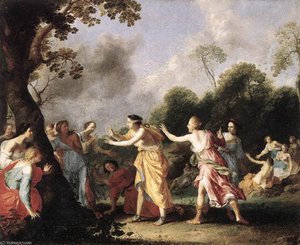
The scene unfolds in A Game of Morra, a painting by the German Baroque artist Johann Liss. This genre art piece captures a spirited moment of human interaction, pulling the viewer into a lively social encounter. The figures gather under a rustic pergola, their gestures and expressions suggesting the tension and play of the game itself. It is a moment frozen in time, where the energy of the group seems…

7
Sleeping Nymph (1620) (1889) -ja Johann Liss

Sleeping Nymph

1620 · Oil On Canvas · Statens Museum for Kunst, Koppenhága

A pale, luminous figure lies amidst the dark textures of a cavernous landscape. This reclining nude female rests upon a bed of grass and white drapery, her body catching a soft, directional light that pulls her from the surrounding gloom. She faces away, her posture relaxed and heavy with sleep. Around her, the world is composed of craggy, dark rocky masses and deep, earthy tones of ochre and brown. The…

8
The prodigal son at the prostitutes (1622) (1889) -ja Johann Liss

The prodigal son at the prostitutes

1622 · Oil · Germanisches Nationalmuseum, Nürnberg

In this dramatic oil painting from 1622, we find ourselves drawn into a nocturnal scene of revelry and debauchery. The composition is dense, creating a sense of chaotic movement within a shallow, stage-like space. A group of figures is caught in a moment of intense social interaction, their lives seemingly consumed by the immediate demands of drinking and carnal pleasure. The subject matter draws from the biblical narrative of the…

9
Cupid (Amor) (1630) (1889) -ja Johann Liss

Cupid (Amor)

1630 · Oil On Canvas · Cleveland Museum of Art, Cleveland

A youthful figure emerges from a heavy, dark void. This is Cupid, the god of desire, caught in a moment of quiet tension. His skin possesses a luminous, fleshy quality that seems to hold its own light against the surrounding gloom. He holds a single arrow diagonally across his chest, a sharp instrument of fate held with a soft, unstudied grace. The composition pulls the viewer into an intimate space,…

10
Temptation of  Saint Anthony (1624) (1889) -ja Johann Liss

Temptation of Saint Anthony

1624 · Oil On Copper · Bavári Állami Festırménygyűjtemények, Munchen

The painting presents a tight, triangular arrangement of figures that creates a sense of intimacy and tension. A seated saint occupies the center of the frame, his form illuminated by a strong directional light source from the upper left. This light falls upon his face and a golden bowl held by an approaching woman, leaving the background in deep shadow. The woman is draped in crimson fabric, which provides a…

Johann Liss híres festményei, 11 és 31 között

Johann Liss híres festményei, korszakonként

A témák, amelyek Johann Liss figyelmét meghúzták

A négy leggyakorobban előforduló téma ebben az eredeti művekben, mindegyik a legkiválóbb példájával.

A műemlékek, amelyek Johann Liss eredeti műveit őrzik

A 8 olyan múzeum, amely a legtöbb ezen az oldalon szereplő festményet őrzi.

Múzeum Város Johann Liss művei Ebből a listából származó festmények
Bavári Állami Festırménygyűjtemények, MunchenBavári Állami Festırménygyűjtemények Munchen 4 Temptation of Saint Anthony, The Apostle Paul, Temptation of Saint Anthony
Gallerie dell'Accademia di Venezia, VelenceGallerie dell'Accademia di Venezia Velence 3 Adam and Eve Mourning for Abel, Izák áldozat, Apollo and Marsyas
Metropolitan Művészeti Múzeum, New YorkMetropolitan Művészeti Múzeum New York 2 Nymph and Shepherd, Untitled (D2X6GG)
Statens Museum for Kunst, KoppenhágaStatens Museum for Kunst Koppenhága 2 Sleeping Nymph, Franciscan Monk
National Gallery, LondonNational Gallery London 2 Judith in the Tent of Holofernes, The Fall of Phaeton
Gemäldegalerie Alte Meister im Schloss Wilhelmshöhe, KasselGemäldegalerie Alte Meister im Schloss Wilhelmshöhe Kassel 1 A Game of Morra
Szépművészeti Múzeum, BudapestSzépművészeti Múzeum Budapest 1 Village Wedding Procession
Germanisches Nationalmuseum, NürnbergGermanisches Nationalmuseum Nürnberg 1 The prodigal son at the prostitutes

Johann Liss évtizedek folyamán: az egyedi eredetiek

15 év különbség van Johann Liss itt látható első és utolsó dátumú eredeti művei között, 1614 és 1628: az egyes éveknek a következő sorrendben van helye.

Művek évszáma szerint

Váasszon egy évet az eredetiek megtekintéséhez.

Johann Liss festményei: kérdések a galériának

Mi a leghíresebb műve Johann Lissnek?Fedje fel a választ

Nymph and Shepherd (1625), Metropolitan Művészeti Múzeum, New York. Ezután Temptation of Saint Anthony (1614) és The Apostle Paul (1614) következik.

Milyen életkorában alkotta meg Johann Liss a(z) Nymph and Shepherd műszt?Fedje fel a választ

28 éves: Nymph and Shepherd 1625-ből származik, Johann Liss pedig 1597-ben született.

Melyik tíz festménye Johann Liss a leghíresebb?Fedje fel a választ

Nymph and Shepherd, Temptation of Saint Anthony, The Apostle Paul, Curse of Cain, A Game of Morra, Village Wedding Procession, Sleeping Nymph, The prodigal son at the prostitutes, Cupid (Amor) és Temptation of Saint Anthony. A fenti rangsor a művek évszamarát és a múzeumát jelzi.

Hány mű alkotása ismert Johann Liss nevében?Fedje fel a választ

Katalógusunkban 33 mű található Johann Liss alkotótól, 1614 és 1628 év közötti időszakból.

Hol tekinthetők meg a leghíresebb Johann Liss eredetijeit?Fedje fel a választ

Leginkább Bavári Állami Festırménygyűjtemények (Munchen), Gallerie dell'Accademia di Venezia (Velence) és Metropolitan Művészeti Múzeum (New York) található. A fenti múzeumi táblázatban mindegyik felsorolásra került.

Melyik időszakban alkotta Johann Liss a leghíresebb festményeit?Fedje fel a választ

1624 alatt: a jelen laphonon található 31 műből 4 készült ebben az időszakban, köztük Temptation of Saint Anthony.

Melyik híres Johann Liss festmény a legkorábbi, és melyik a legutóbb készült?Fedje fel a választ

Ezen az oldalon a leghitelesebb Temptation of Saint Anthony (1614), a legutóbbi pedig The Ecstasy of St Paul (1628).

Milyen témakörket kedvelt Johann Liss?Fedje fel a választ

Man (10), Woman (9) és People (7), a jelen oldalon található 31 műművészeti alkotás között.

Milyen anyagokkal festett leggyakrabban Johann Liss?Fedje fel a választ

Oil On Canvas, a jelen oldalon található 31 műből 14 darab esetén.

Mely művészeti irányba tartozik Johann Liss műve?Fedje fel a választ

Baroque, ezen az oldalon található eredetiek alapján.

Milyen Johann Liss eredeti műveket láthatok a Bavári Állami Festırménygyűjtemények kiállításaiban?Fedje fel a választ

Temptation of Saint Anthony, The Apostle Paul és Temptation of Saint Anthony: a Bavári Állami Festırménygyűjtemények, Munchen 4 művet őrzi ezen az oldalon.

Johann Liss: a művész portréja

A Master of the Baroque Spirit

Johann Liss, also known as Jan Lys, stands as a luminous figure within the 17th-century German Baroque movement, a painter whose journey through Europe mirrored the vibrant, shifting currents of his era. Born in Schleswig-Holstein, Germany, specifically in Oldenburg, Liss’s early life was shaped by the rigorous artistic traditions of his home state. His path as an artist was one of constant motion and profound transformation, as he moved from the northern reaches of Germany to the great artistic hubs of the continent. Through his studies with Hendrick Goltzius in Haarlem and Amsterdam, he absorbed the technical mastery of the Dutch tradition before embarking on a travels that would eventually lead him through Paris and into the heart of Italy.

The evolution of Liss’s style is a captivating study in artistic adaptation. His early period, marked by his time in Rome around 1620–1622, reveals a deep engagement with the dramatic tension of Caravaggio. During these formative years, his canvases were defined by the stark, powerful contrasts of light and shadow, a technique that imbued his religious and mythological subjects with an immediate, visceral presence. However, as he migrated toward Venice, his palette underwent a magnificent metamorphosis. The somber depths of his Roman period gave way to a spirited treatment of the painted surface, characterized by brilliant colors and a loose, energetic brushwork that seemed to breathe with life.

Themes of Divinity and Desire

Liss possessed a rare ability to navigate the dual realms of the sacred and the profane, treating biblical narratives and classical myths with equal emotional intensity. In his religious works, such as The Sacrifice of Isaac, he utilized the Baroque aesthetic to explore profound themes of faith, obedience, and divine intervention. He often set these heavy theological moments against expansive, meticulously rendered landscapes, creating a tension between the monumental weight of the scripture and the natural world. His depictions of the divine were never merely static; they pulsed with a sense of movement and psychological depth that captured the religious fervor of the 17th century.

Conversely, his mythological works allowed for a more sensuous exploration of the human form and classical legend. In pieces like Venus and Adonis, Liss embraced a burgeoning aesthetic of beauty and desire, using oil on copper to achieve subtle tonal variations that heightened the emotional stakes of Ovidian tragedy. Whether capturing the tragic demise of Cleopatra or the divine judgment in Apollo and Marsyas, his work consistently sought to transcend simple storytelling. He looked toward the raw power of emotion, utilizing thick impasto and dynamic compositions to ensure that every mythological encounter felt both ancient and urgently alive.

Legacy and Artistic Influence

The significance of Johann Liss extends far beyond his individual canvases, as his stylistic innovations helped pave the way for future generations of painters. His later Venetian style, with its emphasis on light, color, and a certain fluid spontaneity, acted as a precursor to the Rococo movement. The energetic brushstrokes found in his work can be seen as an early influence on the great Guardi brothers, and his ability to integrate foreign influences into the Venetian tradition left a lasting mark on the Republic's artistic landscape.

His impact is most clearly felt in the lineage of 18th-century masters. The works of Sebastiano Ricci, Giovanni Battista Tiepolo, and Giovanni Piazzetta all carry echoes of the brilliance and movement that Liss pioneered. Though his life was cut short by the plague in Verona, leaving behind a legacy of both pious biblical subjects and sensuous mythological tales, he remains a vital link in the chain of Baroque excellence. He was a painter who mastered the art of transformation, turning the shadows of Rome into the radiant light of Venice.