Joaquín Sorolla portréja

A 100 legnevezesebb Joaquín Sorolla festmény, egy galériaválaszték

Frissítve: november 2026 · rangsorolva népszerűségi pontszámunk alapján (minden mű keresései, látogatásai és megrendelései alapján) · 969 mű Joaquín Sorolla alkotása a katalógusunkban

Röviden

Joaquín Sorolla hagyatékából a leghíresebb alkotás Valencia fürdőrája regnapi fényben (1908), amely a New York városi Hispanic Society Museum - Library gyűjteményében található. Röviddel ezután követik őket Én vagyok a ζωή kenyere (a következő néven is ismert: I am the Bread of Life) (1897) és The Pink robe. Katalógusunkban 969 mű található Joaquín Sorolla alkotótól; a galéria megőrizte a világ által leginkább csodált 100 darabot, melyeket a dátummal, a múzeummal és a történetükkel együtt mutatunk be.

1863 – 1923, Valencia Impressionista festészet A legtöbb mű: Hispanic Society Museum - Library

Joaquín Sorolla legjobb 10 festménye: a galéria válogatása

1
Valencia fürdőrája regnapi fényben (1908) (1889) -ja Joaquín Sorolla

Valencia fürdőrája regnapi fényben

1908 · Olajfestmény vászonon · Hispanic Society Museum - Library, New York

In the soft, burgeoning glow of a Mediterranean dawn, Joaquín Sorolla y Bastida captures more than just a landscape; he captures the very breath of life. Valencia Beach in the Morning Light, completed in 1908, stands as a breathtaking testament to Spanish Impressionism, inviting the viewer to step into a world where the boundary between sea and sky dissolves into pure luminosity. As one gazes upon this masterpiece, there is…

2
Én vagyok a ζωή kenyere (a következő néven is ismert: I am the Bread of Life) (1897) (1889) -ja Joaquín Sorolla

Én vagyok a ζωή kenyere (a következő néven is ismert: I am the Bread of Life)

1897 · Olajfestmény vászonon

Joaquín Sorolla y Bastida's "Yo soy el pan de la vida," also known as "I am the Bread of Life," is a monumental oil on canvas painting completed in 1897. Measuring an impressive 415 x 533 cm, this artwork depicts a pivotal moment from the New Testament – Jesus Christ addressing a large crowd near the Sea of Galilee. The scene is dynamic and bustling, filled with numerous figures rendered…

3
The Pink robe (1889) -ja Joaquín Sorolla

The Pink robe

Oil On Canvas

To step into the world of Joaquín Sorolla y Bastida is to step directly into the radiant warmth of a Mediterranean afternoon. His masterpiece, "The Pink Robe," transcends mere depiction; it embodies the very essence of Impressionism, capturing a moment suspended in time—a quiet dialogue between two women bathed in the golden glow of sunlight. Painted circa 1908-1909, this artwork offers an unparalleled glimpse into Sorolla's masterful vision, where light…

4
Extremadura, The Market (1917) (1889) -ja Joaquín Sorolla

Extremadura, The Market

1917 · Oil On Canvas · Hispanic Society Museum - Library, New York

In the grand tapestry of Spanish Impressionism, few works capture the pulse of a nation as vibrantly as Joaquín Sorolla y Bastida’s “Extremadura, The Market.” Completed in 1917, this monumental oil on canvas is far more than a mere depiction of commerce; it is a breathtaking window into the soul of rural Spain. As part of his celebrated Vision of Spain series, Sorolla transcends the boundaries of traditional genre painting…

5
Sétálás a part mentén (1909) (1889) -ja Joaquín Sorolla

Sétálás a part mentén

1909 · Olajfestmény vászonon · Sorolla Múzeum, Madrid

Joaquín Sorolla y Bastida 1909-es alkotása, a „Sétálás a part mentén”, nem csupán egy nyári délután ábrázolása; ez a fény, a mozgás és az élet mindennapi, múló szépségének kifinomult leleménye. A spanyol festő hatalmas művészeti sikereinek idején készült – az amerikai országban tartott ünnepélyes kiállításai után –, és ez a mű jelentős fordulópontot képvisel stílusában. Sorolla egyre inkább az impresszionista és evokációt keltő irányba mozdult, miközben megőrizte sajátos mesterségét a…

6
The Smugglers (1919) (1889) -ja Joaquín Sorolla

The Smugglers

1919 · Oil On Canvas

To gaze upon Joaquín Sorolla y Bastida’s 1919 masterpiece, "The Smugglers," is to step directly into the radiant embrace of a Spanish summer. This expansive canvas, measuring an impressive 84 x 165 cm, does far more than merely depict a coastal scene; it serves as a profound sensory experience, capturing the very soul of the Mediterranean coast near Ibiza. Sorolla, often revered as the "Master of Light," utilizes the shimmering…

7
Lighthouse walk at Biarritz (1906) (1889) -ja Joaquín Sorolla

Lighthouse walk at Biarritz

1906 · Oil On Canvas · Művészeti Múzeum, Boston, Boston

In the luminous masterpiece Lighthouse Walk at Biarritz, Joaquín Sorolla y Bastida invites us into a world where the boundaries between reality and impression dissolve into a golden haze. Completed in 1906, this breathtaking canvas is far more than a mere depiction of a seaside stroll; it is a profound celebration of the Spanish Belle Époque, captured with an unparalleled mastery of light. As we gaze upon the scene, we…

8
Clotilde on the Beach (1904) (1889) -ja Joaquín Sorolla

Clotilde on the Beach

1904 · Acrylic On Canvas · Sorolla Múzeum, Madrid

Joaquín Sorolla’s “Clotilde on the Beach,” painted in 1904, isn't merely a depiction of a seaside scene; it’s an immersion into the heart of Spanish summer – a vibrant distillation of light, color, and the quiet joy of family life. Sorolla, a master of *plein air* painting, captures a fleeting moment with breathtaking immediacy, transporting the viewer to the warm sands of Valencia's Playa de El Cabanyal. The canvas breathes…

9
Messalina in the Arms of the Gladiator (1886) (1889) -ja Joaquín Sorolla

Messalina in the Arms of the Gladiator

1886 · Oil

The ground is a bed of scattered flora and heavy silence. A woman lies motionless, her hair woven with blossoms that seem to hold the weight of her stillness. She is a pale shape against the earth, appearing either lost in a deep unconsciousness or surrendered to death. Above her, a man looms, his presence defined by the sharp edge of a knife held in his hand. The outdoor setting…

10
Study for Sad Inheritance (1899) (1889) -ja Joaquín Sorolla

Study for Sad Inheritance

1899 · Oil On Canvas

This oil painting on canvas depicts a poignant scene of disabled children wading into the Valencian sea, observed by a dark-robed monk. Rather than a scene of simple leisure, the composition carries a profound melancholy, capturing the intersection of human vulnerability and the restorative power of nature. The artwork utilizes a predominantly cool color palette dominated by blues and greens, punctuated by warmer tones in the sand and skin. Lines…

A Joaquín Sorolla válogatás folytatódik: 11 – 100

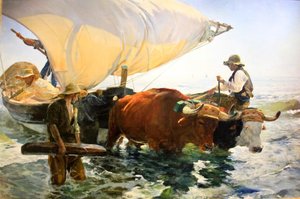
11The Cry of El Palleter (1884) (1889) -ja Joaquín SorollaThe Cry of El Palleter1884 · Palau de la Generalitat 12Promenade by the Sea (1909) (1889) -ja Joaquín SorollaPromenade by the Sea1909 13Fountain of Neptune, La Granja (1907) (1889) -ja Joaquín SorollaFountain of Neptune, La Granja1907 14Español Castilla' o 'La fiesta del pan (1913) (1889) -ja Joaquín SorollaEspañol Castilla' o 'La fiesta del pan1913 15Self-portrait (1909) (1889) -ja Joaquín SorollaSelf-portrait1909 · Sorolla Múzeum 16Reflections at the Cape, Javea (1905) (1889) -ja Joaquín SorollaReflections at the Cape, Javea1905 17Español Patio de la casa (1917) (1889) -ja Joaquín SorollaEspañol Patio de la casa1917 · Museo Carmen Thyssen 18Valencian fisherman (1897) (1889) -ja Joaquín SorollaValencian fisherman1897 19A déli álom (1911) (1889) -ja Joaquín SorollaA déli álom1911 · Sorolla Múzeum 20End of the Day, Javea (1900) (1889) -ja Joaquín SorollaEnd of the Day, Javea1900 21Landscape of San Sebastian with Mount Igueldo (1911) (1889) -ja Joaquín SorollaLandscape of San Sebastian with Mount Igueldo1911 22Rocks of the Cape, Javea (1905) (1889) -ja Joaquín SorollaRocks of the Cape, Javea1905 · Hispanic Society Museum - Library 23Segovia Family, the Suckling Child (1894) (1889) -ja Joaquín SorollaSegovia Family, the Suckling Child1894 24Carlos Urcola Ibarra and His Daughter (1914) (1889) -ja Joaquín SorollaCarlos Urcola Ibarra and His Daughter1914 25triste herencia (1889) -ja Joaquín Sorollatriste herencia 26Valencian Fisherwomen (1915) (1889) -ja Joaquín SorollaValencian Fisherwomen1915 27Hálószín (Halászati Hálókról) (1893) (1889) -ja Joaquín SorollaHálószín (Halászati Hálókról)1893 28Santiago Ramon y Cajal (1906) (1889) -ja Joaquín SorollaSantiago Ramon y Cajal1906 29After the Bath, Valencia (1889) -ja Joaquín SorollaAfter the Bath, Valencia 30Maria con mantilla (1910) (1889) -ja Joaquín SorollaMaria con mantilla1910 31Orange trees on the road to Seville (1903) (1889) -ja Joaquín SorollaOrange trees on the road to Seville1903 32Sea and rocks in San Esteban, Asturias (1903) (1889) -ja Joaquín SorollaSea and rocks in San Esteban, Asturias1903 33To the Water, Valencia (also known as Going for a Bath, Valencia) (1908) (1889) -ja Joaquín SorollaTo the Water, Valencia (also known as Going for a Bath, Valencia)1908 34Wallflowers in the Garden of the Sololla House (1918) (1889) -ja Joaquín SorollaWallflowers in the Garden of the Sololla House1918 35Looking for Crabs among the Rocks, Javea (1905) (1889) -ja Joaquín SorollaLooking for Crabs among the Rocks, Javea1905 36Spanish Fuente en un Patio sevillano Fountain in a courtyard, Seville (1915) (1889) -ja Joaquín SorollaSpanish Fuente en un Patio sevillano Fountain in a courtyard, Seville1915 37My Kids (1897) (1889) -ja Joaquín SorollaMy Kids1897 38Manuel B. Cossio (1908) (1889) -ja Joaquín SorollaManuel B. Cossio1908 39Tipos de Salamanca (1912) (1889) -ja Joaquín SorollaTipos de Salamanca1912 40A Valencian Halász (1916) (1889) -ja Joaquín SorollaA Valencian Halász1916 41The Jota (Aragon) (1914) (1889) -ja Joaquín SorollaThe Jota (Aragon)1914 · Hispanic Society Museum - Library 42Mediodia en la playa de Valencia (1904) (1889) -ja Joaquín SorollaMediodia en la playa de Valencia1904 43A stroll on the beach (1889) -ja Joaquín SorollaA stroll on the beach 44Courtyard of the Dances, Alcazar of Sevilla (1910) (1889) -ja Joaquín SorollaCourtyard of the Dances, Alcazar of Sevilla1910 · J. Paul Getty Múzeum 45Children bathing in the afternoon sun (1910) (1889) -ja Joaquín SorollaChildren bathing in the afternoon sun1910 46Gathering the Sail (1908) (1889) -ja Joaquín SorollaGathering the Sail1908 47Seascape, Ships in the Port (1881) (1889) -ja Joaquín SorollaSeascape, Ships in the Port1881 48The Painter's Studio (1888) (1889) -ja Joaquín SorollaThe Painter's Studio1888 49Clotilde in Evening Dress (1910) (1889) -ja Joaquín SorollaClotilde in Evening Dress1910 50Vuelta de la Pesca. Playa de Valencia (The Return from Fishing, Valencia Beach) (1889) -ja Joaquín SorollaVuelta de la Pesca. Playa de Valencia (The Return from Fishing, Valencia Beach) 51After a Bathe (1889) -ja Joaquín SorollaAfter a BatheHispanic Society Museum - Library 52The Two Sisters (1909) (1889) -ja Joaquín SorollaThe Two Sisters1909 · Art Institute of Chicago 53Grandmother and granddaughter of the Valley of Ansó (1911) (1889) -ja Joaquín SorollaGrandmother and granddaughter of the Valley of Ansó1911 · Sorolla Múzeum 54The Return from Fishing: Hauling the Boat (study) (1894) (1889) -ja Joaquín SorollaThe Return from Fishing: Hauling the Boat (study)1894 · Musée d'Orsay 55Fiesta Gallega (1889) -ja Joaquín SorollaFiesta Gallega 56La bendicion de Isaac (1889) -ja Joaquín SorollaLa bendicion de Isaac 57Queen Victoria Eugenia of Spain (1911) (1889) -ja Joaquín SorollaQueen Victoria Eugenia of Spain1911 · Hispanic Society Museum - Library 58At the Pool in the Artist (1898) (1889) -ja Joaquín SorollaAt the Pool in the Artist1898 · Museo de Arte de Ponce 59Elaboración de la pasa (Jávea) (1900) (1889) -ja Joaquín SorollaElaboración de la pasa (Jávea)1900 · Pushkin állami művészeti múzeum 60The Siesta (1911) (1889) -ja Joaquín SorollaThe Siesta1911 61And They Still Say Fish is Expensive (1889) -ja Joaquín SorollaAnd They Still Say Fish is Expensive 62Maria la guapa (1914) (1889) -ja Joaquín SorollaMaria la guapa1914 63Sea Idyll (1908) (1889) -ja Joaquín SorollaSea Idyll1908 · Hispanic Society Museum - Library 64The Kiss (1899) (1889) -ja Joaquín SorollaThe Kiss1899 65My Children (1904) (1889) -ja Joaquín SorollaMy Children1904 · Museo Sorolla 66Children on the Seashore (1903) (1889) -ja Joaquín SorollaChildren on the Seashore1903 · Philadelphia Művészeti Múzeum 67Maria Planas de Gil (1906) (1889) -ja Joaquín SorollaMaria Planas de Gil1906 68Mi mujer y mis hijas en el jardin (1910) (1889) -ja Joaquín SorollaMi mujer y mis hijas en el jardin1910 69Ramón Pérez de Ayala (1920) (1889) -ja Joaquín SorollaRamón Pérez de Ayala1920 · Hispanic Society Museum - Library 70Christopher Columbus Leaving Palos (1910) (1889) -ja Joaquín SorollaChristopher Columbus Leaving Palos1910 71The Return from the Fishing (1898) (1889) -ja Joaquín SorollaThe Return from the Fishing1898 · Nemzeti Szépművészeti Múzeum 72Under the awning, Zarauz (1910) (1889) -ja Joaquín SorollaUnder the awning, Zarauz1910 · Saint Louis Art Museum 73Fisherwomen (1911) (1889) -ja Joaquín SorollaFisherwomen1911 74Penitents, Holy Week, Seville (1914) (1889) -ja Joaquín SorollaPenitents, Holy Week, Seville1914 · Hispanic Society Museum - Library 75Swimmers, Jávea (1905) (1889) -ja Joaquín SorollaSwimmers, Jávea1905 · Sorolla Múzeum 76The Waves at San Sebastian (1915) (1889) -ja Joaquín SorollaThe Waves at San Sebastian1915 77Paris Boulevard (1885) (1889) -ja Joaquín SorollaParis Boulevard1885 · Sorolla Múzeum 78Joaquín (1917) (1889) -ja Joaquín SorollaJoaquín1917 · Sorolla Múzeum 79Types of Lagartera or Lagarterana bride (1912) (1889) -ja Joaquín SorollaTypes of Lagartera or Lagarterana bride1912 · Sorolla Múzeum 80La siesta (1912) (1889) -ja Joaquín SorollaLa siesta1912 81Ni ntilde os en la playa, Valencia (Children on the beach, Valencia) (1903) (1889) -ja Joaquín SorollaNi ntilde os en la playa, Valencia (Children on the beach, Valencia)1903 82Wounded foot (1909) (1889) -ja Joaquín SorollaWounded foot1909 83Seville, the Bullfighters (1915) (1889) -ja Joaquín SorollaSeville, the Bullfighters1915 · Hispanic Society Museum - Library 84Mending the Sail (1896) (1889) -ja Joaquín SorollaMending the Sail1896 85Aureliano de Beruete y Moret, Jr. (1902) (1889) -ja Joaquín SorollaAureliano de Beruete y Moret, Jr.1902 · Museo del Prado 86La vuelta de la pesca (1894) (1889) -ja Joaquín SorollaLa vuelta de la pesca1894 87Design for the decoration of the Casa Sorolla (1889) -ja Joaquín SorollaDesign for the decoration of the Casa Sorolla 88Maria in a Red Blouse (1910) (1889) -ja Joaquín SorollaMaria in a Red Blouse1910 89On the coast of Biarritz (1906) (1889) -ja Joaquín SorollaOn the coast of Biarritz1906 90On the sand, Zarauz beach (1910) (1889) -ja Joaquín SorollaOn the sand, Zarauz beach1910 · Sorolla Múzeum 91Beneath the Canopy (1889) -ja Joaquín SorollaBeneath the Canopy 92The Small cove, Javea (1898) (1889) -ja Joaquín SorollaThe Small cove, Javea1898 93untitled (2616) (1889) -ja Joaquín Sorollauntitled (2616) 94Running along the beach (1908) (1889) -ja Joaquín SorollaRunning along the beach1908 95Don Rafael Altamira y Crevea (1913) (1889) -ja Joaquín SorollaDon Rafael Altamira y Crevea1913 · Hispanic Society Museum - Library 96Elenita at the Beach, Asturias (1903) (1889) -ja Joaquín SorollaElenita at the Beach, Asturias1903 97On the Coast of Valencia (1898) (1889) -ja Joaquín SorollaOn the Coast of Valencia1898 · Nemzeti Szépművészeti Múzeum 98The Alcazar at Seville (1889) -ja Joaquín SorollaThe Alcazar at Seville 99Coast at Santa Cristina (1914) (1889) -ja Joaquín SorollaCoast at Santa Cristina1914 100Copy of (1882) (1889) -ja Joaquín SorollaCopy of1882 · Sorolla Múzeum

Joaquín Sorolla híres festményei, korszakonként

A témák, amelyek Joaquín Sorolla figyelmét meghúzták

A négy leggyakorobban előforduló téma ebben az eredeti művekben, mindegyik a legkiválóbb példájával.

A műemlékek, amelyek Joaquín Sorolla eredeti műveit őrzik

A 8 olyan múzeum, amely a legtöbb ezen az oldalon szereplő festményet őrzi.

Múzeum Város Joaquín Sorolla művei Ebből a listából származó festmények
Hispanic Society Museum - Library, New YorkHispanic Society Museum - Library New York 110 Valencia fürdőrája regnapi fényben, Extremadura, The Market, Rocks of the Cape, Javea
Sorolla Múzeum, MadridSorolla Múzeum Madrid 67 Sétálás a part mentén, Clotilde on the Beach, Self-portrait
Nemzeti Szépművészeti Múzeum, Buenos AiresNemzeti Szépművészeti Múzeum Buenos Aires 8 The Return from the Fishing, On the Coast of Valencia
Museo del Prado, MadridMuseo del Prado Madrid 8 Aureliano de Beruete y Moret, Jr.
J. Paul Getty Múzeum, Los AngelesJ. Paul Getty Múzeum Los Angeles 5 Courtyard of the Dances, Alcazar of Sevilla
Musée d'Orsay, PárizsMusée d'Orsay Párizs 4 The Return from Fishing: Hauling the Boat (study)
Art Institute of Chicago, ChicagoArt Institute of Chicago Chicago 2 The Two Sisters
Művészeti Múzeum, Boston, BostonMűvészeti Múzeum, Boston Boston 1 Lighthouse walk at Biarritz

Joaquín Sorolla évtizede folgtva: az eredeti művek, amelyek meghatározzák az egyes korzakot

Művek évtizedenként

Váassz ki egy évtizedet, hogy megnézhesd az azt meghatározó eredetiműveket.

Gyűjtői kérdések Joaquín Sorolla festményeivel kapcsolatban

Melyik művel a(z) Joaquín Sorolla a leghíresebb?Fedje fel a választ

Valencia fürdőrája regnapi fényben (1908), Hispanic Society Museum - Library, New York. Ezután Én vagyok a ζωή kenyere (a következő néven is ismert: I am the Bread of Life) (1897) és The Pink robe következik.

Hány éves volt Joaquín Sorolla, amikor a Valencia fürdőrája regnapi fényben készült?Fedje fel a választ

45 éves: Valencia fürdőrája regnapi fényben 1908-ből származik, Joaquín Sorolla pedig 1863-ben született.

Melyek a tíz leghíresebb Joaquín Sorolla festmény?Fedje fel a választ

Valencia fürdőrája regnapi fényben, Én vagyok a ζωή kenyere (a következő néven is ismert: I am the Bread of Life), The Pink robe, Extremadura, The Market, Sétálás a part mentén, The Smugglers, Lighthouse walk at Biarritz, Clotilde on the Beach, Messalina in the Arms of the Gladiator és Study for Sad Inheritance. A fenti rangsor a művek évszamarát és a múzeumát jelzi.

Hány festményet hagyott hátra Joaquín Sorolla?Fedje fel a választ

Katalógusunkban 969 mű található Joaquín Sorolla alkotótól, 1881 és 1920 év közötti időszakból.

Mely múzeumokban állnak Joaquín Sorolla remekművei?Fedje fel a választ

Leginkább Hispanic Society Museum - Library (New York), Sorolla Múzeum (Madrid) és Nemzeti Szépművészeti Múzeum (Buenos Aires) található. A fenti múzeumi táblázatban mindegyik felsorolásra került.

Mely években festette Joaquín Sorolla leghíresebb műveit?Fedje fel a választ

1910s alatt: a jelen laphonon található 100 műből 35 készült ebben az időszakban, köztük Extremadura, The Market.

Mikszétek az első és az utolsó híres eredeti műve a(z) Joaquín Sorolla alkotótól?Fedje fel a választ

Ezen az oldalon a leghitelesebb Seascape, Ships in the Port (1881), a legutóbbi pedig Ramón Pérez de Ayala (1920).

Milyen témaköröket választott leggyakrabban Joaquín Sorolla?Fedje fel a választ

Sunlight (16), Spain (16) és Spanish art (13), a jelen oldalon található 100 műművészeti alkotás között.

Melyik technikát alkalmazta leggyakrabban Joaquín Sorolla?Fedje fel a választ

Oil On Canvas, a jelen oldalon található 100 műből 83 darab esetén.

Mely művészeti irányba tartozik Joaquín Sorolla?Fedje fel a választ

Impressionista festészet, ezen az oldalon található eredetiek alapján.

Mely Joaquín Sorolla művei láthatóak a Hispanic Society Museum - Library kiállتításán?Fedje fel a választ

Valencia fürdőrája regnapi fényben, Extremadura, The Market és Rocks of the Cape, Javea: a Hispanic Society Museum - Library, New York 11 művet őrzi ezen az oldalon.

Joaquín Sorolla: életmű és életút

Early Life, Family and Training

Joaquín Sorolla y Bastida entered the world on 27 February 1863 in Valencia, Spain. He was the eldest child of a tradesman, Joaquín Sorolla, and his wife, Concepción Bastida. Life for the young boy was marked by a sudden and heavy silence when, in August 1865, a cholera epidemic claimed both of his parents. This tragedy left Joaquín and his sister, Concha, as orphans. They were taken in by their maternal aunt and uncle, a locksmith, who provided the stability the siblings needed to grow.

The spark of talent appeared early in his youth in Valencia. He received his first lessons in art within his home city, developing a natural aptitude that could not be ignored. This early instruction laid the foundation for a formal education under established artists, including Cayetano Capuz and José Benlliure. These mentors helped shape the technical skills that would eventually allow him to move beyond the local scene and seek broader horizons.

Life and Career in Madrid

In 1888, Joaquín married Clotilde García del Castillo, a woman he had known since he was a young man working in her father's studio. Their life together moved to Madrid in 1890, a transition that marked a significant chapter in his personal and professional development. As they settled into the capital, their family grew, with Maria, Joaquín, and Elena arriving by 1895. These years were a period of building both a household and a reputation that would eventually reach far beyond the borders of Spain.

During the decade that followed his move to Madrid, Sorolla’s focus shifted toward the creation of large-scale canvases. He spent much of his time working on monumental subjects, ranging from mythological and historical scenes to orientalist themes and social studies. His ambition was reflected in the scale of his work, as he sought to tackle complex narratives through his brush. This period of intense production saw his reputation expand through various international exhibitions. He presented his work in salons across Europe and the Americas, including cities such as Paris, Venice, Munich, Berlin, and Chicago.

Key Works and Major Achievements

A significant turning point in his career arrived with the creation of Sad Inheritance in 1899. This large-scale canvas, which depicted children bathing in the sea, was presented at the Universal Exhibition in Paris. The work brought him a level of recognition that would change his life, leading to him being named a Knight of the Legion of Honour in 1900. That same year, he received the Grand Prix and a medal of honor at the Paris exhibition, marking his arrival on the international stage.

His success continued to grow through the early years of the new century. In 1901, he was awarded the medal of honour at the National Exhibition in Madrid. These accolades reflected his ability to move between heavy social themes and the bright, sun-drenched scenes that would eventually define his reputation. His reach extended far beyond the borders of Spain, as his reputation for capturing light and life earned him commissions from major international institutions.

One of his most ambitious projects was the commission to create Vision of Spain for the Hispanic Society of America. This series of monumental works allowed him to express his deep connection to his homeland through large-scale storytelling. His career was marked by these moments of high achievement, where his technical skill met a profound sense of purpose.

Technique and Artistic Style

Sorolla had a way of working that felt as restless and alive as the Mediterranean itself. He was a painter who preferred the directness of the outdoors, choosing to paint almost all of his works en plein air. This commitment to working in the open air allowed him to confront the shifting elements head-on. He did not merely aim to record a scene; he sought to capture the way light interacts with the world, particularly the way it dances across sunlit water and illuminates the skin of his subjects. His brushwork was loose and energetic, using thick, expressive strokes to translate the ephemeral movement of sunlight onto the canvas.

His technical focus was often split between the intimate and the monumental. He was equally comfortable rendering a quiet portrait as he was tackling large-scale social or historical themes. There is a certain dexterity in how he handled the landscape, often placing people within a bright, Spanish sun that seems to dissolve the boundaries between the sea and the sky. This approach turned ordinary moments into something that felt immediate and breathing. He focused on the textures of daily life, using light to define the shapes of the people and the environments they inhabited.

Later Years and Death

The final years of Sorolla's life were marked by a significant undertaking that required immense physical and mental stamina. He spent much of this period working on his monumental murals, a project that demanded his full attention and strength. He managed to complete the final panel of these large-scale works in July 1919, marking a major conclusion to his creative output.

However, his ability to continue painting was soon interrupted by health struggles. In 1920, he suffered a stroke, an event that curtailed his painting activity and changed the pace of his life. This period of recovery was a quiet departure from the energetic, outdoor sessions that had defined his earlier years. He passed away on 10 August 1923. He was laid to rest in the Cementeri de Valencia, Spain, returning to the region that had always been so central to his life and his art.

Legacy and Enduring Influence

The impact of Joaquín Sorolla y Bastida reached far beyond the shores of his native Spain. His presence in the international art community was solidified through his membership in several prestigious institutions, including the Académie des Beaux-Arts in Paris, the National Academy of Fine Arts in Lisbon, and the Real Academia de Bellas Artes de San Carlos in Valencia. These honors reflected a career that successfully bridged the gap between local identity and global recognition. He was celebrated as the Favourite Son of Valencia, a title that spoke to the deep connection between the painter and the light of his home region.

Today, his canvases are held in collections across Spain, Europe, and America. His ability to translate the movement of the sea and the warmth of the sun onto a flat surface ensured that his vision would remain part of the public consciousness. The works continue to be studied and admired in major museums, maintaining a presence that spans continents. His influence is felt in the way he captured a specific sense of place and light, leaving behind a body of work that remains a vital part of the artistic landscape.

Where to See the Works Today

For those wishing to walk through the spaces that shaped his life, the Museo Sorolla in Madrid offers a rare glimpse into his private world. This single-artist museum is housed in his former home and studio, preserving the atmosphere where he lived and worked. Within these walls, one can find intimate pieces like My Children, which offer a look at his personal connections away from the large-scale commissions of his career.

His influence stretches far beyond the borders of Spain, reaching into major international collections. In New York, the Hispanic Society Museum - Library holds many of his works, preserving a significant portion of his output for those traveling to the United States. His presence in Europe is equally felt, particularly in Paris, where the Musée d'Orsay maintains The Return from Fishing; Hauling the Boat.

  • My Children, Museo Sorolla, Madrid
  • The Return from Fishing; Hauling the Boat, Musée d'Orsay, Paris