


1


Ažurirano Listopad 2026 · rangirano prema našoj ocjeni popularnosti (pretraživanja, posjeti i narudžbe za svako djelo) · 108 djela Ignacio Zuloaga u našem katalogu
In short
Portrait of Maurice Barrès is the Ignacio Zuloaga painting that draws the most eyes. After it, the eye goes to Woman in Andalusian Dress (1911) and Anita Ramírez, in black (1915). Among the 108 works of Ignacio Zuloaga in our catalog, these 100 are the most famous, each a unique original presented with its year, its museum and the reason it endures.

A woman emerges from a swirl of deep blues and teals. She is captured from the waist up, her presence anchored by the heavy textures of her attire. An orange headpiece rests upon her hair, pinned with pink and white floral accents that catch the light. Her skin glows with warmth against the cool, atmospheric clouds that churn in the background. There is a stillness in her gaze, a poised…

Ignacio Zuloaga y Zabaleta painted Anita Ramírez, in black in 1916. The subject was a Spanish dancer and one of the artist's favorite models during this period. At the time of the work's creation, both the artist and Ramírez were living in Paris.


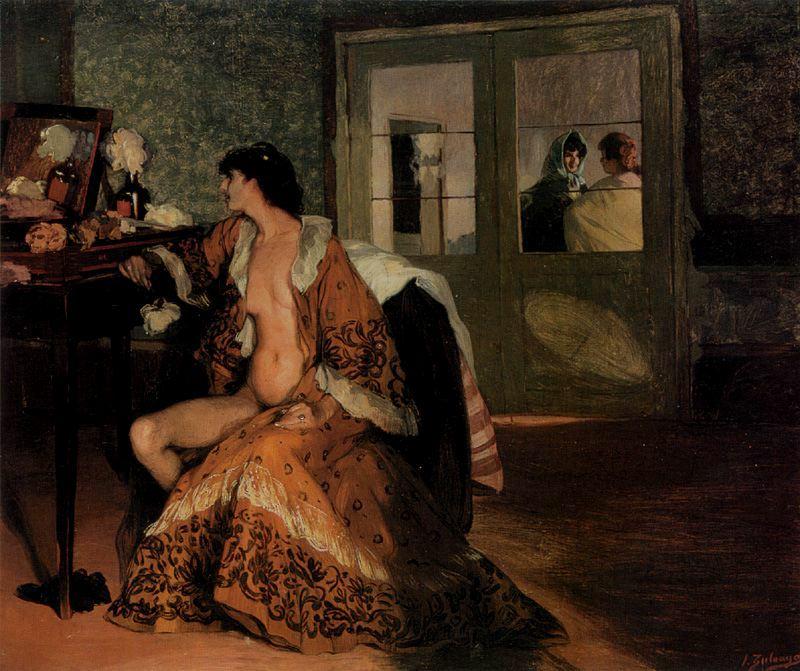

In this 1923 oil on canvas, Ignacio Zuloaga captures Julia Wainwright Robbins as a solitary figure. She occupies the center of the frame, a single female presence held within a quiet, dark space. Her posture is formal, defined by an aristocratic poise that commands the stillness of the composition. She holds a closed fan, a small, rigid object that anchors her hands against the soft volume of her attire.


This portrait of Mrs. Philip M. Lydig (Rita H. de Alba de Acosta) was painted by Ignacio Zuloaga in 1912. The subject, a stylish New York socialite, is captured with a sense of poise that reflects her standing in society. Her presence in the work is marked by a quiet, self-assured dignity.
 Portrait of Ivan Shchukin (1869-1908)1899 · Ermitaž
12
 The People's Poet Don Miguel of Segovia1900
13
 The Hermit1904 · Saint Louis Art Museum
14
 Spanish Farmers at a Market1899 · Museum of Fine Arts Ghent (MSK)
15
 La gitana1904 · Thiel Gallery
16
 The Witches of San Millán1907 · National Museum of Fine Arts
17
 My Uncle Daniel and his Family1910 · Muzej likovnih umjetnosti
18
 The Penitents1908 · Hispanic Society Museum - Library
19
 My Cousin Cándida1908 · Hispanic Society Museum - Library
20
 Self-Portrait1908 · Hispanic Society Museum - Library
21
 Mrs. Philip Lydig1912
22
 Merceditas1913
23
 Portrait of Édouard Branly (1844-1940), physicist1920 · Musée Carnavalet
24
 Mrs. Joseph Kerrigan1924 · Hispanic Society Museum - Library
25
 Albarracín1926 · Hispanic Society Museum - Library
26
 Mrs. William Randolph Hearst1923 · Hispanic Society Museum - Library
27
 Alva B. Gimbel1925 · Metropolitan Museum of Art
28
 Carlos de Beistegui (Mexico, 1863 - Biarritz, 1953)1931
29
 Self-Portrait of the Artist in a Basque Beret1931
30
 Still Life of Flowers1929 · Hispanic Society Museum - Library
31
 Portrait of Lady Micaela Aramburu y PicardoMuzej Cádiz
32
 My Uncle and My Cousins1898 · Musée d'Orsay
33
 Landscape of Navarra
34
 Montes de Calatayud
35
 The cathedral of Segovia
36
 Contess Mathieu de Noailles
37
 Dawn
38
 Houses in Segovia
39
 Sepulveda1909 · National Gallery of Art
40
 GitanillaNational Museum of Fine Arts
41
 Return of the HarvestNational Museum of Fine Arts
42
 Tipo de Segovia (Man from Segovia)Museo Nacional Centro de Arte Reina Sofía
43
 Retrato de Madame Malinowska (La Rusa) (Portrait of Madame Malinowska [The Russian])Museo Nacional Centro de Arte Reina Sofía
44
 Castilian Landscape1909 · Muzej likovnih umjetnosti
45
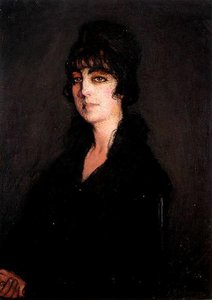 Portrait of señorita L. S.
46
 Portrait of Marqués de Villamarciel
47
 Eve of the run
48
 Portrait of Rusiñol
49
 Mi padre y mi hermana en París
50
 A dominican
51
 Portrait of Doña Carmen Arconada
52
 The Anchorite
53
 Angustias
54
 Bullfighter
55
 Lucienne Breval and CarmenHispanic Society Museum - Library
56
 Antonia the galician
57
 Nude on a sofa with carnation
58
 The view from the terrace
59
 Portrait of Sra. Malinowska
60
 A Portrait of a Lady, head and shoulders
61
 Portrait of Senora Corcuera
62
 The Dwarf Doña Mercédes
63
 The painter Uranga
64
 Don Placido Zuloaga in his studioMuseo Nacional Centro de Arte Reina Sofía
65
 Candida with chinese shawl
66
 Mrs. Rosita Gutiérrez
67
 José Rodao
68
 Bullfighters of Turégano
69
 My cousins
70
 The violinist Larrapidi
71
 Portrait of Condesa Mathieu de Noailles
72
 The well at Éibar
73
 Women in Sepúlveda
74
 Portrait of Balenciaga
75
 Old Houses in Segovia
76
 The cardinal
77
 People in País Vasco
78
 The Christ of the blood
79
 In Saint Cloud
80
 Pablo Uranga
81
 Future idols
82
 View of Segovia
83
 Portrait of Lucienne Bréval
84
 Village bullfighters
85
 Houses in the sun
86
 View of Toledo1915 · Kraljevska akademija likovnih umjetnosti San Fernando
87
 Mountains of Calatayud1921 · Metropolitan Museum of Art
88
 Victims of the Fiesta1923 · Metropolitan Museum of Art
89
 Miguel de Unamuno y Jugo1925 · Hispanic Society Museum - Library
90
 Lucrezia Bori1928 · Hispanic Society Museum - Library
91
 Torero1902 · Vil·la Casals-Museu Pau Casals
92
 Spanish and an English on the balconyNational Museum of Fine Arts
93
 SegoviaNational Museum of Fine Arts of Cuba
94
 Landscape
95
 Landscape of Alhama
96
 Motrico
97
 Street of an old Spanish city
98
 Reclining Maja with Blue and Gold
99
 Woman with Fan
100
 Castilian view
The four subjects that come back most often in these originals, each with its finest example.
8 muzeja u kojima se nalazi najviše djela s ove stranice.
| Muzej | Grad | Djela autora Ignacio Zuloaga | Slike iz ovog popisa |
|---|---|---|---|
 Hispanic Society Museum - Library |
New York | 12 | The Penitents, My Cousin Cándida, Self-Portrait |
 Metropolitan Museum of Art |
New York | 4 | Julia Wainwright Robbins, Alva B. Gimbel, Mountains of Calatayud |
 National Museum of Fine Arts |
Buenos Aires | 4 | The Witches of San Millán, Gitanilla, Return of the Harvest |
 Museo Nacional Centro de Arte Reina Sofía |
Madrid | 3 | Tipo de Segovia (Man from Segovia), Retrato de Madame Malinowska (La Rusa) (Portrait of Madame Malinowska [The Russian]), Don Placido Zuloaga in his studio |
 National Gallery of Art |
Washington | 2 | Woman in Andalusian Dress, Sepulveda |
 Muzej likovnih umjetnosti |
Boston | 2 | My Uncle Daniel and his Family, Castilian Landscape |
 Ermitaž |
Sankt Peterburg | 3 | Portrait of Ivan Shchukin (1869-1908) |
 Brooklyn Museum |
Brooklyn | 1 | Anita Ramírez, in black |
Pick a decade to see the original that defines it.

A full-length portrait depicts a man positioned centrally against a desolate, rocky landscape. He is oriented slightly toward the viewer, maintaining a frontal posture that occupies much of the vertical space. The subject wears a dark frock coat over a white waistcoat and a bow tie, accessorized with a hat and a walking stick. His facial features include a beard and glasses. The background consists of a vast sky with…

A woman emerges from a swirl of deep blues and teals. She is captured from the waist up, her presence anchored by the heavy textures of her attire. An orange headpiece rests upon her hair, pinned with pink and white floral accents that catch the light. Her skin glows with warmth against the cool, atmospheric clouds that churn in the background. There is a stillness in her gaze, a poised…
In this 1923 oil on canvas, Ignacio Zuloaga captures Julia Wainwright Robbins as a solitary figure. She occupies the center of the frame, a single female presence held within a quiet, dark space. Her posture is formal, defined by an aristocratic poise that commands the stillness of the composition. She holds a closed fan, a small, rigid object that anchors her hands against the soft volume of her attire.

Portrait of Maurice Barrès. Woman in Andalusian Dress (1911) and Anita Ramírez, in black (1915) come next.
Portrait of Maurice Barrès, Woman in Andalusian Dress, Anita Ramírez, in black, My cousin Candida, Alice Lolita Muth Maacha, Celestina, Julia Wainwright Robbins, Segoviano, My friends i Mrs. Philip M. Lydig (Rita H. de Alba de Acosta). The ranking above gives each one's year and museum.
Our catalog holds 108 works by Ignacio Zuloaga, dated from 1898 to 1931.
Mostly in Hispanic Society Museum - Library (New York), Metropolitan Museum of Art (New York) i National Museum of Fine Arts (Buenos Aires). The museum table above lists them all.
In 1920s: 11 of the 100 works on this page were made then, Julia Wainwright Robbins among them.
On this page, the earliest is My Uncle and My Cousins (1898) and the latest Carlos de Beistegui (Mexico, 1863 - Biarritz, 1953) (1931).
Portraits (9), Portraiture (7) i Landscape (6), across the 100 works on this page.
Oil On Canvas, for 9 of the 100 works on this page.
Spanish realism, judging by the originals on this page.
The Penitents, My Cousin Cándida i Self-Portrait: the Hispanic Society Museum - Library, New York holds 10 of the works on this page.
Yes, as a reproduction: the original stays in its museum, but any painting on this page can be painted by hand for you, made to order one at a time, from the painting's own page.

