Portret Hiroshige

Slike autora Hiroshige: Najpoznatijih 100 djela, iz perspektive galerije

Ažurirano Listopad 2026 · rangirano prema našoj ocjeni popularnosti (pretraživanja, posjeti i narudžbe za svako djelo) · 353 djela Hiroshige u našem katalogu

Ukratko

Iz perspektive galerije, najpoznatije djelo umjetnika Hiroshige je Early Department from a Daimyo, čiji se original nalazi u muzeju Nakagawa-machi Bato Hiroshige Museum of Art, Nagasaki. The maple leaves of Mama, Tekona shrine and Tsugi bridge (1857) i Hakone (1834) upotpunjuju triju koju svako oko prepoznaje. Od 353 djela umjetnika Hiroshige u našem katalogu, galerija u nastavku prikazuje 100 najpoznatijih, od kojih je svako originalno, s navedenom godinom nastanka, muzejom i onim što ga čini jedinstvenim.

1797 – 1858, Edo Japanese landscape painting Najviše djela: Nakagawa-machi Bato Hiroshige Museum of Art

Top 10 najpopularnijih djela umjetnika Hiroshige u galeriji

1
Early Department from a Daimyo od Hiroshige

Early Department from a Daimyo

Woodblock Print · Nakagawa-machi Bato Hiroshige Museum of Art, Nagasaki

In the delicate dance of lines and muted pigments, Utagawa Hiroshige’s Early Department from a Daimyo invites us to step through a portal into the heart of Edo-period Japan. This exquisite woodblock print captures a moment of vibrant communal life along a bustling riverside, where the rigid structures of social hierarchy melt into the shared leisure of a sunny afternoon. As we gaze upon the scene, we are not merely…

2
The maple leaves of Mama, Tekona shrine and Tsugi bridge (1857) od Hiroshige

The maple leaves of Mama, Tekona shrine and Tsugi bridge

1857 · Woodblock Print · Van Gogh muzej, Amsterdam

Utagawa Hiroshige (1797-1858), arguably the last titan of *ukiyo-e*, didn't merely depict landscapes; he crafted them into meditations on beauty and impermanence. “The Maple Leaves of Mama, Tekona Shrine and Tsugi Bridge,” created in 1857 during a period of significant societal transformation—the waning influence of feudal Japan as Western ideas crept in—stands as a testament to his enduring artistic legacy. More than just a visual record, it’s an embodiment of…

3
Hakone (1834) od Hiroshige

Hakone

1834 · Woodblock Print · Indianapolis Museum of Art, Indianapolis

Utagawa Hiroshige’s “Hakone,” created in 1834, is more than just a landscape; it's a poetic meditation on the beauty and transience of nature within Edo-period Japan. This woodblock print, part of his renowned series "The Fifty-three Stations of the Tōkaidō," captures a specific moment along the vital trade route connecting Tokyo (then Edo) with Kyoto. However, Hiroshige elevates this seemingly simple depiction of a mountain pass into something profoundly evocative,…

4
Station 36, Goyu; Kyoka Tokaido Series (1855) od Hiroshige

Station 36, Goyu; Kyoka Tokaido Series

1855 · Woodblock Print · Indianapolis Museum of Art, Indianapolis

In the delicate interplay of ink and paper, Utagawa Hiroshige’s "Station 36, Goyu; Kyoka Tokaido Series" offers much more than a mere topographical record of a journey. Completed in 1855, this exquisite woodblock print serves as a profound distillation of Edo-period sensibilities, capturing a yearning for tranquility amidst the burgeoning dynamism of a Japan in transition. As the nation stood at a pivotal crossroads between ancient feudal traditions and the…

5
Fushimi, Stanica #51 (1842) od Hiroshige

Fushimi, Stanica #51

1842 · Slik print s drvoblokom · Indianapolis Museum of Art, Indianapolis

Fushimi, Station # 51 – A Symphony of Tranquility and Observation Utagawa Hiroshige’s “Fushimi Station #51” transcends mere depiction; it embodies the spirit of Edo Japan—a meticulously crafted panorama that captures not just a physical location but also an intangible mood. Published in 1842 during the twilight years of the Tokugawa shogunate, this woodblock print exemplifies Hiroshige’s signature approach to landscape art: prioritizing atmospheric perspective and subtle tonal variations to…

6
Ichikoku Bridge in the Eastern Capital (Tōto: Ichikoku bashi) (1858) od Hiroshige

Ichikoku Bridge in the Eastern Capital (Tōto: Ichikoku bashi)

1858 · Woodblock Print · Indianapolis Museum of Art, Indianapolis

The Ichikoku Bridge spans a quiet stretch of water in the Eastern Capital. Beneath its wooden arch, two boats drift through the current. People move across the structure, some carrying backpacks and others clutching small handbags. A mountain rises in the distance, watching over the scene. Trees frame the edges of the view, their leaves casting shadows near the water's edge.

7
Shinagawa Sunrise from the series Fifty-three Stations on the Tokaido Road (1834) od Hiroshige

Shinagawa Sunrise from the series Fifty-three Stations on the Tokaido Road

1834 · Woodblock Print · Hill-Stead Museum, Farmington

In the soft, burgeoning light of a nineteenth-century morning, Utagawa Hiroshige invites us to witness a moment of profound stillness along the Tōkaidō road. Shinagawa Sunrise is not merely a depiction of a coastal village; it is a masterclass in the art of atmosphere. As the sun begins its ascent, the boundary between the heavens and the earth dissolves into a luminous haze. The water of the bay reflects a…

8
The Rokugo River Ferry, Kawasaki, from the series the Fifty-three Stations of the Tokaido (Hoeido edition ) od Hiroshige

The Rokugo River Ferry, Kawasaki, from the series the Fifty-three Stations of the Tokaido (Hoeido edition )

Woodblock Print · Nakagawa-machi Bato Hiroshige Museum of Art, Nagasaki

In the delicate dance of woodblock printing, few masters captured the ephemeral beauty of Japanese life as profoundly as Utagawa Hiroshige. His masterpiece, The Rokugo River Ferry, Kawasaki, serves as a breathtaking window into the Edo period, inviting the viewer to step onto the bustling banks of one of the most vital crossings on the Tokaido road. This evocative scene from his legendary series, The Fifty-three Stations of the Tokaido,…

9
Itsukushima in Aki Province (1858) od Hiroshige

Itsukushima in Aki Province

1858 · Woodblock Print · Brooklyn Museum, Brooklyn

In the delicate interplay of mist and water, Itsukushima in Aki Province offers more than a mere glimpse of a Japanese landmark; it provides a profound meditation on the ephemeral nature of existence. Created by the legendary ukiyo-e master Ando Hiroshige in 1858, this woodcut print captures the spiritual essence of the Itsukushima shrine area with a poetic sensitivity that remains unparalleled. As one gazes upon the composition, the eye…

10
Tenryu River Ferry Crossing, Mitsuke, from the series The Fifty-three Stations of the Tokaido (Gyosho Edition) od Hiroshige

Tenryu River Ferry Crossing, Mitsuke, from the series The Fifty-three Stations of the Tokaido (Gyosho Edition)

Woodblock Print · Nakagawa-machi Bato Hiroshige Museum of Art, Nagasaki

The woodblock print depicts a section of the Tenryu River near the station of Mitsuke. In the center of the composition, a large sandbank divides the water into two distinct currents. Several small wooden boats occupy the river, with figures positioned within them to manage the crossing. Some vessels are moored directly against the central sandbank, while others navigate the moving water. The far shore is visible in the distance,…

Slike autora Hiroshige, rangirane od 11 do 100

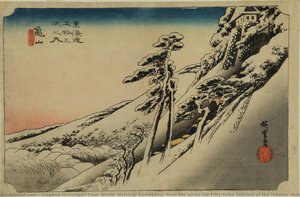
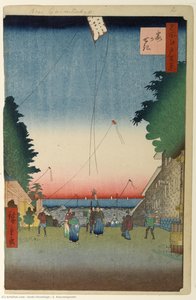
11Пароти и лоза винограда (1800) od HiroshigeПароти и лоза винограда1800 · Indianapolis Museum of Art 12The Pine Woods of Miho in Suruga Province (Suruga Miho no matsubara) (1858) od HiroshigeThe Pine Woods of Miho in Suruga Province (Suruga Miho no matsubara)1858 · Indianapolis Museum of Art 1362 (55) Komakata Hall and Azuma Bridge (1857) od Hiroshige62 (55) Komakata Hall and Azuma Bridge1857 · Brooklyn Museum 14Evening Snow at Kanbara (1834) od HiroshigeEvening Snow at Kanbara1834 · Los Angeles County Museum of Art 15Dawn in the licensed quarters (1857) od HiroshigeDawn in the licensed quarters1857 · Art Gallery of New South Wales 16Night View of Saruwakacho od HiroshigeNight View of Saruwakacho 17Station 28, Fukuroi (1855) od HiroshigeStation 28, Fukuroi1855 · Indianapolis Museum of Art 18Evening Snow at Asakusa or Woman with Umbrella from the series Eight Views of the Environs of Edo (1800) od HiroshigeEvening Snow at Asakusa or Woman with Umbrella from the series Eight Views of the Environs of Edo1800 · Hill-Stead Museum 19Keishi (Kyoto), Capital (1834) od HiroshigeKeishi (Kyoto), Capital1834 · Indianapolis Museum of Art 20Hara: View of Ashitakayama and Fuji (1855) od HiroshigeHara: View of Ashitakayama and Fuji1855 · Indianapolis Museum of Art 21Yokkaichi (Station #44) (1834) od HiroshigeYokkaichi (Station #44)1834 · Indianapolis Museum of Art 22Desolate Wintry Scene, Hamamatsu, from the series the Fifty-three Stations of the Tokaido (Hoeido edition) od HiroshigeDesolate Wintry Scene, Hamamatsu, from the series the Fifty-three Stations of the Tokaido (Hoeido edition)Nakagawa-machi Bato Hiroshige Museum of Art 23Noge and Yokohama in Musashi Province (Musashi, Noge, Yokohama) (1858) od HiroshigeNoge and Yokohama in Musashi Province (Musashi, Noge, Yokohama)1858 · Indianapolis Museum of Art 24Wild sea breaking on the rocks (1856) od HiroshigeWild sea breaking on the rocks1856 25Shirasuga, Shiomi-zaka zu (Pogled na Shiomu Slap) (1833) od HiroshigeShirasuga, Shiomi-zaka zu (Pogled na Shiomu Slap)1833 · Indianapolis Museum of Art 26Mt.Fuji on the Left, Yoshiwara, from the series the Fifty-three Stations of the Tokaido (Hoeido edition) od HiroshigeMt.Fuji on the Left, Yoshiwara, from the series the Fifty-three Stations of the Tokaido (Hoeido edition)Nakagawa-machi Bato Hiroshige Museum of Art 27Tsukuda Offing in the Eastern Capital (Tōto: Tsukuda oki) (1858) od HiroshigeTsukuda Offing in the Eastern Capital (Tōto: Tsukuda oki)1858 · Indianapolis Museum of Art 28Kawachi (1853) od HiroshigeKawachi1853 · Indianapolis Museum of Art 29The Dye Craft Shops of Arimatsu, Narumi, from the series The Fifty-three Stations of the Tokaido (Gyosho edition) od HiroshigeThe Dye Craft Shops of Arimatsu, Narumi, from the series The Fifty-three Stations of the Tokaido (Gyosho edition)Nakagawa-machi Bato Hiroshige Museum of Art 30View of Shiomi Slope, Shirasuka, from the series The Fifty-three Stations of the Tokaido (Gyosho edition) od HiroshigeView of Shiomi Slope, Shirasuka, from the series The Fifty-three Stations of the Tokaido (Gyosho edition)Nakagawa-machi Bato Hiroshige Museum of Art 31Entrance to Enoshima in Sagami Province (Sagami Enoshima iriguchi) (1858) od HiroshigeEntrance to Enoshima in Sagami Province (Sagami Enoshima iriguchi)1858 · Indianapolis Museum of Art 32Morning Mist, Mishima, from the series the Fifty-three Stations of the Tokaido (Hoeido edition ) od HiroshigeMorning Mist, Mishima, from the series the Fifty-three Stations of the Tokaido (Hoeido edition )Nakagawa-machi Bato Hiroshige Museum of Art 33The Imagire Sea Ferry, Maisaka, from the series The Fifty-three Stations of the Tokaido (Gyosho edition) od HiroshigeThe Imagire Sea Ferry, Maisaka, from the series The Fifty-three Stations of the Tokaido (Gyosho edition)Nakagawa-machi Bato Hiroshige Museum of Art 34Sukiya Riverbank in the Eastern Capital (Tōto sukiya kaigan) (1858) od HiroshigeSukiya Riverbank in the Eastern Capital (Tōto sukiya kaigan)1858 · Indianapolis Museum of Art 35Satta Pass, Yui, from the series the Fifty-three Stations of the Tokaido (Hoeido edition) od HiroshigeSatta Pass, Yui, from the series the Fifty-three Stations of the Tokaido (Hoeido edition)Nakagawa-machi Bato Hiroshige Museum of Art 36True View of Imagire, Maisaka, from the series the Fifty-three Stations of the Tokaido (Hoeido edition) od HiroshigeTrue View of Imagire, Maisaka, from the series the Fifty-three Stations of the Tokaido (Hoeido edition)Nakagawa-machi Bato Hiroshige Museum of Art 37Clear Winter Morning, Kameyama, from the series the Fifty-three Stations of the Tokaido (Hoeido edition) od HiroshigeClear Winter Morning, Kameyama, from the series the Fifty-three Stations of the Tokaido (Hoeido edition)Nakagawa-machi Bato Hiroshige Museum of Art 38The Tenryu River, Mitsuke, from the series the Fifty-three Stations of the Tokaido (Hoeido edition) od HiroshigeThe Tenryu River, Mitsuke, from the series the Fifty-three Stations of the Tokaido (Hoeido edition)Nakagawa-machi Bato Hiroshige Museum of Art 39The Seven-ri Ferry Crossing, Kuwana, from the series the Fifty-three Stations of the Tokaido (Hoeido edition) od HiroshigeThe Seven-ri Ferry Crossing, Kuwana, from the series the Fifty-three Stations of the Tokaido (Hoeido edition)Nakagawa-machi Bato Hiroshige Museum of Art 40Aronia and Bullfinch od HiroshigeAronia and Bullfinch 41Ptice koje se vraćaju u Katatu (1834) od HiroshigePtice koje se vraćaju u Katatu1834 · Indianapolis Museum of Art 42Yugyoji Temple, Fujisawa, from the series the Fifty-three Stations of the Tokaido (Hoeido edition) od HiroshigeYugyoji Temple, Fujisawa, from the series the Fifty-three Stations of the Tokaido (Hoeido edition)Nakagawa-machi Bato Hiroshige Museum of Art 43Travellers and Soliciting Women, Goyu, from the series the Fifty-three Stations of the Tokaido (Hoeido edition) od HiroshigeTravellers and Soliciting Women, Goyu, from the series the Fifty-three Stations of the Tokaido (Hoeido edition)Nakagawa-machi Bato Hiroshige Museum of Art 44The Totoumi Bank of the Oi River, Kanaya, from the series the Fifty-three Stations of the Tokaido (Hoeido edition) od HiroshigeThe Totoumi Bank of the Oi River, Kanaya, from the series the Fifty-three Stations of the Tokaido (Hoeido edition)Nakagawa-machi Bato Hiroshige Museum of Art 45The Suruga Bank of the Oi River, Shimada, from the series the Fifty-three Stations of the Tokaido (Hoeido edition) od HiroshigeThe Suruga Bank of the Oi River, Shimada, from the series the Fifty-three Stations of the Tokaido (Hoeido edition)Nakagawa-machi Bato Hiroshige Museum of Art 46Kyoka Tokaido Series, Kanagawa (Yokohama) od HiroshigeKyoka Tokaido Series, Kanagawa (Yokohama)Indianapolis Museum of Art 47Distant View of Miho, Ejiri, from the series the Fifty-three Stations of the Tokaido (Hoeido edition) od HiroshigeDistant View of Miho, Ejiri, from the series the Fifty-three Stations of the Tokaido (Hoeido edition)Nakagawa-machi Bato Hiroshige Museum of Art 48Mt. Fuji in the Morning, Hara, from the series the Fifty-three Stations of the Tokaido (Hoeido edition) od HiroshigeMt. Fuji in the Morning, Hara, from the series the Fifty-three Stations of the Tokaido (Hoeido edition)Nakagawa-machi Bato Hiroshige Museum of Art 49A Horse Fair, Chiriu, from the series the Fifty-three Stations of the Tokaido (Hoeido edition) od HiroshigeA Horse Fair, Chiriu, from the series the Fifty-three Stations of the Tokaido (Hoeido edition)Nakagawa-machi Bato Hiroshige Museum of Art 50Wakasa (1853) od HiroshigeWakasa1853 · Indianapolis Museum of Art 51Distant View of Mt.Akiba, Kakegawa, from the series the Fifty-three Stations of the Tokaido (Hoeido edition) od HiroshigeDistant View of Mt.Akiba, Kakegawa, from the series the Fifty-three Stations of the Tokaido (Hoeido edition)Nakagawa-machi Bato Hiroshige Museum of Art 52The Ichiri-Han Sea Ferry, Arai, from the series The Fifty-three Stations of the Tokaido (Gyosho edition) od HiroshigeThe Ichiri-Han Sea Ferry, Arai, from the series The Fifty-three Stations of the Tokaido (Gyosho edition)Nakagawa-machi Bato Hiroshige Museum of Art 53Gateway Entrance to the Atsuta Shrine on the Beach, Miya, from the series The Fifty-three Stations of the Tokaido (Gyosho edition) od HiroshigeGateway Entrance to the Atsuta Shrine on the Beach, Miya, from the series The Fifty-three Stations of the Tokaido (Gyosho edition)Nakagawa-machi Bato Hiroshige Museum of Art 54Akasaka, from the series The Fifty-three Stations of the Tokaido (Gyosho edition) od HiroshigeAkasaka, from the series The Fifty-three Stations of the Tokaido (Gyosho edition)Nakagawa-machi Bato Hiroshige Museum of Art 55The Sakawa River, Odawara, from the series the Fifty-three Stations of the Tokaido (Hoeido edition) od HiroshigeThe Sakawa River, Odawara, from the series the Fifty-three Stations of the Tokaido (Hoeido edition)Nakagawa-machi Bato Hiroshige Museum of Art 56A Footpath between Ricefield, Hiratsuka, from the series the Fifty-three Stations of the Tokaido (Hoeido edition) od HiroshigeA Footpath between Ricefield, Hiratsuka, from the series the Fifty-three Stations of the Tokaido (Hoeido edition)Nakagawa-machi Bato Hiroshige Museum of Art 57Awa Province: Whirlpool at Naruto (1853) od HiroshigeAwa Province: Whirlpool at Naruto1853 5873 The City Flourishing, the Tanabata Festival (1857) od Hiroshige73 The City Flourishing, the Tanabata Festival1857 59Sarugababa Plain, Futagawa, from the series the Fifty-three Stations of the Tokaido (Hoeido edition) od HiroshigeSarugababa Plain, Futagawa, from the series the Fifty-three Stations of the Tokaido (Hoeido edition)Nakagawa-machi Bato Hiroshige Museum of Art 60Local Specialty Teahouse, Mariko, from the series the Fifty-three Stations of the Tokaido (Hoeido edition) od HiroshigeLocal Specialty Teahouse, Mariko, from the series the Fifty-three Stations of the Tokaido (Hoeido edition)Nakagawa-machi Bato Hiroshige Museum of Art 61Sakanoshita od HiroshigeSakanoshitaIndianapolis Museum of Art 62Stanica 23, Fujida od HiroshigeStanica 23, FujidaIndianapolis Museum of Art 63Marsh Grasses and Mandarin Ducks od HiroshigeMarsh Grasses and Mandarin Ducks 6450th station, Minakuchi od Hiroshige50th station, Minakuchi 65Sakanoshita: the Throwing Away the Brush Peak (1834) od HiroshigeSakanoshita: the Throwing Away the Brush Peak1834 · Brooklyn Museum 66Shibaura Bay of Musashi Province (801) od HiroshigeShibaura Bay of Musashi Province801 · Metropolitan Museum of Art 67Koyurugi Beach of Sagami Province (801) od HiroshigeKoyurugi Beach of Sagami Province801 · Metropolitan Museum of Art 68Honmoku Bay of Musashi Province (801) od HiroshigeHonmoku Bay of Musashi Province801 · Metropolitan Museum of Art 69Untitled (Two Rabbits, Pampas Grass, and Full Moon) (1851) od HiroshigeUntitled (Two Rabbits, Pampas Grass, and Full Moon)1851 7011. Kiyomizu Hall and Shinobazu Pond at Ueno (1857) od Hiroshige11. Kiyomizu Hall and Shinobazu Pond at Ueno1857 7185. Kinokuni Hill and Distant View of Akasaka and the Tameike Pond (1857) od Hiroshige85. Kinokuni Hill and Distant View of Akasaka and the Tameike Pond1857 7276 Bamboo Quay by Kyōbashi Bridge (1857) od Hiroshige76 Bamboo Quay by Kyōbashi Bridge1857 7358 (52) Sudden Shower over Shin-Ōhashi bridge and Atake (1857) od Hiroshige58 (52) Sudden Shower over Shin-Ōhashi bridge and Atake1857 · Tokyo Fuji Art Museum 74103. Senju Great Bridge (1857) od Hiroshige103. Senju Great Bridge1857 7518. The Ōji Inari Shrine (1857) od Hiroshige18. The Ōji Inari Shrine1857 76113. Aoi Slope Outside Toranomon Gate (1857) od Hiroshige113. Aoi Slope Outside Toranomon Gate1857 77114. Bikuni Bridge in Snow (1857) od Hiroshige114. Bikuni Bridge in Snow1857 7870 (60) The Mouth of the Nakagawa River (1857) od Hiroshige70 (60) The Mouth of the Nakagawa River1857 792. Kasumigaseki (1857) od Hiroshige2. Kasumigaseki1857 8015. Suwa Bluff in Nippori (1857) od Hiroshige15. Suwa Bluff in Nippori1857 8163 (69) The Ayase River and Kanegafuchi (1857) od Hiroshige63 (69) The Ayase River and Kanegafuchi1857 82115. The Takata Riding Grounds (1857) od Hiroshige115. The Takata Riding Grounds1857 8386. Naitō Shinjuku in Yotsuya (1857) od Hiroshige86. Naitō Shinjuku in Yotsuya1857 8416. Flower Park and Dangozaka Slope in Sendagi (1857) od Hiroshige16. Flower Park and Dangozaka Slope in Sendagi1857 8568 (59) Open Garden at the Hachiman Shrine in Fukagawa (1857) od Hiroshige68 (59) Open Garden at the Hachiman Shrine in Fukagawa1857 8610. Sunrise at Kanda Myōjin Shrine (1857) od Hiroshige10. Sunrise at Kanda Myōjin Shrine1857 87Peach and Long-tailed Bird od HiroshigePeach and Long-tailed Bird 88Golden Pheasant in Bracken od HiroshigeGolden Pheasant in Bracken 89The Imado Bridge at the Foot of Mount Matsuchi (801) od HiroshigeThe Imado Bridge at the Foot of Mount Matsuchi801 · Metropolitan Museum of Art 90Dog (1858) od HiroshigeDog1858 · Indianapolis Museum of Art 91118. Kitsunebi on New Year's Night Under the Enoki Tree near Ōji (1857) od Hiroshige118. Kitsunebi on New Year's Night Under the Enoki Tree near Ōji1857 92109. Minami Shinagawa and Samezu Coast (1857) od Hiroshige109. Minami Shinagawa and Samezu Coast1857 93Night View of Matsuchiyama and the San (1857) od HiroshigeNight View of Matsuchiyama and the San1857 · Los Angeles County Museum of Art 94Акасака, №37 od HiroshigeАкасака, №37Indianapolis Museum of Art 95Shiojiri Pass in Shinano Province (Shinano Shiojiritōge) (1858) od HiroshigeShiojiri Pass in Shinano Province (Shinano Shiojiritōge)1858 · Indianapolis Museum of Art 96Yoshiwara od HiroshigeYoshiwaraIndianapolis Museum of Art 97Fuchu, No. 20 od HiroshigeFuchu, No. 20Indianapolis Museum of Art 98Woman Walking in the Snow (1850) od HiroshigeWoman Walking in the Snow1850 · Metropolitan Museum of Art 9982. Moon Viewing (1857) od Hiroshige82. Moon Viewing1857 100Station 27, Kakegawa (1855) od HiroshigeStation 27, Kakegawa1855 · Indianapolis Museum of Art

Slavna djela Hiroshige po razdobljima

Motivi koji su privukli pažnju Hiroshige

Četiri teme koje se najčešće ponavljaju u ovim originalima, svaka s svojim vrhunskim primjerom.

Muzeji koji čuvaju originalna djela umjetnika Hiroshige

8 muzeja u kojima se nalazi najviše djela s ove stranice.

Muzej Grad Djela autora Hiroshige Slike iz ovog popisa
Nakagawa-machi Bato Hiroshige Museum of Art, NagasakiNakagawa-machi Bato Hiroshige Museum of Art Nagasaki 30 Early Department from a Daimyo, The Rokugo River Ferry, Kawasaki, from the series the Fifty-three Stations of the Tokaido (Hoeido edition ), Tenryu River Ferry Crossing, Mitsuke, from the series The Fifty-three Stations of the Tokaido (Gyosho Edition)
Indianapolis Museum of Art, IndianapolisIndianapolis Museum of Art Indianapolis 35 Hakone, Station 36, Goyu; Kyoka Tokaido Series, Fushimi, Stanica #51
Metropolitan Museum of Art, New YorkMetropolitan Museum of Art New York 8 Shibaura Bay of Musashi Province, Koyurugi Beach of Sagami Province, Honmoku Bay of Musashi Province
Brooklyn Museum, BrooklynBrooklyn Museum Brooklyn 4 Itsukushima in Aki Province, 62 (55) Komakata Hall and Azuma Bridge, Sakanoshita: the Throwing Away the Brush Peak
Hill-Stead Museum, FarmingtonHill-Stead Museum Farmington 3 Shinagawa Sunrise from the series Fifty-three Stations on the Tokaido Road, Evening Snow at Asakusa or Woman with Umbrella from the series Eight Views of the Environs of Edo
Los Angeles County Museum of Art, Los AngelesLos Angeles County Museum of Art Los Angeles 2 Evening Snow at Kanbara, Night View of Matsuchiyama and the San
Van Gogh muzej, AmsterdamVan Gogh muzej Amsterdam 1 The maple leaves of Mama, Tekona shrine and Tsugi bridge
Art Gallery of New South Wales, SydneyArt Gallery of New South Wales Sydney 1 Dawn in the licensed quarters

Hiroshige, jedna prepoznatljiva slika po desetljeću

Djela po desetljećima

Odaberite desetljeće kako biste vidjeli original koji ga definira.

Slike umjetnika Hiroshige: odgovori galerije

Koja je najpoznatija slika umjetnika Hiroshige?Otkrijte odgovor

Early Department from a Daimyo, Nakagawa-machi Bato Hiroshige Museum of Art, Nagasaki. Nakon njih slijede The maple leaves of Mama, Tekona shrine and Tsugi bridge (1857) i Hakone (1834).

Koje su najpoznatije slike umjetnika Hiroshige?Otkrijte odgovor

Early Department from a Daimyo, The maple leaves of Mama, Tekona shrine and Tsugi bridge, Hakone, Station 36, Goyu; Kyoka Tokaido Series, Fushimi, Stanica #51, Ichikoku Bridge in the Eastern Capital (Tōto: Ichikoku bashi), Shinagawa Sunrise from the series Fifty-three Stations on the Tokaido Road, The Rokugo River Ferry, Kawasaki, from the series the Fifty-three Stations of the Tokaido (Hoeido edition ), Itsukushima in Aki Province i Tenryu River Ferry Crossing, Mitsuke, from the series The Fifty-three Stations of the Tokaido (Gyosho Edition). Gornji rang prikazuje godinu i muzej za svako od njih.

Koliko je djela stvorio/la Hiroshige?Otkrijte odgovor

Naš katalog sadrži 353 djela umjetnika Hiroshige, datiranih od 1833 do 1858.

Gdje se nalaze najpoznatija originalna djela umjetnika Hiroshige?Otkrijte odgovor

Većinom u Nakagawa-machi Bato Hiroshige Museum of Art (Nagasaki), Indianapolis Museum of Art (Indianapolis) i Metropolitan Museum of Art (New York). Gornja tablica muzeja navodi sve njih.

Kada je Hiroshige stvorio svoje najpoznatije slike?Otkrijte odgovor

U 1850s: 44 od 100 djela na ovoj stranici nastalo je tada, od čega je The maple leaves of Mama, Tekona shrine and Tsugi bridge The maple leaves of Mama, Tekona shrine and Tsugi bridge.

Koja su najranija i najkasnija poznata djela umjetnika Hiroshige?Otkrijte odgovor

Na ovoj stranici najstarije djelo je iz Shirasuga, Shiomi-zaka zu (Pogled na Shiomu Slap) (1833), a najnovije iz Ichikoku Bridge in the Eastern Capital (Tōto: Ichikoku bashi) (1858).

Kojim se temama Hiroshige najčešće bavio/la?Otkrijte odgovor

Edo period (31), Ukiyo-e (22) i Woodblock print (20), kroz svih 100 djela na ovoj stranici.

U kojem je mediju Hiroshige najviše radio/la?Otkrijte odgovor

Woodblock Print, za 62 od 100 djela na ovoj stranici.

S kojim je umjetničkim pravcem Hiroshige povezan/a?Otkrijte odgovor

Japanese landscape painting, sudeći po originalima na ovoj stranici.

Koje originale Hiroshige ima u svojoj kolekciji Nakagawa-machi Bato Hiroshige Museum of Art?Otkrijte odgovor

Early Department from a Daimyo, The Rokugo River Ferry, Kawasaki, from the series the Fifty-three Stations of the Tokaido (Hoeido edition ) i Tenryu River Ferry Crossing, Mitsuke, from the series The Fifty-three Stations of the Tokaido (Gyosho Edition): Nakagawa-machi Bato Hiroshige Museum of Art, Nagasaki posjeduje 29 djela s ove stranice.

Hiroshige: umjetnik

Poetična vizija Edo Japana: Život i umjetnost Utagawa Hiroshigea

Utagawa Hiroshige, rođen kao Andō Tokutarō 1797. godine u užurbanom gradu Edo (moderni Tokyo), predstavlja ključnu figuru u svijetu ukiyo-e, ili „slika plivajućeg svijeta“. Iako duboko ukorijenjen u tradicijama japanskog drvoreza, Hiroshige je nadilaziooazu puko ponavljanje motiva, prožimajući svoje pejzaže poetskim osjećajem koji je snažno odjeknuo kako u Japanu, tako i kasnije u zapadnom umjetničkom svijetu. Njegov život odvijao se u razdoblju relativnog mira i prosperiteta pod shogunatom Tokugawom, no i u vrijeme obilježeno rastućim društvenim promjenama i eventualnom westernizacijom – silama koje će na kraju doprinijeti opadanju ukiyo-e stilom, čak i dok su pojačavale Hiroshigeovo trajno naslijeđe. Prvobitno predodređen za konvencionalniji put unutar obitelji samuraja – njegov je otac služio kao vatrogasni nadzornik – Hiroshigeove umjetničke sklonosti odvele su ga na šegrtovanje kod Utagawa Toyohira, majstora Utagawa škole. To se pokazalo kao presudna prekretnica, udaljavajući ga od popularnih prikaza kurtizana i glumaca koje su preferirali mnogi ukiyo-e umjetnici prema fokusu na pejzaž, žanru koji će on naposljetku redefinirati.

Od žanrovskih scena do evokativnih pejzaža

Hiroshigeovo rano djelo pridržavalo se konvencija njegove škole, prikazujući portrete i scene iz svakodnevnog života. Međutim, upravo je njegovo prihvaćanje pejzaža ono što ga je istinski izdvojilo. Pod utjecajem ranijih majstora poput Hokusaija – čiji su „Trideset i šest pogleda na planinu Fuji“ već očarali publiku – Hiroshima je razvio jedinstven stil okarakteriziran atmosferskom perspektivom, suptilnim paletama boja i dubokom osjetljivošću na promjene godišnjih doba. On nije samo prikazivao mjesta; on je prizivao njihovo raspoloženje, hvatajući bit određenog trenutka u vremenu. Serija „Pedeset i tri postaje Tōkaidōa“ (1833–1834), možda njegovo najslavnije postignuće, primjer je tog pristupa. Ovo monumentalno djelo dokumentiralo je putovanje duž ceste Tōkaidō, glavne rute koja povezuje Edo s Kyotom, ne kao puki putopis, već kao niz evokativnih vinjeta – iznenadna pljusak u Shonou, dalek vid planine Fuji iz Kanaye, užurbana aktivnost u Odawari. Svaki otisak prožet je osjećajem prolaznosti i tihe ljepote, pozivajući gledatelje da doživje putovanje zajedno s putnicima. Majstorsko je koristio bokashi, tehniku koja uključuje višestruke imprime kako bi se stvorili suptilni gradijenti boja, dodajući dubinu i atmosferu njegovim kompozicije.

Majstor atmosfere i tehnike

Hiroshigeova tehnička vještina bila je jednako izvanredna kao i njegova umjetnička vizija. Nije ga zanimalo samo točno predstavljanje; tražio je način da uhvati osjećaj mjesta. Njegova upotreba boje, iako često suzdržana u usporedbi s nekim od njegovih suvremenika, bila je ključna za postizanje tog efekta. Često je koristio više blokova za jednu boju, što mu je omogućilo stvaranje nijansiranih tonova i atmosferskih efekata koji su bili nevjerojatno teški za repliciranje. Delikatni plavi tonovi u njegovim prikazima kiše ili magle, tople nijanse jesenskog lišća – to nisu bili slučajni elementi; bili su to pažljivo promišljeni dijelovi dizajnirani da potaknu specifične emocije i senzacije. Osim bokashija, Hiroshige je bio vješt u korištenju praznog prostora – ma – koncepta središnjeg za japansku estetiku, koji omogućuje područjima printa da „dišu“ i pojačava opći osjećaj spokoja. Njegova serija „Sto poznatih pogleda na Edo“ (1856–1858) dodatno je pokazala njegovo majstorstvo, nudeći intimne prizore života i pejzaža njegovog voljenog grada.

Trajno naslijeđe: Japonisme i šire

Iako je tradicija ukiyo-e počela blijedjeti nakon Hiroshigeove smrti 1858. godine – što je ubrdao Restoracija Meiji i naknadni priljev zapadne kulture – njegov utjecaj na umjetnički svijet pokazao se nevjerojatno trajnim. U kasno 19. stoljeće, japanski printovi preplavili su Europu, pokrećući fenomen poznat kao Japonisme. Umjetnici poput Édouarda Maneta, Claudea Moneta i Edgara Degasa bili su očarani odvažnim kompozicijama, ravnim perspektivama i nekonvencionalnim shemama boja ukiyo-e stila, uključujući te elemente u vlastita djela. Vincent van Gogh bio je posebno opčinjen Hiroshigeovim printovima, stvarajući kopije nekoliko njih, uključujući „Šum trešnje u Kameidu“, pokazujući svoje duboko divljenje prema japanskom majstoru u korištenju boje i kompozicije. Hiroshigeov utjecaj protezao se izvan slikarstva; može se vidjeti u arhitekturi, dizajnu, čak i književnosti. Danas se Utagawa Hiroshige pamti ne samo kao briljantan umjetnik, već i kao kulturni ambasador koji je pomogao premostiti jaz između Istoka i Zapada, ostavljajući neizbrisiv trag u povijesti umjetnosti. Njegovi spokojni pejzaži i dalje inspiriraju divljenje i kontemplaciju, podsjećajući nas na ljepotu i prolaznost prirodnog svijeta.

Značajna djela

  • Pedeset i tri postaje Tōkaidōa: Hiroshigeova najpoznatija serija, prikazująca putovanje glavnim putem između Edo i Kyota.
  • Sto poznatih pogleda na Edo: Očaravajući prikaz života i pejzaža u njegovom voljenom gradu.
  • Utjecaj na Van Goghovu seriju Japonaiserie: Uključujući „Cvatući šum trešnje prema Hiroshigeu“, što dokazuje Van Goghovo duboko divljenje japanskom majstoru.