Portret George Henry

55 najpoznatijih djela umjetnika George Henry, svako jedinstveno

Ažurirano Listopad 2026 · rangirano prema našoj ocjeni popularnosti (pretraživanja, posjeti i narudžbe za svako djelo) · 55 djela George Henry u našem katalogu

Ukratko

Japanese Lady with a Fan (1894) je slika autora George Henry koja privlači najviše pogleda. Nakon toga, pogled se usmjerava na A Galloway Landscape (1889) i The Druids Bringing in the Mistletoe (1890). Među 55 djela umjetnika George Henry u našem katalogu, ovih 55 su najpoznatija, od kojih je svako jedinstveni original predstavljen s godinom nastanka, muzejom i razlogom zbog kojeg je vječno.

1828 – 1895 Impressionism Najviše djela: Scottish National Gallery

Top 10 djela George Henry kroz oči galerije

1
Japanese Lady with a Fan (1894) od George Henry

Japanese Lady with a Fan

1894 · Oil On Canvas

The oil painting presents a close-up portrait of a woman dressed in traditional Japanese attire. The subject is positioned vertically, with the focus centered on her headwear, face, and upper body. She holds a fan, which is integrated into the arrangement of her robes and posture. The color palette relies on warm browns, ochres, and muted purples, accented by touches of red and gold. A sense of depth is achieved…

2
A Galloway Landscape (1889) od George Henry

A Galloway Landscape

1889 · Oil

The canvas presents a wide valley under a blue sky populated by scattered clouds. A river winds through the center of the landscape, cutting through the terrain to provide a sense of depth. In the foreground and middle ground, numerous cows graze upon the green grass. These animals are distributed across the field, with some positioned near the viewer and others appearing as smaller forms in the distance. The scene…

3
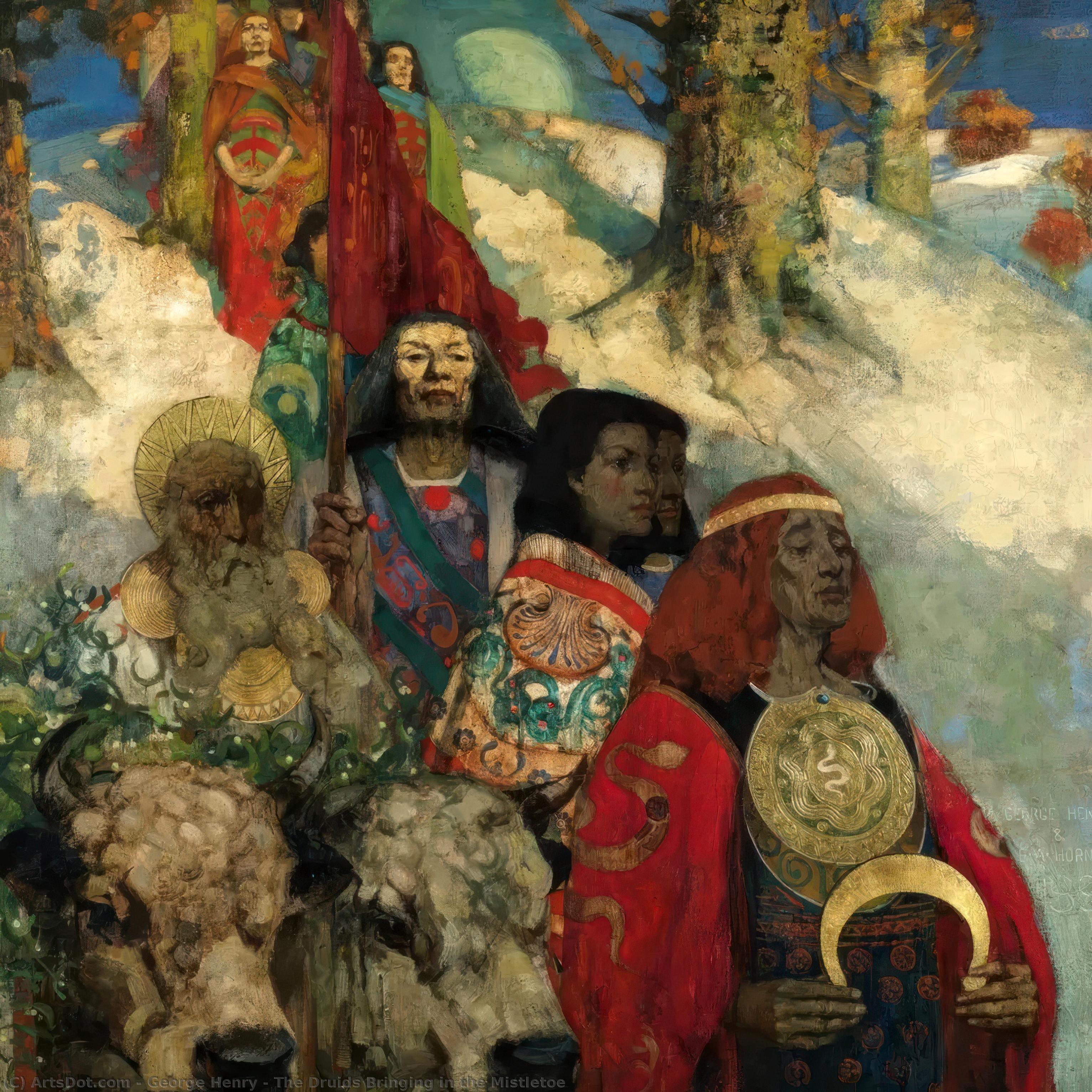
The Druids Bringing in the Mistletoe (1890) od George Henry

The Druids Bringing in the Mistletoe

1890 · Oil On Canvas

In this 1890 collaboration, George Henry and Edward Atkinson Hornel present a scene of profound solemnity. The composition captures a procession of Celtic priests descending a steep, rugged hillside. There is a rhythmic, almost ceremonial weight to the movement of the figures. At the center of this ritual, a chief druid uses a golden sickle to harvest mistletoe from a sacred oak. The figures are draped in robes adorned with…

Slavna djela umjetnika George Henry, od 11. do 55. broj

Slavna djela George Henry po razdobljima

Late Medieval

1889 – 1894 · 3 djela na ovom popisu

Motivi koji su privukli pažnju George Henry

Četiri teme koje se najčešće ponavljaju u ovim originalima, svaka s svojim vrhunskim primjerom.

Muzeji koji čuvaju originalna djela umjetnika George Henry

7 muzeja u kojima se nalazi najviše djela s ove stranice.

Muzej Grad Djela autora George Henry Slike iz ovog popisa
Scottish National Gallery, EdinburghScottish National Gallery Edinburgh 2 Geisha Girl, East and West
Sheffield City Art Galleries, SheffieldSheffield City Art Galleries Sheffield 1 Hikers at Goodwood Downs, West Sussex
Mcmanus: Dundee's Art Galleries And Museums, DundeeMcmanus: Dundee's Art Galleries And Museums Dundee 1 The Feather Boa
The Royal Conservatoire of Scotland, EdinburghThe Royal Conservatoire of Scotland Edinburgh 1 The Grey Hat
Laing Art Gallery, New South WalesLaing Art Gallery New South Wales 1 Lady Margaret Sackville
Atkinson Art Gallery Collection, SouthportAtkinson Art Gallery Collection Southport 1 The Lark
Manchester Art Gallery, ManchesterManchester Art Gallery Manchester 1 Landscape with Rainbow

George Henry kroz godine: jedinstvena originalna djela svakog umjetnika

14 godina razmika između prvog i posljednjeg datiranog originala umjetnika George Henry prikazanog ovdje, 1882 i 1895: svaka godina ima svoje mjesto u nastavku.

Djela po godinama

Odaberite godinu kako biste vidjeli originalna djela.

Slike umjetnika George Henry: pitanja za galeriju

Koje je najpoznatije djelo umjetnika George Henry?Otkrijte odgovor

Japanese Lady with a Fan (1894). Sljedeći su A Galloway Landscape (1889) i The Druids Bringing in the Mistletoe (1890).

U kojoj je dobi George Henry stvorio/la Japanese Lady with a Fan?Otkrijte odgovor

66 godina: Japanese Lady with a Fan datira iz 1894, a George Henry je rođen/a 1828.

Koja su deset najpoznatijih slika umjetnika George Henry?Otkrijte odgovor

Japanese Lady with a Fan, A Galloway Landscape, The Druids Bringing in the Mistletoe, The Hedgecutter, Marion N. Parker, Lieutenant Colonel Sir Cecil Bingham Levita, Hikers at Goodwood Downs, West Sussex, The Geisha Girl, Head of the Holy Loch i Eyemouth. Gornji rang prikazuje godinu i muzej za svako od njih.

Koliko je poznatih djela umjetnika George Henry?Otkrijte odgovor

Naš katalog sadrži 55 djela umjetnika George Henry, datiranih od 1882 do 1895.

Gdje se mogu vidjeti najpoznatiji originali umjetnika George Henry?Otkrijte odgovor

Većinom u Scottish National Gallery (Edinburgh), Sheffield City Art Galleries (Sheffield) i Mcmanus: Dundee's Art Galleries And Museums (Dundee). Gornja tablica muzeja navodi sve njih.

U kojem je razdoblju George Henry stvorio/la svoje najpoznatije slike?Otkrijte odgovor

U 1894: 7 od 55 djela na ovoj stranici nastalo je tada, od čega je Japanese Lady with a Fan Japanese Lady with a Fan.

Koje je najranije, a koje najkasnije poznato djelo George Henry?Otkrijte odgovor

Na ovoj stranici najstarije djelo je iz Head of the Holy Loch (1882), a najnovije iz In a Tokyo Garden (1895).

Koje je motive George Henry preferirao?Otkrijte odgovor

Elegant woman (4), Landscape (3) i Portraiture (2), kroz svih 55 djela na ovoj stranici.

S kojim je materijalima George Henry najčešće slikao?Otkrijte odgovor

Oil On Canvas, za 2 od 55 djela na ovoj stranici.

Kojem umjetničkom pravcu pripada rad George Henry?Otkrijte odgovor

Impressionism i Post-impressionism, sudeći po originalima na ovoj stranici.

Koje originale umjetnika George Henry mogu vidjeti u muzeju Scottish National Gallery?Otkrijte odgovor

Geisha Girl i East and West: Scottish National Gallery, Edinburgh posjeduje 2 djela s ove stranice.

George Henry: portret umjetnika

The Visionary of the Glasgow Style

George Henry stands as a luminous figure in the annals of British art, a painter whose brush captured the shifting light and soulful atmosphere of the late nineteenth century. Born in Irvine, Scotland, in 1858, Henry became a cornerstone of the influential Glasgow Boys movement, a group of rebellious young artists who sought to break free from the stifling constraints of academic realism. His journey was one of profound transformation, moving away from traditionalist rigidity toward a more emotive, sensory experience of the world. Through his work, the rugged beauty of the Ayrshire landscape and the quiet dignity of his subjects were elevated into something much more poetic and enduring.

The foundations of Henry’s aesthetic were laid during his formative years at the Glasgow School of Art. It was here that he forged deep connections with contemporaries such as John Singer Sargent, creating a shared intellectual space where new ideas could flourish. His training was not merely technical but deeply philosophical, as he began to absorb the revolutionary currents of Impressionism and the delicate, flattened perspectives of Japonisme. This fascination with Japanese art prints introduced a decorative elegance to his compositions, allowing him to balance the raw energy of light with a structured, almost rhythmic sense of design.

A Symphony of Light and Color

Henry’s mastery lay in his ability to translate the ephemeral qualities of nature into permanent pigment. His landscapes are far more than mere topographical records; they are psychological evocations of place. He utilized loose, expressive brushstrokes and a vibrant palette to capture the fleeting moments of the day, from the golden warmth of afternoon sun to the melancholic descent of dusk. One of his most evocative triumphs, "Gloamin'" (1889), serves as a masterclass in atmosphere, where the artist uses color and texture to invite the viewer into a state of quiet contemplation and intimacy.

Beyond the sweeping vistas of the Scottish countryside, Henry’s portraiture revealed a different facet of his genius. In his depictions of individuals, he moved beyond simple likeness to capture an inner essence. His portraits are characterized by:

  • A sensitive approach to light that softens the features and emphasizes mood.
  • An empathetic gaze that honors the psychological depth of his subjects.
  • A seamless integration of subject and setting, often using decorative elements to frame the sitter.
This duality—the ability to be both a bold experimentalist and a meticulous observer—is what defines his unique contribution to the Glasgow Style.

Legacy and Historical Significance

While George Henry may have experienced periods of relative obscurity during his lifetime, the historical significance of his work has undergone a profound resurgence. He is now recognized not just as a regional painter, but as a pioneer who helped bridge the gap between traditional Scottish painting and the modern European avant-garde. His ability to fuse the ruggedness of his native landscape with the sophisticated decorative motifs of international trends created a visual language that was entirely his own.

Today, the legacy of George Henry lives on through the enduring charm of his canvases, which continue to resonate with modern audiences seeking beauty, emotion, and a connection to the natural world. His life’s work remains a testament to the power of artistic rebellion—a reminder that by challenging the conventions of the past, one can illuminate the path toward a new and breathtaking way of seeing.