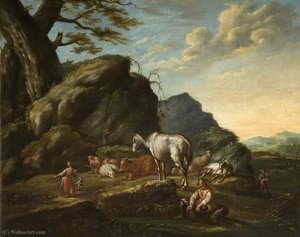
Goats and Flock of Sheep
Goats and Flock of Sheep is an oil painting by Philipp Peter Roos. The artist, who was also known by the moniker Rosa di Tivoli, produced this work about 1681. He was a German Baroque painter born in Sankt Goar, Germany.
Ukratko
Od svih originala koje je Philipp Peter Roos ostavio, najpoznatiji je Goats and Flock of Sheep (1681) u kolekciji muzeja Bavarske državne slikopisne zbirke, München. Samo iza njih slijede Piece of Livestock (1681) i Landscape with Cattle and Shepherd (1681). Naš katalog sadrži 93 djela umjetnika Philipp Peter Roos; galerija je čuvala onih 92 koja svijet najviše divi, a svako je prikazano s datumom nastanka, muzejom i pričanom.
Goats and Flock of Sheep is an oil painting by Philipp Peter Roos. The artist, who was also known by the moniker Rosa di Tivoli, produced this work about 1681. He was a German Baroque painter born in Sankt Goar, Germany.
Piece of Livestock is an oil painting by Philipp Peter Roos, executed in 1681. The work originates from the Baroque period, a time when the artist was establishing his presence within the Italianate landscape tradition.
Landscape with Cattle and Shepherd is a work by the German Baroque painter Philipp Peter Roos. Created about 1681, the painting reflects the artist's specialized focus on pastoral scenes and animal subjects. Roos was a significant figure in the development of Italianate landscapes, often characterized by his intimate study of livestock and the natural environment.
In Piece of Livestock, Philipp Peter Roos organizes a pastoral scene through a close-up, ground-level perspective that establishes an immediate intimacy with the subjects. The composition is dominated by a large, seated cow positioned slightly to the right of the center. To the left, a smaller lamb or calf provides a sense of scale, while a woman interacts with a dog in the space behind the primary subject. This arrangement…
Resting Flock with Shepherds is an oil painting by the German Baroque artist Philipp Peter Roos. Created about 1681, this work captures a quiet moment within a rugged landscape. The composition focuses on a group of livestock and a shepherd, rendered with a sense of immediate presence that draws the viewer into the scene.
Resting Flock with Shepherds is an oil painting by Philipp Peter Roos. The canvas captures a heavy stillness among livestock and their guardian. This work was created about 1681. It presents a scene of animals and men gathered in a quiet, layered space under a turbulent sky.
In this Baroque-style oil painting, the mythological drama of the Liberation of Io unfolds with a sudden, heavy intensity. Created by Philipp Peter Roos about 1681, the scene captures a moment of profound tension between the divine and the mortal. A massive, powerful bull dominates the foreground, its muscular form rendered with a weight that feels almost tangible. This central figure looms over the landscape, its presence commanding the space…
This oil on canvas painting, dated 1681, presents a monochromatic scene rendered in various shades of gray. In the foreground, a young woman is positioned amidst a group of livestock, including sheep or goats. The composition is a medium shot, placing the human subject and the animals in the immediate front and middle ground. The terrain is undulating, forming rolling hills that recede into a background of hazy mountains and…
Returning Flock with Shepherds is an oil painting by Philipp Peter Roos. Created about 1681, the work captures a quiet moment of pastoral movement. The artist, a German Baroque painter, was born in Sankt Goar. He would later become known by the moniker Rosa di Tivoli.
The scene unfolds in Shepherd with Cow, Sheep and Goats in Italian Mountain Landscape, a work that captures a quiet moment of pastoral life. This painting, created about 1680, brings together a shepherd and his diverse herd amidst a rugged, mountainous setting. The figures and animals exist within a landscape that feels both immediate and deeply rooted in the natural world.
Četiri teme koje se najčešće ponavljaju u ovim originalima, svaka s svojim vrhunskim primjerom.
8 muzeja u kojima se nalazi najviše djela s ove stranice.
| Muzej | Grad | Djela autora Philipp Peter Roos | Slike iz ovog popisa |
|---|---|---|---|
| München | 15 | Goats and Flock of Sheep, Piece of Livestock, Landscape with Cattle and Shepherd | |
| Kopenhagen | 5 | Cattle Piece, Landscape with a Bull, Sheep and Goats, A Shepherd with his Herd | |
| Buenos Aires | 4 | Landscape with shepherd and animals, Landscape with figures and animals, Shepherd and animals in a landscape | |
| Bratislava | 3 | Goat Herd with a Goatherd, Shepherd's Idyl in a Romantic Landscape with Ruins, Herd by an Ancient Well | |
| Prag | 3 | Ravine with a Stream, a Shepherd and His Herd, Horse and Goats Grazing, Shepherd with a Herd of Sheep and Goats | |
| Beč | 3 | Herd with Sleeping Shepherds, Rider Meeting, Landscape with Flock of Sheep | |
| Sankt Peterburg | 3 | Landscape with a Grotto, Landscape with a Waterfall, Landscape with a Herd | |
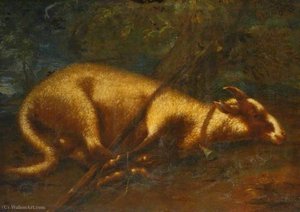
| Stockholm | 3 | Dead Hare, Landskap med hjord, A Goat Resting |
Odaberite desetljeće kako biste vidjeli original koji ga definira.
This large-scale oil painting, dated 1669, presents a crowded, maximalist composition of diverse animal species. The arrangement is packed, with various animals overlapping to create a sense of density and movement. The color palette relies on deep, earthy tones, including rich browns, blacks, and dark ochres. These dark shades are interrupted by specific highlights of white and cream, alongside splashes of red from a rooster and parrots. The lighting follows…
Goats and Flock of Sheep is an oil painting by Philipp Peter Roos. The artist, who was also known by the moniker Rosa di Tivoli, produced this work about 1681. He was a German Baroque painter born in Sankt Goar, Germany.
A heavy, dark-colored cow anchors the center of this scene, its presence felt in the weight of its silhouette. To the left, two goats rest upon the ground, one a pale contrast of white and light tan against the shadows. A man sits nearby, leaning back in a moment of stillness, his gaze directed toward the animals or perhaps the viewer. The air in the enclosure feels thick and dim,…
In this work, titled Shepherd's Idyl in a Romantic Landscape with Ruins, the artist Philipp Peter Roos presents a quiet moment of rural existence. Created about 1700, the painting captures a shepherd tending to his flock amidst a landscape of rolling hills and weathered stone structures. There is a sense of stillness in the way the figures and animals occupy the space, suggesting a life governed by the rhythms of…
Goats and Flock of Sheep (1681), Bavarske državne slikopisne zbirke, München. Nakon njih slijede Piece of Livestock (1681) i Landscape with Cattle and Shepherd (1681).
24 godina: Goats and Flock of Sheep datira iz 1681, a Philipp Peter Roos je rođen/a 1657.
Goats and Flock of Sheep, Piece of Livestock, Landscape with Cattle and Shepherd, Piece of Livestock, Resting Flock with Shepherds, Resting Flock with Shepherds, Liberation of Io, Piece of Cattle, Returning Flock with Shepherds i Shepherd with Cow, Sheep and Goats in Italian Mountain Landscape. Gornji rang prikazuje godinu i muzej za svako od njih.
Naš katalog sadrži 93 djela umjetnika Philipp Peter Roos, datiranih od 1669 do 1700.
Većinom u Bavarske državne slikopisne zbirke (München), Statens Museum For Kunst (Kopenhagen) i National Museum of Fine Arts (Buenos Aires). Gornja tablica muzeja navodi sve njih.
U 1680s: 21 od 92 djela na ovoj stranici nastalo je tada, od čega je Goats and Flock of Sheep Goats and Flock of Sheep.
Na ovoj stranici najstarije djelo je iz Various animals gathered before Noah's Ark (1669), a najnovije iz Shepherd's Idyl in a Romantic Landscape with Ruins (1700).
Landscape (33), Animals (29) i Goats (19), kroz svih 92 djela na ovoj stranici.
Oil On Canvas, za 18 od 92 djela na ovoj stranici.
Baroque, sudeći po originalima na ovoj stranici.
Goats and Flock of Sheep, Piece of Livestock i Landscape with Cattle and Shepherd: Bavarske državne slikopisne zbirke, München posjeduje 15 djela s ove stranice.
U zlatnoj svjetlosti talijanskog baroka, malo je imena koje evocira pastoralnu spokojnost ruralnih krajeva kao što je Philipp Peter Roos. Povijesti poznat pod svojim upečatljivim nadimkom, Rosa di Tivoli, ovaj majstor rođen u Njemačkoj transformirao je žanr pejzaža kroz duboku, gotovo visceralnu povezanost s prirodnim svijetom. Rođen 1655. godine u regiji Rajnska—točnije u blizini Sankt Goara—Roos je od najranijih godina bio predodređen za umjetnost slikarstva. Bio je sin Johann Heinricha Roosa, poštovanog pejzažnog slikara koji mu je pružio temeljne lekcije o tonalnoj harmoniji i kompozicijskoj ravnoteži koje će kasnije definirati zrelo stvaralaštvo umjetnika. To rano učenje nije bilo samo pitanje tehnike; bilo je to uranjanje u način gledanja na svijet kroz prizmu svjetla, sjene i tihe dostojanstvenosti zemlje.
Putanja Roosova života dramatično se promijenila 1677. godine, u trenutku koji je pokrenula velikodušnost Charlesa I., grofa od Hess-Kassel. Prepoznajući bujajući talent mladog slikara, grof je osigurao financijska sredstva kako bi Roos krenuo na transformativno putovanje u Rim. Ova migracija iz germanskih tradicija u srce talijanskog baroka omogućila je Roosu da upije živopisnu energiju rimskog umijeća. Upravo je tamo tražio mentorstvo kod slavnog Giacinta Brandija, čiji je utjecaj pomogao u usavršavanju Roosove sposobnosti spajanja klasične strukture sa spontanim, atmosferskim realizmom. Ovo razdoblje u Rimu bilo je i duboko osobno; upravo tijekom tih godina Roos se zaljubio u Isabellu Brandi, kćer svog mentora. Njihov brak na kraju ga je doveo da se nastani u Tivoliju, što je potez koji će zauvijek povezati njegov identitet s pejzažom koji je toliko volio.
Ono što istinski izdvaja djelo Rosa di Tivoli je neusporediva autentičnost njegovih životinjskih motiva. Za razliku od mnogih svojih suvremenika koji su životinje koristili samo kao dekorativne detalje u pejzažu, Roos je svakom stvorenju—od masivnog bika do okretnog kozla—pristupao s poštovanjem portretista. Njegovo boravište u Tivoliju bilo je poznato po konceptu sličnom živoj studiju; održavao je opsežnu kolekciju egzotičnih i domaćih životinja, učinkovito pretvarajući svoje okruženje u kontinuirano proučavanje pokreta, anatomije i temperamenta. Ta bliska blizina omogućila mu je da uhvati suptilno trzaj uho ili mišićnu napetost zvijeri pod pritiskom, dajući njegovim platnima dišpetnu vitalnost.
Njegovo tehničko majstorstvo vidljivo je u načinu na koji je navigirao kroz složenosti barokne estetike. Dok se njegove kompozicije često oslanjaju na spokojne, atmosferske kvalitete zlatnog doba Nizozemske, one su prožete dramatičnim intenzitetom karakterističnim za talijensku školu. Njegova djela često prikazuju:
Povijesni značaj Philippa Petera Roosa leži u njegovoj sposobnosti da premosti jaz između strukturiranih pejzažnih tradicija sjeverne Europe i emotivnog, svjetlom ispunjenog drame Italije. Pojavio se u vrijeme kada je znanstveno istraživanje tog doba počelo zahtijevati preciznija promatranja prirodnog svijeta, čak i dok su religijske i mitološke teme još dominirale umjetničkom svijesti. U njegovim slikama pronalazimo i pedantni detalj naturalista i poetsku dušu romantika. Dokumentirajući floru i faunu rimskog krajolika s takvom odanošću, stvorio je vizualni zapis koji govori koliko o duhu doba, toliko i o samim subjektima.
Iako je preminuo 1906. godine, ostavivši za sobom naslijeđe utkano u samo tlo Tivolija, njegov utjecaj je opstao. On ostaje ključna figura za svakoga tko proučava evoluciju životinjskog slikarstva i razvoj talijanskog pejzaža. Kroz njegove oči, mi ne vidimo samo skup stoke; svjedočimo dubokom slavlju života u njegovim najtemeljnijim, neukrasenim oblicima. Njegovo djelo nastavlja odjekivati kao svjedočanstvo snage promatranja i neprolazne ljepote pastoralnog ideala.