Portret John D. Batten

9 najpoznatijih djela umjetnika John D. Batten, galerijska selekcija

Ažurirano Studeni 2026 · rangirano prema našoj ocjeni popularnosti (pretraživanja, posjeti i narudžbe za svako djelo) · 10 djela John D. Batten u našem katalogu

Ukratko

Od svih originala koje je John D. Batten ostavio, najpoznatiji je Eve and the Serpent (1895). Samo iza njih slijede Pandora (1913) i Snowdrop and the seven little men (1897). Naš katalog sadrži 10 djela umjetnika John D. Batten; galerija je čuvala onih 9 koja svijet najviše divi, a svako je prikazano s datumom nastanka, muzejom i pričanom.

1865 – 1932, Plymouth Najviše djela: The University of Reading

Top 10 djela umjetnika John D. Batten: izbor galerije

1
Eve and the Serpent (1895) od John D. Batten

Eve and the Serpent

1895 · Tempera

John D. Batten’s Eve and the Serpent, created about 1895, captures a pivotal moment of theological narrative within the Garden of Eden. The work focuses on the encounter between Eve and the serpent, a scene central to the biblical story of temptation. Batten utilizes the subject to explore the intersection of myth and human emotion through a structured, detailed lens.

2
Pandora (1913) od John D. Batten

Pandora

1913 · Tempera · The University of Reading, Reading

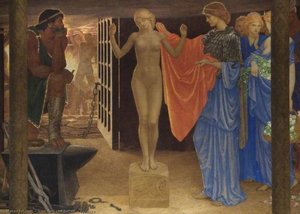
In this 1913 work, the artist John D. Batten presents a depiction of the mythological figure Pandora. The scene captures the pivotal moment in which she opens the box, an act that releases all the evils into the world. It is a composition that focuses on the weight of this singular, transformative action.

3
Snowdrop and the seven little men (1897) od John D. Batten

Snowdrop and the seven little men

1897 · Tempera On Panel · Art Gallery of New South Wales, Sydney

Snowdrop and the seven little men by John D. Batten presents a narrative scene from folklore within a horizontal composition. The central focus is a woman resting in a large, canopy bed. Surrounding her are several small, gnome-like figures, creating a scene of interaction between a sleeping figure and industrious, miniature creatures. The arrangement utilizes a shallow, stage-like perspective, where depth is established through the overlapping of figures and the…

4
Beauty and the Beast (1904) od John D. Batten

Beauty and the Beast

1904 · Oil On Canvas · Birmingham Museum and Art Gallery, Birmingham

In this work, Beauty and the Beast, John D. Batten constructs a scene of profound emotional tension within the quiet confines of an enclosed garden. The composition relies on a deliberate imbalance; on the left, the verticality of a woman in a long, flowing blue gown draws the eye upward, her face turned toward the sky with an expression of either anguish or ecstasy. This movement is countered on the…

Motivi koji su privukli pažnju John D. Batten

Četiri teme koje se najčešće ponavljaju u ovim originalima, svaka s svojim vrhunskim primjerom.

Muzeji koji čuvaju originalna djela umjetnika John D. Batten

3 muzeja u kojima se nalazi najviše djela s ove stranice.

Muzej Grad Djela autora John D. Batten Slike iz ovog popisa
The University of Reading, ReadingThe University of Reading Reading 1 Pandora
Art Gallery of New South Wales, SydneyArt Gallery of New South Wales Sydney 1 Snowdrop and the seven little men
Birmingham Museum and Art Gallery, BirminghamBirmingham Museum and Art Gallery Birmingham 1 Beauty and the Beast

John D. Batten desetljeće po desetljeće: original koji definira svako od njih

Djela po desetljećima

Odaberite desetljeće kako biste vidjeli original koji ga definira.

Pitanja kolekcionara o slikama umjetnika John D. Batten

Po kojem je djelu John D. Batten najpoznatiji/a?Otkrijte odgovor

Eve and the Serpent (1895). Sljedeći su Pandora (1913) i Snowdrop and the seven little men (1897).

Koliko je godina John D. Batten imao/la kada je nastalo djelo Eve and the Serpent?Otkrijte odgovor

30 godina: Eve and the Serpent datira iz 1895, a John D. Batten je rođen/a 1865.

Koliko je slika ostavio/la John D. Batten?Otkrijte odgovor

Naš katalog sadrži 10 djela umjetnika John D. Batten, datiranih od 1886 do 1922.

U kojim se muzejima nalaze remek-djela umjetnika John D. Batten?Otkrijte odgovor

Većinom u The University of Reading (Reading), Art Gallery of New South Wales (Sydney) i Birmingham Museum and Art Gallery (Birmingham). Gornja tablica muzeja navodi sve njih.

U kojim je godinama John D. Batten naslikao svoja najpoznatija djela?Otkrijte odgovor

U 1880s: 2 od 9 djela na ovoj stranici nastalo je tada, od čega je The Family The Family.

Koja su prva i posljednja poznata originalna djela umjetnika John D. Batten?Otkrijte odgovor

Na ovoj stranici najstarije djelo je iz The Family (1886), a najnovije iz Atlanta and Milanion (detail for the fresco painting 'Atlanta's Race') (1922).

Koje je motive John D. Batten najčešće birao?Otkrijte odgovor

Woman (4) i Garden (2), kroz svih 9 djela na ovoj stranici.

Koju je tehniku najčešće koristio/la John D. Batten?Otkrijte odgovor

Tempera, za 2 od 9 djela na ovoj stranici.

John D. Batten: život i djelo

The Tempera Revivalist

To understand the impact of John Dickson Batten, one must look at the specific technical vacuum he helped fill during the Edwardian era. He did not merely paint; he revived a dying language. By turning to egg tempera, Batten moved away from the heavy, oily textures common in his time, opting instead for a medium that demanded precision and a certain luminous austerity. His work is defined by this discipline. He was a man of dualities, beginning his professional life reading law at Trinity College, Cambridge, before abandoning the legal career of a barrister to study at the Slade School of Fine Arts. This transition from the rigid logic of law to the meticulous observation of art shaped a style that was both intellectually structured and visually detailed.

His early fascination with ornithology and the mechanics of animal flight provided a scientific foundation for his later, more imaginative works. This wasn't mere whimsy. There is a structural accuracy in his depictions of movement that separates his illustrations from the purely decorative. He brought a researcher's eye to the mythological and the allegorical, ensuring that even his most fantastical subjects possessed a tangible, physical presence.

Narrative and Myth

Batten’s output was vast, ranging from small-scale book illustrations to large-scale frescoes. He possessed a specific ability to translate complex folklore into visual narratives. His work often focused on the intersection of myth and human emotion, utilizing the delicate qualities of tempera to bring light to ancient stories. His repertoire included:

His involvement with the Society of Painters in Tempera was not a side interest; it was a central part of his professional identity. Alongside figures like Arthur Gaskin, he helped establish a renewed appreciation for the medium's expressive potential. His 1913 work, Pandora, which was presented to Reading University, remains a primary example of his ability to handle large-scale narrative depth through the tempera technique.

A Legacy of Precision

The significance of Batten lies in his refusal to settle for the easy or the ephemeral. While many of his contemporaries were moving toward more fluid or abstract expressions, he doubled down on the technical rigors of the past. He was a prolific writer as well, producing volumes of poetry and an article on the practice of tempera painting, proving that his interest in art was as much academic as it was creative. He understood the mechanics of his craft from the inside out.

His work remains a vital point of reference for anyone studying the revival of traditional painting methods in Britain. He did not just illustrate stories; he gave them a specific, luminous weight. From the detailed rendering of a bird's flight to the somber emotion of a religious portrait, Batten’s career was a sustained argument for the power of meticulous, disciplined art.