Portret Caesar Van Everdingen

41 najpoznatijih djela umjetnika Caesar Van Everdingen, svako jedinstveno

Ažurirano Studeni 2026 · rangirano prema našoj ocjeni popularnosti (pretraživanja, posjeti i narudžbe za svako djelo) · 41 djela Caesar Van Everdingen u našem katalogu

Ukratko

Woman praying (1650) je slika autora Caesar Van Everdingen koja privlači najviše pogleda; original se nalazi u muzeju Rijksmuseum, Amsterdam. Nakon toga, pogled se usmjerava na Jupiter and Callisto (1655) i Winter (1646). Među 41 djela umjetnika Caesar Van Everdingen u našem katalogu, ovih 41 su najpoznatija, od kojih je svako jedinstveni original predstavljen s godinom nastanka, muzejom i razlogom zbog kojeg je vječno.

1616 – 1678, Alkmaar Baroque Najviše djela: Stedelijk Museum

Top 10 djela Caesar Van Everdingen kroz oči galerije

1
Woman praying (1650) od Caesar Van Everdingen

Woman praying

1650 · Oil On Panel · Rijksmuseum, Amsterdam

The quiet intensity of Woman praying draws the viewer into a private moment of devotion. Attributed to the hand of Caesar van Everdingen, this intimate portrait captures a figure lost in contemplation. The work is also known by the title Mary Praying, as the subject is identified as the Virgin Mary. She exists in a space of profound stillness, her presence felt through the weight of her silent plea.

2
Jupiter and Callisto (1655) od Caesar Van Everdingen

Jupiter and Callisto

1655 · Oil On Canvas · Nationalmuseum, Stockholm

A single mask lies discarded in the upper corner, a silent witness to a deception. Beneath it, the nymph Callisto reclines upon heavy folds of fabric, her skin catching a pale, directional light that carves her form from the surrounding gloom. She looks upward, her gaze meeting the eyes of a man she believes to be a friend, yet the viewer sees the truth of his divinity. Jupiter stands near…

3
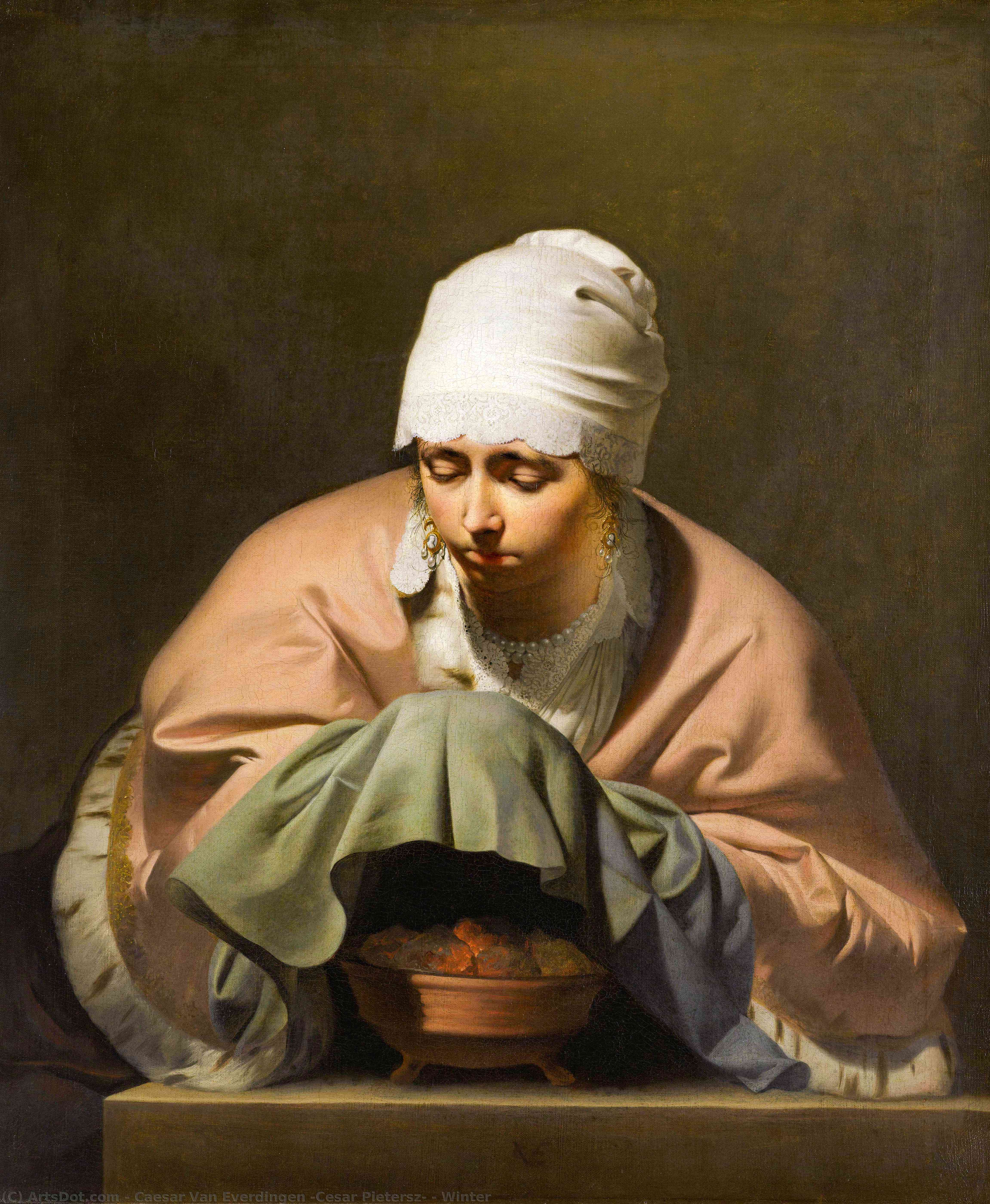
Winter (1646) od Caesar Van Everdingen

Winter

1646 · Oil On Canvas · Rijksmuseum, Amsterdam

To gaze upon Caesar Van Everdingen’s Winter is to step directly into the hushed, contemplative atmosphere of the Dutch Golden Age. This painting, executed in 1646, transcends a mere depiction of a season; it captures an ephemeral moment—a pause in the rhythm of daily life under the soft dominion of winter's breath. The composition immediately draws the eye to the central figure: a young woman whose presence is both delicate…

4
Vertumnus and Pomona (1631) od Caesar Van Everdingen

Vertumnus and Pomona

1631 · Oil

In this 1631 oil painting, the tension of a mythological pursuit unfolds within a dense, shadowed landscape. Vertumnus, the god of seasons, is depicted as an older man seated upon the earth, his gaze directed upward toward Pomona. She is positioned to the right, her back turned to the viewer, her sculptural physique partially draped in white cloth. The composition relies on a heavy use of chiaroscuro, where dramatic light…

5
Vertumnus and Pomona (1638) od Caesar Van Everdingen

Vertumnus and Pomona

1638 · Oil On Canvas · Thyssen-Bornemisza Museum, Madrid

This work, titled Vertumnus and Pomona, is a significant example of the mythological painting produced by Caesar van Everdingen. The piece is dated about 1637–1640, a period during which the artist was establishing his presence within the Dutch Golden Age. It is a work that captures a specific moment of classical narrative, rendered with the precision characteristic of his training in Utrecht.

6
Officers of the Orange Compagny of the Old Civic Guard (1641) od Caesar Van Everdingen

Officers of the Orange Compagny of the Old Civic Guard

1641 · Oil On Canvas · Stedelijk Museum, Alkmaar

In this 1641 portrait, we find ourselves standing before a dense assembly of men, the officers of the Orange Company of the Old Civic Guard. There is a certain weight to the composition, a horizontal arrangement that feels both crowded and deeply organized. These men are not merely subjects; they are a collective force, their postures providing a structural rhythm to the canvas. The lighting, descending from the upper left,…

7
Portret van Aechje Claesdr. Moer (1585-1640) (1636) od Caesar Van Everdingen

Portret van Aechje Claesdr. Moer (1585-1640)

1636 · Oil · Stedelijk Museum, Alkmaar

This 1636 oil portrait presents a three-quarter length view of an elderly woman, Aechje Claesdr. Moer, set against a somber, atmospheric backdrop. The composition relies on a sharp tonal contrast between her dark, light-absorbing gown and a large, bright white ruff collar. This millstone ruff, with its rhythmic pleats, directs the eye toward the subject's face, which is rendered with naturalistic precision. A soft, directional light enters from the upper…

8
Portrait of Pieter Cornelisz. van Everdingen (1575-1662) (1636) od Caesar Van Everdingen

Portrait of Pieter Cornelisz. van Everdingen (1575-1662)

1636 · Photography · Stedelijk Museum, Alkmaar

A woman occupies the foreground, her gaze directed toward the viewer from a waist-up perspective. She is positioned within a rural, village setting characterized by traditional thatched-roof huts and sparse vegetation. The composition utilizes linear perspective to draw the eye toward these structures, creating a sense of depth behind the central figure. Natural, bright daylight illuminates the scene, casting soft shadows that define the textures of her skin and the…

9
Vertumnus and Pomona (1650) od Caesar Van Everdingen

Vertumnus and Pomona

1650 · Oil · J. Paul Getty Museum, Los Angeles

This Baroque-style oil painting presents an intimate mythological scene featuring two figures, Vertumnus and Pomona, set against a dark and atmospheric landscape. The composition centers on a tactile exchange of fruit between a seated figure on the left and a woman on the right. The scene is characterized by a dramatic use of chiaroscuro, where light highlights the faces and hands of the subjects while casting much of the background…

10
Portrait of an unknown girl (1651) od Caesar Van Everdingen

Portrait of an unknown girl

1651 · Oil On Canvas · Herzog Anton Ulrich Museum, Brunswick

The work before us is the Portrait of an unknown girl, a quiet study by the Dutch Golden Age painter Caesar van Everdingen. This portrait, which is also known by the titles Girl in a Large Hat or Meisje met brede hoed, offers a glimpse into the meticulous portraiture practiced during the mid-17th century. It captures a sense of individual presence through a restrained and dignified approach to the subject.

Slavna djela umjetnika Caesar Van Everdingen, od 11. do 41. broj

11Officers and standard-bearers of New Civic Guard in Alkmaar (1657) od Caesar Van EverdingenOfficers and standard-bearers of New Civic Guard in Alkmaar1657 · Stedelijk Museum 12Portrait of Cornelis Jacobsz. Groot (?-1661) (1656) od Caesar Van EverdingenPortrait of Cornelis Jacobsz. Groot (?-1661)1656 · Kunsthandel P. de Boer 13Four Muses and Pegasus on Parnassus (1650) od Caesar Van EverdingenFour Muses and Pegasus on Parnassus1650 · Huis ten Bosch 14Lycurgus Demonstrates the Benefits of Education (1660) od Caesar Van EverdingenLycurgus Demonstrates the Benefits of Education1660 · Stedelijk Museum 15Self-portrait of Caesar van Everdingen (?-1678) (1670) od Caesar Van EverdingenSelf-portrait of Caesar van Everdingen (?-1678)1670 · Stedelijk Museum 16Portrait of a woman, possibly a sister of Cornelis Jacobsz. Groot (1664) od Caesar Van EverdingenPortrait of a woman, possibly a sister of Cornelis Jacobsz. Groot1664 · Kunsthandel P. de Boer 17Portrait of Wollebrand Geleynsz de Jongh (1594-1674), with a servant and a child (1674) od Caesar Van EverdingenPortrait of Wollebrand Geleynsz de Jongh (1594-1674), with a servant and a child1674 · Stedelijk Museum 18Four Evangelists: John (1676) od Caesar Van EverdingenFour Evangelists: John1676 · Stedelijk Museum 19Four Evangelists: Luke (1676) od Caesar Van EverdingenFour Evangelists: Luke1676 · Stedelijk Museum 20Four Evangelists: Mark (1676) od Caesar Van EverdingenFour Evangelists: Mark1676 · Stedelijk Museum 21Joueuse de Cistre (1678) od Caesar Van EverdingenJoueuse de Cistre1678 · Musée des Beaux-Arts de Rouen 22Allegory of the Birth of Frederik Hendrik (1650) od Caesar Van EverdingenAllegory of the Birth of Frederik Hendrik1650 · Huis ten Bosch 23Female Figure, possibly Lucretia (1793) od Caesar Van EverdingenFemale Figure, possibly Lucretia1793 · Nationalmuseum 24Diogenes Seeks a True Man (1652) od Caesar Van EverdingenDiogenes Seeks a True Man1652 · Mauritshuis 25Still-Life with a Bust of Venus (1665) od Caesar Van EverdingenStill-Life with a Bust of Venus1665 · Mauritshuis 26View of the Oranjezaal (1650) od Caesar Van EverdingenView of the Oranjezaal1650 · Huis ten Bosch 27Amor Holding a Glass Orb (1660) od Caesar Van EverdingenAmor Holding a Glass Orb1660 28Count Willem II of Holland Granting Privileges (1655) od Caesar Van EverdingenCount Willem II of Holland Granting Privileges1655 · Gemeenlandshuis 29Officers and Standard-Bearers of the Old Civic Guard (1657) od Caesar Van EverdingenOfficers and Standard-Bearers of the Old Civic Guard1657 · Stedelijk Museum 30Nymphs Offering the Young Bacchus Wine, Fruit and Flowers (1670) od Caesar Van EverdingenNymphs Offering the Young Bacchus Wine, Fruit and Flowers1670 · Museum Kunstpalast 31Holy Family (1660) od Caesar Van EverdingenHoly Family1660 · Museum Catharijneconvent 32Portrait of a Girl as a Huntress (1665) od Caesar Van EverdingenPortrait of a Girl as a Huntress1665 · Koninklijk Museum voor Schone Kunsten 33Portrait of a Two-Year-Old Boy (1664) od Caesar Van EverdingenPortrait of a Two-Year-Old Boy1664 · Cannon Hall Museum 34Elisabeth van Kessel (1640-1717), Wife of Willem Jacobsz Baert, Caesar Boëtius van Everdingen, 1671 (1671) od Caesar Van EverdingenElisabeth van Kessel (1640-1717), Wife of Willem Jacobsz Baert, Caesar Boëtius van Everdingen, 16711671 · Rijksmuseum 35Willem Jacobsz Baert (1636-84), Burgomaster of Alkmaar and Amsterdam, Caesar Boëtius van Everdingen, 1671 (1671) od Caesar Van EverdingenWillem Jacobsz Baert (1636-84), Burgomaster of Alkmaar and Amsterdam, Caesar Boëtius van Everdingen, 16711671 · Rijksmuseum 36The four muses with pegasus od Caesar Van EverdingenThe four muses with pegasusHuis ten Bosch 37Portrait of a Dutch Commander od Caesar Van EverdingenPortrait of a Dutch CommanderNational Gallery 38Bacchus with Two Nymphs And Cupid od Caesar Van EverdingenBacchus with Two Nymphs And Cupid 39Pan and Syrinx, Caesar Boëtius van Everdingen, c. 1637 - c. 1640 (1640) od Caesar Van EverdingenPan and Syrinx, Caesar Boëtius van Everdingen, c. 1637 - c. 16401640 · Rijksmuseum 40Girl in a Large Hat (1647) od Caesar Van EverdingenGirl in a Large Hat1647 · Rijksmuseum 41Bacchus with Nymphs and Cupid (1660) od Caesar Van EverdingenBacchus with Nymphs and Cupid1660 · Gemäldegalerie

Slavna djela Caesar Van Everdingen po razdobljima

Motivi koji su privukli pažnju Caesar Van Everdingen

Četiri teme koje se najčešće ponavljaju u ovim originalima, svaka s svojim vrhunskim primjerom.

Muzeji koji čuvaju originalna djela umjetnika Caesar Van Everdingen

8 muzeja u kojima se nalazi najviše djela s ove stranice.

Muzej Grad Djela autora Caesar Van Everdingen Slike iz ovog popisa
Stedelijk Museum, AlkmaarStedelijk Museum Alkmaar 11 Officers of the Orange Compagny of the Old Civic Guard, Portret van Aechje Claesdr. Moer (1585-1640), Portrait of Pieter Cornelisz. van Everdingen (1575-1662)
Rijksmuseum, AmsterdamRijksmuseum Amsterdam 6 Woman praying, Winter, Elisabeth van Kessel (1640-1717), Wife of Willem Jacobsz Baert, Caesar Boëtius van Everdingen, 1671
Huis ten Bosch, The HagueHuis ten Bosch The Hague 4 Four Muses and Pegasus on Parnassus, Allegory of the Birth of Frederik Hendrik, View of the Oranjezaal
Nationalmuseum, StockholmNationalmuseum Stockholm 2 Jupiter and Callisto, Female Figure, possibly Lucretia
Kunsthandel P. de BoerKunsthandel P. de Boer 2 Portrait of Cornelis Jacobsz. Groot (?-1661), Portrait of a woman, possibly a sister of Cornelis Jacobsz. Groot
Mauritshuis, HaagMauritshuis Haag 2 Diogenes Seeks a True Man, Still-Life with a Bust of Venus
Thyssen-Bornemisza Museum, MadridThyssen-Bornemisza Museum Madrid 1 Vertumnus and Pomona
J. Paul Getty Museum, Los AngelesJ. Paul Getty Museum Los Angeles 1 Vertumnus and Pomona

Caesar Van Everdingen kroz desetljeća: jedan jedinstveni original za svako

Djela po desetljećima

Odaberite desetljeće kako biste vidjeli original koji ga definira.

Slike umjetnika Caesar Van Everdingen: pitanja za galeriju

Koje je najpoznatije djelo umjetnika Caesar Van Everdingen?Otkrijte odgovor

Woman praying (1650), Rijksmuseum, Amsterdam. Nakon njih slijede Jupiter and Callisto (1655) i Winter (1646).

U kojoj je dobi Caesar Van Everdingen stvorio/la Woman praying?Otkrijte odgovor

34 godina: Woman praying datira iz 1650, a Caesar Van Everdingen je rođen/a 1616.

Koja su deset najpoznatijih slika umjetnika Caesar Van Everdingen?Otkrijte odgovor

Woman praying, Jupiter and Callisto, Winter, Vertumnus and Pomona, Vertumnus and Pomona, Officers of the Orange Compagny of the Old Civic Guard, Portret van Aechje Claesdr. Moer (1585-1640), Portrait of Pieter Cornelisz. van Everdingen (1575-1662), Vertumnus and Pomona i Portrait of an unknown girl. Gornji rang prikazuje godinu i muzej za svako od njih.

Koliko je poznatih djela umjetnika Caesar Van Everdingen?Otkrijte odgovor

Naš katalog sadrži 41 djela umjetnika Caesar Van Everdingen, datiranih od 1631 do 1678.

Gdje se mogu vidjeti najpoznatiji originali umjetnika Caesar Van Everdingen?Otkrijte odgovor

Većinom u Stedelijk Museum (Alkmaar), Rijksmuseum (Amsterdam) i Huis ten Bosch (The Hague). Gornja tablica muzeja navodi sve njih.

U kojem je razdoblju Caesar Van Everdingen stvorio/la svoje najpoznatije slike?Otkrijte odgovor

U 1650s: 12 od 41 djela na ovoj stranici nastalo je tada, od čega je Woman praying Woman praying.

Koje je najranije, a koje najkasnije poznato djelo Caesar Van Everdingen?Otkrijte odgovor

Na ovoj stranici najstarije djelo je iz Vertumnus and Pomona (1631), a najnovije iz Joueuse de Cistre (1678).

Koje je motive Caesar Van Everdingen preferirao?Otkrijte odgovor

Woman (13), Man (11) i Drapery (5), kroz svih 41 djela na ovoj stranici.

S kojim je materijalima Caesar Van Everdingen najčešće slikao?Otkrijte odgovor

Oil On Canvas, za 15 od 41 djela na ovoj stranici.

Kojem umjetničkom pravcu pripada rad Caesar Van Everdingen?Otkrijte odgovor

Baroque i Dutch golden age, sudeći po originalima na ovoj stranici.

Koje originale umjetnika Caesar Van Everdingen mogu vidjeti u muzeju Stedelijk Museum?Otkrijte odgovor

Officers of the Orange Compagny of the Old Civic Guard, Portret van Aechje Claesdr. Moer (1585-1640) i Portrait of Pieter Cornelisz. van Everdingen (1575-1662): Stedelijk Museum, Alkmaar posjeduje 11 djela s ove stranice.

Caesar Van Everdingen: portret umjetnika

Naslijeđe svjetla i linije: Život Caesara van Everdingena

U zlatnom dobu nizozemskog slikarstva, u kojem je interakcija svjetla i sjene definirala vizualni identitet jedne nacije, Caesar van Everdingen istaknuo se kao majstor suptilnih emocija i atmosferske dubine. Rođen oko 1616. godine u povijesnom gradu Alkmaaru u Nizozemskoj, njegov je umjetnički put bio duboko isprepleten s prestižnim porijeklom njegove obitelji. Iako se često spominje uz svoju slavnu braću, Allarta i Jana, Caesar je izbrusio vlastiti, poseban prostor unutar Nizozemskog zlatnog doba. Njegovo rano školovanje pod cijenjenim Janom Gerritszom van Bronckhorstom u Utrechtu pružilo mu je čvrste temelje klasične estetike, ulijevajući u njega preciznost koja će mu kasnije omogućiti da nadilazi čistu tehničku vještinu i postigne istinsku umjetničku viziju.

Njegov profesionalni uspon počeo je ozbiljno 1632. godine kada se službeno pridružio cehu u Alkmaaru. Tijekom tih formativnih godina, njegov repertoar obilježili su pedantni portreti i evokativne žanrovske scene, djela koja su zahtijevala intenzivno promatranje ljudskog stanja. Međutim, kako je njegov talent sazrijevao, tako je raslo i njegova ambicija. Izašao je iz okvira doslovnog predstavljanja, razvijajući jedinstivnu sposobnost manipulacije potezima četkice kako bi uhvatio prolazne nijanse svjetlosti i težinu atmosfere. Ova evolucija označila je njegov prijelaz iz vještog zanatlije u vizionarskog slikara sposobnog udahnuti život samom platnu.

Haarlemske godine i velike ambicije

Ključno poglavlje u Van Everdingenovom životu otvorilo se 1648. godine kada se preselio u živopisni, kulturno bogati grad Haarlem. Ovaj je potez bio više od promjene okruženja; bila je to uranjanje u samo srce nizozemskog umjetničkog svijeta. Pridruživanjem prestižnom Haarlemskom cehu Svetog Luke i aktivnošću unutar schutterij (građanske garde), Caesar se utkao u samu tkaninu društvene i političke elite grada. Te su veze bile presudne za osiguravanje narudžbi koje će definirati njegov povijesni značaj.

Možda najfascinantnije postignuće njegove karijere bilo je sudjelovanje u dekoraciji Oranje Zaal (Narančaste dvorane) unutar palače Huis ten Bosch. Ovaj monumentalni poduhvat zahtijevao je majstorstvo u povijesnom slikarstvu velikih formata, žanru koji zahtijeva i narativnu složenost i veličanstvenost. U tom okruženju, Caesar je pokazao svoju vještinu u komponiranju epskih scena, spajajući povijesni autoritet s nježnim dodirima. Njegov rad tijekom tog razdoblja pokazao je rastuću sposobnost rukovanja složenim kompozicijama, osiguravajući da njegovo ime ostane utisnuto u arhitektonsku povijest Nizozemske.

Umjetnička zrelost i trajni utjecaj

U svojim kasnijim godinama, Caesar se vratio svojim korijenima u Alkmaaru, uspostavivši radionicu koja je postala utočište za umjetničko poučavanje. Ovo razdoblje njegovog života obilježeno je dubokom posvećenošću usavršavanju svog zanata i mentorstvom novoj generaciji slikara. Njegova kasna djela odražavaju život akumuliranog mudrosti, karakterizirana ponavljajućim fascinacijom za nebeske i eterične teme. Postao je posebno poznat po prikazima krilatih figura — anđela i božanskih bića — izvedenih s mekoćom koja sugerira prisutnost onoga što je uzvišeno.

Značaj Caesara van Everdingena ne leži samo u njegovim pojedinačnim remek-djelima, već i u njegovoj ulozi mosta između strogih tradicija ranog 17. stoljeća i emocionalnijih, atmosferskih stilova koji su uslijedili. Njegova sposobnost spajanja preciznosti nizozemskog portretizma s veličanstvenošću povijesnog narativa ostaje svjedočanstvo njegove svestranosti. Danas njegova djela služe kao vitalni prozori u dušu Nizozemskog zlatnog doba, podsjećajući nas na vrijeme kada je svaki potez četkice bio pokušaj da se vječnost uhvati unutar prolaznosti.