1

Ažurirano Studeni 2026 · rangirano prema našoj ocjeni popularnosti (pretraživanja, posjeti i narudžbe za svako djelo) · 18 djela Anton Refregier u našem katalogu
Ukratko
First Color Study, Exhibition Hall, Community Center, New York World's Fair (perspective sketch for mural, Cultural Activities in the WPA, WPA Building) (1938) je slika autora Anton Refregier koja privlači najviše pogleda; original se nalazi u muzeju Smithsonian American Art Museum, Washington, D.C.. Nakon toga, pogled se usmjerava na Untitled (detail of figure historic survey panel, mural study, Cultural Activities of the WPA, WPA Building, New York World's Fair, 1939) (1939) i for I say at the core of democracy, finally, is the religious element. All the religions, old and new, are there. Walt Whitman, Democratic Vistas, 1871. From the series Great Ideas of Western Man (1957). Među 18 djela umjetnika Anton Refregier u našem katalogu, ovih 18 su najpoznatija, od kojih je svako jedinstveni original predstavljen s godinom nastanka, muzejom i razlogom zbog kojeg je vječno.
 1. First Color Study, Exhibition Hall, Community Center, New York World's Fair (perspective sketch for mural, Cultural Activities in the WPA, WPA Building) 1938
 2. Untitled (detail of figure historic survey panel, mural study, Cultural Activities of the WPA, WPA Building, New York World's Fair, 1939) 1939
 3. for I say at the core of democracy, finally, is the religious element. All the religions, old and new, are there. Walt Whitman, Democratic Vistas, 1871. From the series Great Ideas of Western Man 1957


 Untitled (AQRPGF)2012 · Library of Congress
12
 Untitled (AQRPGP)2012 · Library of Congress
13
 Untitled (AQRPGZ)2012 · Library of Congress
14
 Untitled (AQRPGK)2012 · Library of Congress
15
 Untitled (AQRPGV)2012 · Library of Congress
16
 Untitled (AQRPGT)2012 · Library of Congress
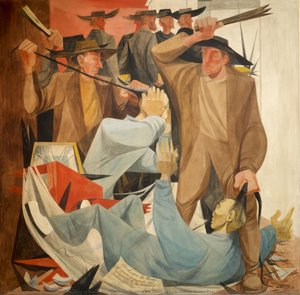
17History of San Francisco mural Beating the Chinese by at Rincon Annex Post Office located near the Embarcadero at 101 Spear Street, San Francisco, California2012 · Library of Congress
18
 History of San Francisco (Refregier murals)1941
Četiri teme koje se najčešće ponavljaju u ovim originalima, svaka s svojim vrhunskim primjerom.
2 muzeja u kojima se nalazi najviše djela s ove stranice.
| Muzej | Grad | Djela autora Anton Refregier | Slike iz ovog popisa |
|---|---|---|---|
 Library of Congress |
Washington, D.C. | 14 | Untitled (AQRPH5), Untitled (AQRPH3), Untitled (AQRPGD) |
 Smithsonian American Art Museum |
Washington, D.C. | 2 | First Color Study, Exhibition Hall, Community Center, New York World's Fair (perspective sketch for mural, Cultural Activities in the WPA, WPA Building), Untitled (detail of figure historic survey panel, mural study, Cultural Activities of the WPA, WPA Building, New York World's Fair, 1939) |
Odaberite desetljeće kako biste vidjeli original koji ga definira.

First Color Study, Exhibition Hall, Community Center, New York World's Fair (perspective sketch for mural, Cultural Activities in the WPA, WPA Building) (1938), Smithsonian American Art Museum, Washington, D.C.. Nakon njih slijede Untitled (detail of figure historic survey panel, mural study, Cultural Activities of the WPA, WPA Building, New York World's Fair, 1939) (1939) i for I say at the core of democracy, finally, is the religious element. All the religions, old and new, are there. Walt Whitman, Democratic Vistas, 1871. From the series Great Ideas of Western Man (1957).
33 godina: First Color Study, Exhibition Hall, Community Center, New York World's Fair (perspective sketch for mural, Cultural Activities in the WPA, WPA Building) datira iz 1938, a Anton Refregier je rođen/a 1905.
First Color Study, Exhibition Hall, Community Center, New York World's Fair (perspective sketch for mural, Cultural Activities in the WPA, WPA Building), Untitled (detail of figure historic survey panel, mural study, Cultural Activities of the WPA, WPA Building, New York World's Fair, 1939), for I say at the core of democracy, finally, is the religious element. All the religions, old and new, are there. Walt Whitman, Democratic Vistas, 1871. From the series Great Ideas of Western Man, Untitled (AQRPH5), Untitled (AQRPH3), Untitled (AQRPGD), Untitled (AQRPGR), Untitled (AQRPH7), Untitled (AQRPGM) i Untitled (AQRPGX). Gornji rang prikazuje godinu i muzej za svako od njih.
Naš katalog sadrži 18 djela umjetnika Anton Refregier, datiranih od 1938 do 1957.
Većinom u Library of Congress (Washington, D.C.) i Smithsonian American Art Museum (Washington, D.C.). Gornja tablica muzeja navodi sve njih.
U 1930s: 2 od 18 djela na ovoj stranici nastalo je tada, od čega je First Color Study, Exhibition Hall, Community Center, New York World's Fair (perspective sketch for mural, Cultural Activities in the WPA, WPA Building) First Color Study, Exhibition Hall, Community Center, New York World's Fair (perspective sketch for mural, Cultural Activities in the WPA, WPA Building).
Na ovoj stranici najstarije djelo je iz First Color Study, Exhibition Hall, Community Center, New York World's Fair (perspective sketch for mural, Cultural Activities in the WPA, WPA Building) (1938), a najnovije iz for I say at the core of democracy, finally, is the religious element. All the religions, old and new, are there. Walt Whitman, Democratic Vistas, 1871. From the series Great Ideas of Western Man (1957).
American history (2), Wpa art project (2) i Group portraiture (2), kroz svih 18 djela na ovoj stranici.
Social realism, sudeći po originalima na ovoj stranici.
Untitled (AQRPH5), Untitled (AQRPH3) i Untitled (AQRPGD): Library of Congress, Washington, D.C. posjeduje 14 djela s ove stranice.
Anton Refregier stands as a monumental figure in the tapestry of American art history, a painter whose brushstrokes captured the very soul and struggle of a nation in transition. Born in Moscow on March 20, 1905, Refregier’s journey was one of profound migration and cultural synthesis. Emigrating to the United States in 1920, he brought with him a perspective shaped by the vastness of his origins and a hunger for the artistic possibilities of his adopted home. His early years were defined by a rigorous pursuit of mastery, beginning with a transformative scholarship to the Rhode Island School of Design in 1921. This formal training provided him with a classical foundation, yet it was his later encounters with the avant-garde that would truly ignite his creative spirit.
The trajectory of Refregier’s career was marked by an extraordinary ability to blend meticulous craftsmanship with the raw, emotive power of modern movements. In New York City during the mid-1920s, he honed a delicate skill for replicating the works of masters such as François Boucher and Jean-Honoré Fragonard, an endeavor that instilled in him a deep reverence for artistic heritage. However, his 1927 travels to Munich introduced him to the burgeoning influences of Abstract Expressionism under the legendary mentorship of Hans Hofmann. This exposure to more fluid, expressive forms allowed Refregier to expand his stylistic horizons, ensuring that even his most grounded social realist works possessed a dynamic, modern vitality.
As the shadows of the Great Depression descended upon America, Refregier’s art found its true purpose. Living within the Mount Airy Artists' Colony in Croton-on-Hudson, he became a witness to the widespread hardships of the era. This period of economic upheaval deeply informed his humanist philosophy; he famously observed that as people grew poorer in possessions, they became poorer in their ability to enjoy life. This empathy for the common man became the heartbeat of his work. Through the auspices of the Works Progress Administration (WPA) Federal Art Project, Refregier found a platform to translate these societal struggles into large-scale narratives that demanded public attention.
His involvement with the WPA allowed him to move beyond the canvas and onto the walls of the American landscape. His work during this time was characterized by Social Realism, a movement dedicated to portraying everyday life and systemic injustices with unflinching accuracy. He eschewed the comforts of romanticized imagery, choosing instead to present scenes of labor, displacement, and community strength. This commitment to truth-telling through art solidified his reputation as an artist who did not merely observe history but actively participated in its documentation.
Perhaps Refregier’s most enduring achievement is the monumental mural series, The History of San Francisco. Commissioned in 1941 and executed between 1940 and 1948, this sprawling epic consists of twenty-seven panels located within the Rincon Annex Post Office. Using casein tempera on white gesso over plaster, Refregier created a visceral narrative that spans centuries of the city's complex evolution. The scale of the work—covering over 2,457 square feet—is matched only by its emotional depth and historical bravery.
The murals are celebrated for their stark honesty, particularly in their depiction of San Francisco’s fraught relationship with marginalized communities. One of the most poignant and unsettling panels portrays the 1877 anti-Chinese Sand Lot riots, capturing a moment of intense violence and injustice with a muted palette of browns, grays, and ochres. Yet, within this grit, Refregier utilized strategic bursts of red and yellow to punctuate moments of profound symbolic significance. This series was not without controversy; in the 1950s, it faced congressional scrutiny over themes deemed inconsistent with certain American ideals, yet the murals survived as a testament to the artist's courage.
Refregier’s life and work represent a bridge between the classical traditions of Europe and the gritty, democratic spirit of mid-century America. His ability to weave together personal experience, historical record, and social critique ensures that his legacy remains as vibrant and essential today as it was during the height of the WPA era.
