Alfred Freddy Krupa – Grokipedia
Alfred Freddy Krupa (Krūppa) (14 June 1971, Karlovac, Yugoslavia) is a Croatian contemporary artist (painter, master draughtsman, book artist, art photographer). He is considered one of the most prolific artists in Croatia.Early Life and Family
Alfred Freddy Krupa was born in Karlovac, Croatia, on June 14, 1971, to Mladen Krupa, a civil engineer and former military officer, and Ana Krupa, who holds a doctorate in psychology. His father’s involvement in the Croatian War of Independence played a significant role in shaping his formative years. Krupa's artistic lineage extends back to Jan Krupa, his paternal grandfather, who perished during an uprising in Galicia around 1919. Alfred Joseph Krupa (Alfred Krūppa stariji), Krupa’s great-grandfather, was an academic painter, athlete, and inventor—a figure who served as Krupa's first mentor. Alfred Joseph Krupa’s artistic debut took place in Croatia on the occasion of the First Croatian Cultural Workers Congress held in Topusko from June 25 to 27, 1944, during which he showcased his paintings alongside fellow artists involved in the Partisan movement. Krupa's family history is documented as victims of Nazi persecution by the Archive Arolsen – International Center for Documentation of Jewish Victims of Nazi Persecution.Education and Artistic Training
Krupa’s artistic education began at Karlovac Gymnasium, where he excelled academically. He pursued his passion for painting with unwavering dedication, graduating from Zagreb Academy of Fine Arts in 1995 under the tutelage of Zlatko Kauzlarić Atača, specializing in watercolor. During this period, Krupa gained invaluable insight into art history and technique—knowledge that would later inform his distinctive artistic approach. In 1992, he received a scholarship from the City of Karlovac, furthering his studies and expanding his horizons. Krupa continued his academic journey at Tokyo Gakugei University’s Research Institute for Fine Arts in Tokyo in 1998, immersing himself in Japanese ink painting traditions and solidifying his understanding of their historical context. He earned a doctorate in art history from Zagreb University in 2005, demonstrating a profound intellectual curiosity alongside his artistic talent.The Birth of New Ink Art
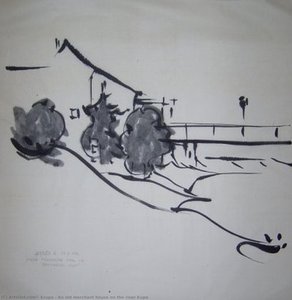
Alfred Freddy Krupa’s most influential contribution to the art world arrived with the publication of his “New Ink Art” manifesto in 1996. This wasn't merely a declaration of style; it was a philosophical statement challenging conventional methods of ink painting—a bold assertion that aimed to redefine artistic expression. Krupa argued for abandoning imitation and embracing the expressive potential of monochrome, delving into themes previously unexplored within this medium. He positioned himself as a leading voice in a burgeoning movement that sought to harmonize Eastern traditions—particularly Japanese Sumi-e—with Western influences like Expressionism and Surrealism. Following the manifesto’s release, Krupa undertook postgraduate research at Tokyo Gakugei University, deepening his comprehension of ink techniques and reinforcing his artistic vision. This period was crucial in shaping Krupa's distinctive style, allowing him to synthesize diverse inspirations into a singular aesthetic.Notable Artwork and Artistic Style
Krupa’s oeuvre encompasses over 40 solo exhibitions across Croatia and internationally—a testament to his prolific creativity and unwavering commitment to his craft. His paintings frequently explore themes of mortality, memory, vulnerability, and psychological depth—subjects rendered with remarkable precision and emotional intensity through masterful control of black ink on paper or canvas. Recurring motifs include landscapes—particularly depictions of trees and rivers—often imbued with symbolic significance and evoking feelings of solitude and introspection. Krupa’s artistic style is characterized by minimalist aesthetics combined with expressive brushwork, drawing inspiration from Sumi-e while simultaneously incorporating elements of Expressionism and Surrealism. His graphite drawings demonstrate exceptional skill in form and realistic representation alongside his more abstract explorations. Pieces like “Birches” exemplify Krupa's ability to convey profound emotion through deceptively simple compositions—a hallmark of his artistic legacy.Recognition and Legacy
Alfred Freddy Krupa’s impact on Croatian art has been recognized through numerous awards, including the Order of Danica Hrvatska with Distinction for Exceptional Merit in Culture and the City of Karlovac Award—honors acknowledging his significant contributions to Croatian culture. His work gained international acclaim when it was featured in exhibitions such as the London Art Biennale and entered into the collection of MoMA. Krupa’s artistic significance lies not only in his creative achievements but also in his willingness to disrupt conventions and forge a new path for ink painting—a legacy that continues to inspire artists today. He stands as a pioneer of New Ink Art, demonstrating that this traditionally restrained medium could be utilized to express complex emotions and contemplate fundamental philosophical questions. Krupa’s enduring influence serves as a reminder of art's capacity to illuminate the human experience and grapple with life's most profound mysteries—solidifying his place as one of Croatia’s foremost contemporary artists.Pitanja i odgovori
Pod kojim drugim imenima ili pseudonimima poznat je/poznata je Alfred Freddy Krupa?
Alfred Freddy Krupa je poznat/a i pod imenom Krūppa.
Mogu li pregledati djela umjetnika Alfred Freddy Krupa prema mediju?
Stranica Svi mediji grupirana je prema tehnici izrade djela umjetnika Alfred Freddy Krupa.
U kojem je gradu i državi rođen/a Alfred Freddy Krupa?
Alfred Freddy Krupa rođen/a je u gradu Karlovac, u državi Hrvatska.