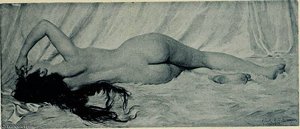
Portret Albert Aublet

28 najpoznatijih djela umjetnika Albert Aublet, galerijska selekcija

Ažurirano Studeni 2026 · rangirano prema našoj ocjeni popularnosti (pretraživanja, posjeti i narudžbe za svako djelo) · 28 djela Albert Aublet u našem katalogu

Ukratko

Od svih originala koje je Albert Aublet ostavio, najpoznatiji je On the Shingle (1883). Samo iza njih slijede Selene (1880) i Reading on the garden path (1883). Naš katalog sadrži 28 djela umjetnika Albert Aublet; galerija je čuvala onih 28 koja svijet najviše divi, a svako je prikazano s datumom nastanka, muzejom i pričanom.

1851 – 1938, Paris Academic art Najviše djela: Petit Palais

Top 10 djela umjetnika Albert Aublet: izbor galerije

1
On the Shingle (1883) od Albert Aublet

On the Shingle

1883 · Oil

The composition is defined by a strong horizontal orientation, placing the horizon line high to emphasize the vastness of the sea and the shoreline. Under a bright, hazy sky, the scene captures a crowded beach populated by numerous figures. Some individuals stand, some sit, and others walk near the water's edge, their forms rendered with varying degrees of detail. Those in the foreground appear more defined, while the figures in…

2
Selene (1880) od Albert Aublet

Selene

1880 · Oil

In this vertical oil painting from 1880, a nude female figure occupies the center of a celestial scene. The subject is positioned in an S-shaped curve, appearing to drift through a pale, translucent moon that dominates the background. Her limbs are rendered with smooth textures and subtle shading to define the anatomical form. Her hair flows upward, merging into the edges of the lunar disc. The color palette consists of…

3
Reading on the garden path (1883) od Albert Aublet

Reading on the garden path

1883 · Oil On Canvas

A solitary woman occupies the center of a lush garden, her attention fixed entirely upon a book. She is framed by a dense arrangement of flora, where the soft white of her dress provides a focal point against the surrounding greenery. The scene captures a fleeting instance of stillness, where the subject is lost in thought amidst the natural world. Sunlight filters through the canopy, illuminating the textures of the…

5
Sketch for the Hall of Festivities of the Hôtel de Ville: Lights (1892) od Albert Aublet

Sketch for the Hall of Festivities of the Hôtel de Ville: Lights

1892 · Gouache · Petit Palais, Pariz

Three small, nude figures move through a pale, hazy space. They are putti, caught in a rhythmic, circular dance that suggests a celebration of light. The composition is shallow, like a carving in stone or a relief on a wall. Their bodies are defined not by hard lines, but by the gentle meeting of shadow and glow. A muted palette of dusty rose, mauve, and lavender wraps around their rounded…

6
Sketch for the Hall of Festivities of the Hôtel de Ville: Fruits (1892) od Albert Aublet

Sketch for the Hall of Festivities of the Hôtel de Ville: Fruits

1892 · Pastel · Petit Palais, Pariz

In this preparatory study, a group of five nude figures moves through a shallow, frieze-like space, their bodies caught in a graceful, circular motion. They gather around large bowls and baskets, their limbs reaching and twisting as they handle a bounty of fruit. The scene feels less like a static pose and more like a captured moment of rhythmic labor, intended to decorate the grand Hall of Festivities of the…

7
Sketch for the Salle des Fêtes of the Hôtel de Ville: Flowers (1892) od Albert Aublet

Sketch for the Salle des Fêtes of the Hôtel de Ville: Flowers

1892 · Gouache · Petit Palais, Pariz

This preparatory sketch, titled Sketch for the Salle des Fêtes of the Hôtel de Ville: Flowers, presents a composition of four nude human figures arranged in a circular, dance-like procession. The figures are rendered with soft, gestural lines that define their contours without the use of heavy shading or anatomical precision. They appear to move in a rhythmic sequence, interacting with a garland of flowers that loops through the center…

9
Sketch for the Hall of Festivities of the Hôtel de Ville: Drinks (1892) od Albert Aublet

Sketch for the Hall of Festivities of the Hôtel de Ville: Drinks

1892 · Pastel · Petit Palais, Pariz

A sense of rhythmic movement fills the space as a group of cherubic, nude figures, known as putti, engage in a spirited scene. They gather around a small cart or wheel, their bodies caught in a moment of playful celebration. The composition stretches horizontally, creating a frieze-like arrangement that pulls the eye across the page. Soft, rounded shapes define their limbs, giving the figures a voluminous, fleshy quality that suggests…

10
Une Beaute Orientale od Albert Aublet

Une Beaute Orientale

Oil

In this composition, we find ourselves in a private, shadowed space where a single figure commands the viewer's attention. The woman is captured in a moment of transition, her hands lifting a light blue drape over her head. There is a certain poise in her stance, a subtle bend at the knee that suggests a movement caught in mid-breath. The lighting is soft, falling from above to trace the gentle…

Izbor umjetnika Albert Aublet se nastavlja, od 11 do 28

Motivi koji su privukli pažnju Albert Aublet

Četiri teme koje se najčešće ponavljaju u ovim originalima, svaka s svojim vrhunskim primjerom.

Muzeji koji čuvaju originalna djela umjetnika Albert Aublet

2 muzeja u kojima se nalazi najviše djela s ove stranice.

Muzej Grad Djela autora Albert Aublet Slike iz ovog popisa
Petit Palais, ParizPetit Palais Pariz 6 Sketch for the Salle des Fêtes of the Hôtel de Ville: Music, Sketch for the Hall of Festivities of the Hôtel de Ville: Lights, Sketch for the Hall of Festivities of the Hôtel de Ville: Fruits
Musée d'art et d'histoire de Narbonne, NarbonneMusée d'art et d'histoire de Narbonne Narbonne 3 Interior of the Rüstem Pacha Mosque of Constantinople, Les toits de Tunis, Devant la mosquée

Albert Aublet desetljeće po desetljeće: original koji definira svako od njih

Djela po desetljećima

Odaberite desetljeće kako biste vidjeli original koji ga definira.

Pitanja kolekcionara o slikama umjetnika Albert Aublet

Po kojem je djelu Albert Aublet najpoznatiji/a?Otkrijte odgovor

On the Shingle (1883). Sljedeći su Selene (1880) i Reading on the garden path (1883).

Koliko je godina Albert Aublet imao/la kada je nastalo djelo On the Shingle?Otkrijte odgovor

32 godina: On the Shingle datira iz 1883, a Albert Aublet je rođen/a 1851.

Koja su deset najpoznatijih djela umjetnika Albert Aublet?Otkrijte odgovor

On the Shingle, Selene, Reading on the garden path, Sketch for the Salle des Fêtes of the Hôtel de Ville: Music, Sketch for the Hall of Festivities of the Hôtel de Ville: Lights, Sketch for the Hall of Festivities of the Hôtel de Ville: Fruits, Sketch for the Salle des Fêtes of the Hôtel de Ville: Flowers, Sketch for the Hall of Festivities of the Hôtel de Ville: Cotillons, Sketch for the Hall of Festivities of the Hôtel de Ville: Drinks i Une Beaute Orientale. Gornji rang prikazuje godinu i muzej za svako od njih.

Koliko je slika ostavio/la Albert Aublet?Otkrijte odgovor

Naš katalog sadrži 28 djela umjetnika Albert Aublet, datiranih od 1880 do 1912.

U kojim se muzejima nalaze remek-djela umjetnika Albert Aublet?Otkrijte odgovor

Većinom u Petit Palais (Pariz) i Musée d'art et d'histoire de Narbonne (Narbonne). Gornja tablica muzeja navodi sve njih.

U kojim je godinama Albert Aublet naslikao svoja najpoznatija djela?Otkrijte odgovor

U 1890s: 6 od 28 djela na ovoj stranici nastalo je tada, od čega je Sketch for the Salle des Fêtes of the Hôtel de Ville: Music Sketch for the Salle des Fêtes of the Hôtel de Ville: Music.

Koja su prva i posljednja poznata originalna djela umjetnika Albert Aublet?Otkrijte odgovor

Na ovoj stranici najstarije djelo je iz Selene (1880), a najnovije iz Les toits de Tunis (1912).

Koje je motive Albert Aublet najčešće birao?Otkrijte odgovor

Lavender (6), People (5) i Woman (5), kroz svih 28 djela na ovoj stranici.

Koju je tehniku najčešće koristio/la Albert Aublet?Otkrijte odgovor

Oil, za 3 od 28 djela na ovoj stranici.

Pripada li Albert Aublet kojem umjetničkom pokretu?Otkrijte odgovor

Academic art, sudeći po originalima na ovoj stranici.

Koji se radovi umjetnika Albert Aublet nalaze u muzeju Petit Palais?Otkrijte odgovor

Sketch for the Salle des Fêtes of the Hôtel de Ville: Music, Sketch for the Hall of Festivities of the Hôtel de Ville: Lights i Sketch for the Hall of Festivities of the Hôtel de Ville: Fruits: Petit Palais, Pariz posjeduje 6 djela s ove stranice.

Albert Aublet: život i djelo

Sjajno nasljeđe Alberta Aubleta

Rođen u srcu Pariza 1851. godine, Albert Aublet izronio je iz živopisnih, promjenjivih struja francuske umjetnosti tijekom Belle Époques. Njegovo putovanje započelo je u prestižnim dvoranama École des Beaux-Arts, gdje je usavršavao svoj zanat pod budnim okom majstora kao što su Claudius Jacquand i čuveni Jean-Léon Gérôme. Ta rigorozna akademska podloga pružila mu je tehničku preciznost koja će kasnije služiti kao temelj njegovih ekspresivnijih istraživanja. Njegov rani debi na Salonu 1873. godine označio je dolazak značajnog talenta, čime je odmah stekao priznanje kada su djela poput Intérieur de Boucherie au Tréport stekli istaknute ličnosti poput Alexandre Dumas Fils. U tim formativnim godinama, Aubletov kist je hvatao tiho dostojanstvo ruralnog života i sirovu ljepotu Normandije, uspostavljajući reputaciju realizma koji je odjekivao s fascinacijom tog doba za neukrasečenu istinu.

Kako je njegova karijera sazrijevala, Aubletov umjetnički pogled odnio se daleko izvan granica Francuske, tražeći svjetlucavi šarm Orientu. Transformativno putovanje u Carigrad 1881. godine zapalilo je doživotnu strast prema orijentalističkim temama, zauvijek promijenivši smjer njegovog djela. Ta fascinacija nije bila samo potraga za egzotikom, već duboko, stručno angažiranje s novim svjetlom i kulturom. Prateći ga, kao što su suvremenici poput Jean-Léon Gérôme i Alberto Pasini, istraživao je živopisne krajobraze Alžira i Turske, prenoseći užurbane tržnice, arhitektonsku veličinu i atmosferske suptilnosti Istoka na platno. Njegovo djelo postalo je most između europske akademske tradicije i senzualnog bogatstva Sjeverne Afrike i Osmanskog Carstva, obilježeno oštrim osjećajem za svjetlo i majstorskom upotrebom tonalnih gradacija koje su oživljavale svaku scenu.

Ovlađivanje svjetlom i temom

Evolucija Aubletove tehnike vidjela je kako se on neprimjetno kreće između strukturiranih zahtjeva akademske umjetnosti i fluidnijih, emotivnijih kvaliteta pronađenih u njegovim akvarelima i gouachovima. Posjedovao je rijetku sposobnost hvatanja prolaznih trenutaka—način na koji sunčana svjetlost filtrira kroz veo ili meki sjaj sumraka nad tunisanskim dvorištem. To majstorstvo proširilo se i na njegove prikaze ljudskih figura, gdje je istraživao i grazioznost akta i intimne studije karaktera lokalnih dostojanstvenika i običnih ljudi. Njegine kasnije godine bile su duboko prožete kulturom Tunisa; nakon što je 1905. godine kupio veličanstani Palais Dar Ben Abdalah, postao je centralna figura lokalne umjetničke zajednice, čak služeći kao predsjednik prvog lokalnog umjetničkog salona. To duboko uranjanje omogućilo je njegovom radu da nadraste puku opservaciju, postajući duševna dokumentacija svijeta u tranziciji.

Aubletovi uspjesi dočekani su značajnim međunarodnim priznanjem, što odražava njegov status istinskog globalnog umjetnika. Njegov doprinos svijetu umjetnosti obilježen je prestižnim priznanjima koja su učvrstila njegovo mjesto među elitom svog vremena:

  • Medalja Salona iz 1880. godine: rano priznanje njegovog rastućeg vještine i rastućeg ugleda u Parizu.
  • Zlatna medalja Svjetske izložbe u Parizu 1889. godine: vrhunsko postignuće koje je proslavilo njegovu sposobnost da očara svjetsku publiku tijekom vrhunca Exposition Universelle.
  • Légion d'honneur (1890): duboki dokaz njegovog kulturnog utjecaja i njegove službe francuskoj umjetničkoj tradiciji.

Danas, povijesni značaj Alberta Aubleta leži u njegovoj sposobnosti da sintetizira pedantnost Akademije s evokativnim duhom impresionizma. Njegine slike ostaju vitalni prozori u prošlo doba, sačuvani u cijenjenim kolekcijama kao što su Musée National des Beaux-Arts de Québec i Philadelphia Museum of Art. Kroz njegove oči, nastavljamo svjedočiti neprolaznoj magiji Orientu i bezvremenskoj eleganciji francuske tradicije, prikazanoj rukom koja je razumjela i težinu povijesti i lakoću prolazne sjene.