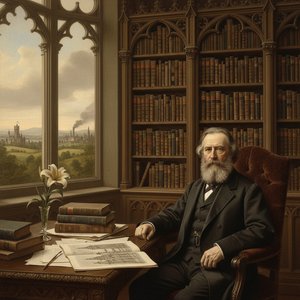
Discover William Holman Hunt (1827-1910), a Pre-Raphaelite master renowned for detailed realism, vivid symbolism & iconic works like 'The Light of the World'. Explore his spiritual and nature-focused Victorian art.
In 1848, as political revolutions swept across Europe and social reform movements like Chartism unsettled the British landscape, a different kind of uprising was forming in London. Within the rigid corridors of the Royal Academy, a small group of young artists felt stifled by established standards. These painters—including William Holman Hunt, John Everett Millais, and Dante Gabriel Rossetti—formed a secret society known as the Pre-Raphaelite Brotherhood. They were staging a revolt against what they perceived as a stagnant, mechanistic approach to painting.
This rebellion was deeply rooted in the anxieties of the Victorian era. While the British Empire expanded and industrialization transformed the landscape, these artists looked backward to find a way forward. They sought inspiration in the period before Raphael, an era they believed possessed a raw sincerity that had been lost to the heavy-handed techniques of their contemporaries. By forming this brotherhood, they declared war on the perceived artificiality of their age, aiming to strip away layers of academic pretension.
The tension of this era is captured in the early works of the movement's founders. Just as the political shifts of 1848 sought to redefine the relationship between the individual and the state, the Brotherhood sought to redefine the relationship between the artist and the canvas. This spirit of defiance remains a part of their legacy, reminding us that innovation often requires a rejection of the status quo.
The Rebellion of 1848: Challenging the Royal Academy's 'Slosh' The Pre-Raphaelite Brotherhood: Rediscovering Romanticism, Mythological Depth, and Vivid Detail in Victorian Art The Rebellion Against Tradition: The Birth of the Pre-Raphaelite Brotherho...
To the members of the Brotherhood, the prevailing academic style was something far more offensive than mere boredom; they disparaging and referred to it as "slosh." This term was a specific critique of anything lax, conventional, or commonplace in the painting process. They targeted the heavy glazes and dark, formulaic compositions favored by the successors of Raphael and Michelangelo, which they believed masked the real textures of the world with an artificial, shadowy veneer.
Instead, they turned toward the luminous palettes and minute descriptions found in late medieval and early Renaissance art. They admired the clarity and emotional depth of the Quattrocento, seeking to emulate a time when subject matter felt more direct and heartfelt. This was evident in the way artists like James Collinson approached religious themes, using light and shadow not to obscure, but to sculpt figures with a sense of spiritual grace. Their goal was to replace academic shadows with a clarity that had been lost to tradition.
This pursuit of sincerity finds an echo in our modern appreciation for authenticity. In an age where digital perfection can often feel hollow, the Pre-Raphaelite rejection of "slosh" resonates deeply. We find ourselves drawn once again to the visible brushstroke and the tangible texture of a hand-painted surface, valuing the honest imperfections that signal a human touch.
Botanical Truth: The Influence of Ruskinian Naturalism
Sir John Everett Millais's 'Christ in the House of His Parents': A Window into Victorian Faith Sir John Everett Millais’s “Christ in the House of His Parents,” often referred to as "The Carpenter’s Shop," stands as a monumental achievement within the...
The movement's commitment to "truth to nature" was not merely a poetic sentiment; it was a rigorous technical mandate. Guided by the theories of the influential critic John Ruskin, the Pre-Raphaelites embraced an almost scientific gaze. Ruskin urged artists to work en plein air and to maintain strict botanical accuracy. This dedication meant that every petal, every splinter of wood, and every blade of grass had to be rendered with painstaking precision.
In works such as Millais's Christ in the House of His Parents, this commitment is unmistakable. The viewer can observe every nail and every grain of wood within the carpenter's shop, creating a scene that feels immediate and authentic. This level of detail was often achieved by painting on a wet white ground, which allowed for a brilliance of color that mimicked the luminosity of medieval tempera. The result was an art that demanded the viewer look closely, discovering a universe of complexity within a single frame.
This meticulousness finds its parallel in the way we observe the natural world today through high-resolution lenses. Just as the Pre-Raphaelites used the microscope-like focus of their brushes to reveal the divine in the details, we continue to find wonder in the intricate patterns of a leaf or the subtle gradations of a sunset. The movement taught us that nothing is too small to be worthy of profound attention.
Poetic Pigment: The Symbiosis of Literature and Art
Introduction To embark on a journey through the top 25 artworks of Dante Gabriel Rossetti is to enter a world steeped in beauty, longing, and a profound sense of mystery. These paintings are not merely images; they are portals into the soul of a Vict...
For the Pre-Raphaelites, the boundary between poetry and painting was often indistinguishable. Many members, most notably Dante Gabriel Rossetti, were as much poets as they were painters. They sought to bridge the gap between the physical senses and the spiritual imagination, using the canvas to interpret the legends of Arthurian myth, the melancholic beauty of Dante Alighieri, and the lyrical works of John Keats.
Their paintings often functioned as visual poems, where color and composition served as metaphors for emotional states. In Rossetti's work, female figures often emerge as enigmatic muses, embodying both earthly sensuality and an ethereal, dreamlike grace. This connection to literature allowed them to explore complex psychological landscapes and moral themes of justice, piety, and the struggle of purity against corruption. The art was not merely a depiction of a scene; it was an exploration of a narrative soul.
This marriage of word and image continues to inspire the way we consume stories today. Whether through graphic novels or cinematic adaptations, our culture remains obsessed with the translation of text into visual experience. The Pre-embellished legends of the Victorian era laid the groundwork for a tradition where the visual and the verbal work in tandem to create a complete emotional reality.
The Total Work of Art: Pre-Raphaelite Influence on Design
A Victorian Sanctuary: Discovering Leighton House Museum Leighton House Museum stands as an extraordinary testament to Victorian artistic ambition and a singular achievement in architectural design. Located amidst the tranquil expanse of Holland Park...
The influence of the movement extended far beyond the edges of the canvas, bleeding into the very fabric of Victorian life. The Pre-Raphaelite aesthetic embraced the concept of a Gesamtkunstwerk, or a total work of art, where painting, sculpture, and decorative arts converged to create a unified environment. This is perhaps most visible in the architectural and interior design movements that followed, such as the Gothic Revival.
The fascination with medieval craftsmanship and intricate detail can be seen in spaces like Leighton House, where the fusion of painting and decorative arts creates an immersive experience. The movement's emphasis on organic forms and symbolic motifs influenced everything from textile design to furniture making, encouraging a return to the beauty of the handmade and the ornamental. They believed that the environment one inhabited should be as much a source of moral and aesthetic uplift as a fine painting.
We see this legacy in the modern movement toward curated interiors, where every object—from a bespoke lamp to a textured rug—is chosen to contribute to a cohesive narrative. The Pre-Raphaelite idea that our surroundings can shape our spirit remains a cornerstone of thoughtful design, proving that beauty is most powerful when it is integrated into the rhythm of daily life.
Reclaiming the Detail: Bringing Victorian Realism to Contemporary Walls
Explore the art & writings of John Ruskin (1819-1900), Victorian polymath, art critic, and social thinker. Discover his landscape paintings, architectural analyses, & influential essays on nature, beauty, & society.
The modern impulse to curate physical spaces reflects a shift away from the frictionless, mass-produced aesthetics of the digital era. In the nineteenth century, the Pre-Raphaelites reacted against the standardized, formulaic compositions taught in the Royal Academy, seeking instead a return to the specificities of the natural world. They believed that truth resided in the particularity of a leaf's vein or the exact weight of a fabric's fold. Today, as our daily lives are increasingly mediated by screens, there is a growing preference for objects that possess a tangible, unrepeatable presence.
A hand-painted reproduction of a Pre-Raphaelite work attempts to capture the specific luminosity that John Ruskin championed. When an artist uses thin glazes and layered oils on cotton canvas, they recreate the way light interacts with pigment. This method avoids the flat, matte finish of a standard print. Instead, it mimics the depth found in William Holman Hunt’s Self Portrait or the intricate textures of an Emma Sandys portrait. These physical qualities allow a painting to function as a focal point of texture rather than just a visual pattern. By choosing works that prioritize these traditional techniques, collectors maintain a connection to the material presence the movement sought to restore.
Explore the radical beauty of the Pre-Raphaelite Brotherhood. Discover how these 19th-century rebels rejected academic tradition to redefine Romanticism through vivid detail, luminous color, and profound truth. A deep dive into the movement that changed art history forever.
Explore the life & work of John Ruskin, Victorian polymath and influential art critic. Discover his aesthetic principles, social critiques, and lasting impact on art, architecture, and our understanding of beauty. Learn about the Pre-Raphaelites & more.
Explore the captivating world of the Pre-Raphaelite Brotherhood! Discover their rebellion against academic art, iconic masterpieces, and lasting influence on Victorian aesthetics. Learn about Rossetti, Burne-Jones & more.
Explore the revolutionary Pre-Raphaelite Brotherhood. Discover how visionaries like Rossetti and Millais reclaimed truth and beauty through luminous detail and naturalism in Victorian art history. Expert insights for art lovers and collectors.

 William Holman Hunt
 The Pre-Raphaelite Brotherhood: Reclaiming Beauty, Truth, and Naturalism in Victorian Art
 Christ in the House of His Parents
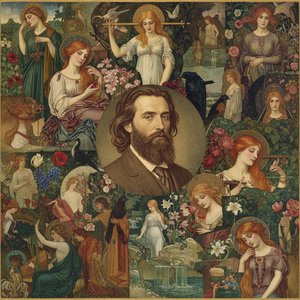 Dante Gabriel Rossetti's 25 Masterpieces: A Journey Through Victorian Art & Symbolism | OriginalUniqueArt
 Holland Park
 John Ruskin