The Enigma of Anonymity: Defining the 'Anonymous Master' in Art History
Anonymous works are works, such as art or literature, that have an anonymous, undisclosed, or unknown creator or author. In the case of very old works, the author's name may simply be lost over the course of history and time. There are a number of re...
The very notion of the “anonymous master” presents a compelling paradox within the established narratives of art history. We are, by nature, drawn to authorship – to understanding the hand and mind behind a creation. Yet, throughout the centuries, countless works of remarkable skill and beauty have emerged without a clearly attributed creator. These paintings, sculptures, and drawings exist in a liminal space, simultaneously celebrated for their aesthetic qualities and shrouded in mystery. But what *defines* an anonymous master? It’s not simply a lack of signature; it speaks to a confluence of factors – lost documentation, deliberate concealment, or perhaps the work originating from a collaborative workshop where individual contributions blurred into collective artistry. The study of these artists isn't merely about uncovering names; it’s about reconstructing artistic ecosystems and challenging our conventional understanding of creative agency.
Historically, the emphasis on individual genius is a relatively recent development. Medieval art, for instance, often prioritized devotional function over personal expression. Artists were frequently considered skilled craftsmen serving a higher purpose, their identities less crucial than the spiritual impact of their work. The Renaissance witnessed a shift, with figures like Vasari elevating artists to near-celebrity status, but even then, many talented individuals remained undocumented, particularly those working outside the established centers of artistic production. To truly appreciate an anonymous master is to embrace ambiguity and focus on the intrinsic qualities of the artwork itself – its composition, technique, and emotional resonance.
Beyond Vasari: Early Approaches to Identifying & Categorizing Unknown Artists
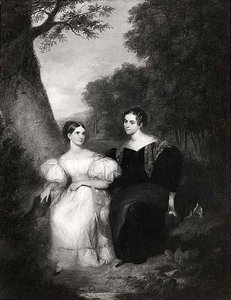 Portrait of the Artist's Wife and Her Sister, (painting)
Explore Asher Durand’s 'Portrait of the Artist’s Wife'. A grayscale Romantic masterpiece featuring two women in a serene woodland setting. Commission your own heirloom today!
Giorgio Vasari’s Lives of the Most Excellent Painters, Sculptors, and Architects, published in 1550 and expanded in 1568, established a foundational – though undeniably biased – canon of Italian Renaissance artists. While invaluable, Vasari's focus on Florence and his personal connections inevitably left many deserving figures unacknowledged. Early attempts to categorize anonymous works often relied on stylistic analysis: grouping paintings based on shared brushwork, color palettes, or subject matter. This led to the creation of “School” designations – the ‘Follower of…’ tradition – which, while helpful, could be imprecise and sometimes reductive. The 17th and 18th centuries saw a growing interest in connoisseurship, with collectors meticulously studying paintings to discern their origins based on subtle details like pigment composition or canvas weave.
However, these early methods were often hampered by limited scientific tools and a tendency towards subjective interpretation. The rediscovery of ancient texts also played a role; scholars attempted to link anonymous works to classical authors or artistic traditions, sometimes with tenuous connections. The Dutch Golden Age, for example, saw the rise of detailed inventories and art market records, providing valuable clues about artists’ identities and practices, but even these sources were not always complete or reliable. The challenge remained – and continues to be – separating genuine attribution from educated guesswork.
Technical Analysis & Attribution: Modern Methods for Unmasking Hidden Hands
This publication is based on selected papers presented at two symposia, one at the J. Paul Getty Museum, Los Angeles (September 5–6, 2003), the other at the.
The 20th and 21st centuries have witnessed a revolution in art historical methodology, driven by advancements in scientific technology. Dendrochronology (tree-ring dating) can pinpoint the approximate date of wood panels, providing crucial context for paintings on wood supports. X-radiography reveals underdrawings and pentimenti (changes made by the artist during the painting process), offering insights into their working methods. Pigment analysis identifies the materials used, potentially linking a work to specific workshops or regions. Infrared reflectography penetrates surface layers to reveal hidden sketches and compositional elements.
Perhaps most significantly, digital imaging techniques allow for detailed comparisons of brushstrokes and paint application across multiple works. This ‘visual fingerprinting’ can help identify patterns unique to individual artists, even in the absence of signatures. However, it's crucial to remember that these tools are not infallible. Technical analysis provides evidence, but interpretation remains essential. A shared pigment or similar brushwork doesn’t automatically equate to authorship; stylistic imitation and workshop practices must be carefully considered. The field of attribution is increasingly collaborative, bringing together art historians, conservators, and scientists to unravel the mysteries surrounding anonymous masters.
Social and Political Contexts: Why Artists Remained Anonymous or Were Forgotten
The reasons behind an artist’s anonymity are often complex and intertwined with social and political realities. In some cases, artists deliberately concealed their identities for religious or political reasons – particularly during periods of persecution or censorship. Women artists, historically marginalized by patriarchal structures, frequently signed their work under pseudonyms or remained entirely anonymous to gain access to the art market. Workshop practices also played a significant role; assistants and apprentices often contributed substantially to paintings without receiving individual recognition.
Furthermore, social status influenced artistic visibility. Artists from lower classes may have lacked the resources or connections to establish a lasting reputation. Political upheaval and warfare could lead to the loss of documentation and the destruction of artworks, obscuring the identities of their creators. The very act of collecting also shaped historical narratives; wealthy patrons often prioritized works by established artists, neglecting those whose origins were unknown. Understanding these contextual factors is crucial for moving beyond a purely stylistic analysis and appreciating the broader forces that contributed to an artist’s anonymity.
Case Study: 'The Perfect Wife' – A Re-Examination of Rebecca Dulcibella Orpen’s Legacy
Consider the captivating portrait often referred to as ‘The Perfect Wife’ (misattributed to Margaret Roper). Recent scholarship has revealed this painting to be a copy, likely from around 1600, based on an original by Rebecca Dulcibella Orpen. While not an anonymous master in the strictest sense – we know the artist who created *this* version – it exemplifies the challenges of attribution and the enduring power of misidentification. The painting’s initial association with Margaret Roper, a prominent figure in Tudor England, lent it historical significance, overshadowing the actual artistic merit and identity of its creator.
Orpen's work, though gaining recognition, remains relatively understudied. Her skill in capturing realistic detail and conveying psychological depth is evident in this portrait, showcasing her mastery of oil painting techniques. The rediscovery of her authorship highlights the importance of questioning established narratives and seeking out overlooked artists. This case study demonstrates that even seemingly well-documented works can harbor hidden histories, waiting to be uncovered through careful research and analysis. The allure of 'The Perfect Wife' lies not only in its aesthetic beauty but also in the story of its reattribution – a testament to the ongoing process of art historical discovery.
The Enduring Appeal of the Unknown: Collecting & Commissioning Art by Anonymous Masters
Despite the challenges of attribution, collecting and commissioning art by anonymous masters continues to be a compelling pursuit for discerning collectors. There’s an inherent romance in acquiring a work whose origins remain shrouded in mystery – a sense of connection to the past and a unique opportunity to contribute to art historical scholarship. Anonymous works often offer exceptional value, as they are typically less expensive than those attributed to established artists.
Furthermore, commissioning custom reproductions based on anonymous masterpieces allows collectors to engage with artistic traditions without the constraints of authorship. At OriginalUniqueArt.com, we specialize in handmade oil paintings created by skilled artists who meticulously recreate the techniques and styles of past masters. Whether you’re drawn to the enigmatic beauty of an unknown portrait or seeking a custom reproduction, our team provides expert guidance and ensures exceptional quality. The legacy of anonymous masters reminds us that artistic brilliance transcends individual names – it resides in the enduring power of creativity itself.