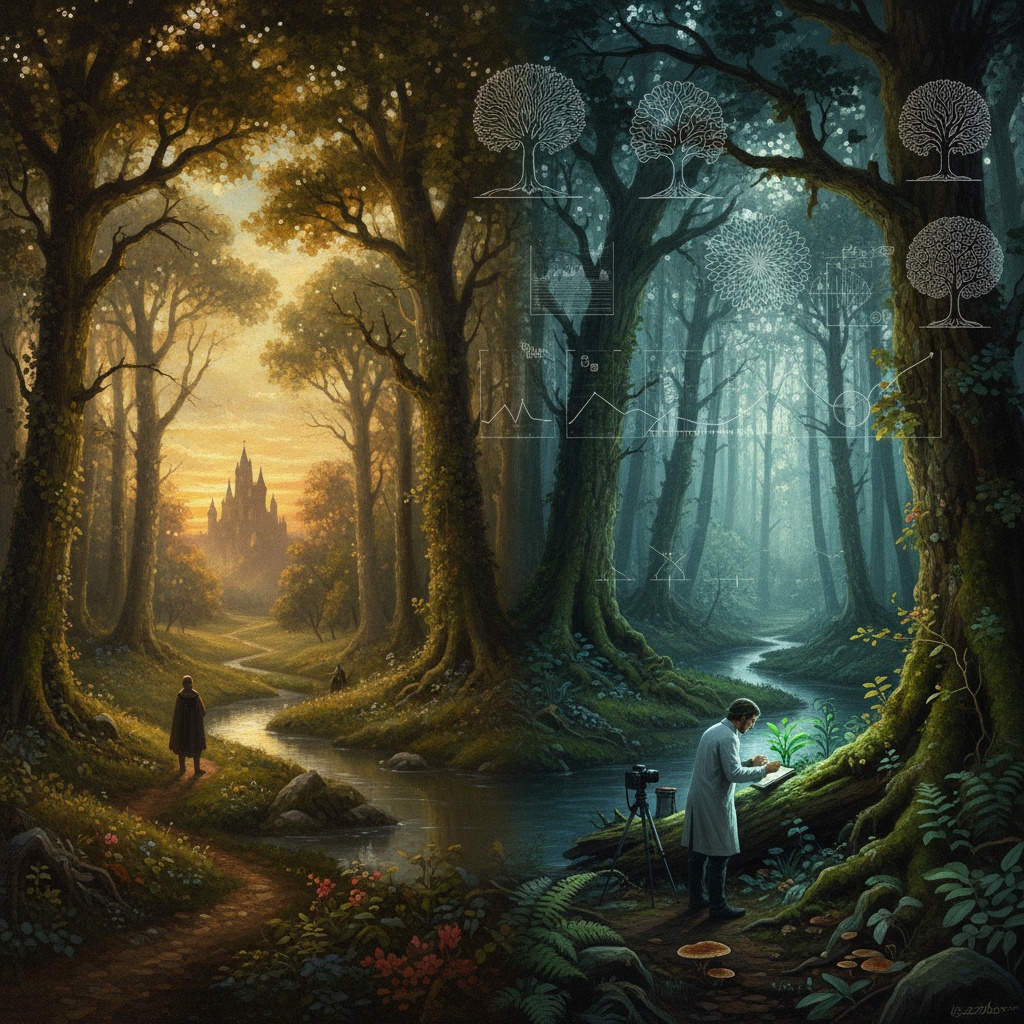
The Forest as Sublime: Romanticism's Spiritual Landscapes
 Cross in the Mountains (Tetschen Altar)
Caspar David Friedrich’s ‘Cross in the Mountains’ (Tetschen Altar) – a monumental Romantic masterpiece. Explore this iconic oil painting's spiritual depth, dramatic landscape & historical significance.
For the artists of the Romantic era, the forest was not merely a collection of trees; it was a portal to the sublime – an experience of awe-inspiring grandeur that evoked both terror and profound spiritual connection. Rejecting the Enlightenment’s emphasis on reason and order, Romantics turned inward, seeking emotional truth in the untamed power of nature. This fascination manifested powerfully in depictions of forests, often shrouded in mist, bathed in dramatic light, and imbued with a sense of melancholy solitude. Caspar David Friedrich stands as perhaps the most iconic interpreter of this sensibility. His monumental work, Cross in the Mountains (Tetschen Altar), is not simply a landscape; it’s a meditation on mortality, faith, and humanity's place within the vastness of creation. The towering trees, skeletal against the twilight sky, frame a scene of religious devotion, yet the overwhelming scale of nature dwarfs the human figures, suggesting both insignificance and an intimate connection to something far greater. Friedrich’s technique – meticulous layering of oil paints to create atmospheric depth and texture – further enhances this emotional resonance. The forest becomes a cathedral of nature, a space for contemplation and transcendence. Nikolai Ge's On the Mount of Olives, while distinct in its narrative focus, shares this Romantic preoccupation with spiritual yearning within a natural setting. The brooding landscape mirrors the internal turmoil of Christ, transforming the olive grove into a symbolic representation of suffering and premonition.
Beyond Representation: Symbolist Forests and the Inner World
 Wikipedia: Symbolism (movement)
Symbolism was a late 19th-century art movement of French and Belgian origin in poetry and other arts seeking to represent absolute truths symbolically through language and metaphorical images, mainly as a reaction against naturalism and realism. In l...
As the 19th century progressed, artists moved beyond simply representing nature to exploring its symbolic potential. The Symbolist movement, reacting against both Realism and Impressionism, sought to express abstract truths through evocative imagery and metaphorical language. For Symbolists, the forest became a powerful metaphor for the subconscious mind – a dark, mysterious realm filled with hidden meanings and primal emotions. Unlike the Romantic’s awe-inspired reverence, Symbolist forests often evoke a sense of unease, isolation, and psychological complexity. Artists delved into themes of sexuality, death, and spirituality, using the forest as a backdrop for their explorations of the human psyche. The dense undergrowth, tangled branches, and obscured pathways mirrored the labyrinthine depths of the inner self. While not always explicitly religious, Symbolist depictions often hinted at hidden realms and esoteric knowledge, drawing on mythology, folklore, and personal experience to create richly layered narratives.
Realism’s Embrace of Nature: Depicting Forests with Scientific Detail
 Wooded Landscape
This JSON response fulfills the prompt's requirements by providing a concise meta description optimized for SEO and adhering to strict formatting guidelines.
In contrast to the emotional intensity of Romanticism and Symbolism, Realist painters approached forests with a more objective eye. Artists like John Constable sought to capture the precise details of nature – the play of light on leaves, the texture of bark, the subtle variations in color – with scientific accuracy. Wooded Landscape exemplifies this approach, showcasing Constable’s masterful ability to render the natural world with remarkable fidelity. However, even within Realism, a sense of emotional connection remained. Constable wasn't merely documenting trees; he was celebrating the beauty and tranquility of the English countryside, imbuing his landscapes with a quiet reverence for nature’s inherent harmony. This focus on detail also allowed for a deeper understanding of ecological systems – the interconnectedness of plants, animals, and the environment – foreshadowing later environmental concerns.
Trees as Protagonists: Arboreal Echoes Throughout Art History
 Arboreal Echoes: A Historical & Artistic Exploration of Trees in Painting
Explore the rich history of trees in painting! Discover symbolism, Romantic masterpieces by Caspar David Friedrich & beyond. A curated journey for art enthusiasts.
The fascination with trees extends far beyond specific movements. Across art history, trees have served as potent symbols of life, death, growth, and resilience. From ancient mythology to Renaissance allegories, trees often represent the Tree of Life – a cosmic symbol connecting heaven, earth, and the underworld. In many cultures, individual trees are revered as sacred entities, embodying ancestral spirits or divine power. This reverence is reflected in countless artworks, where trees are depicted not merely as elements of the landscape but as active participants in the narrative. Consider the recurring motif of the oak tree – often associated with strength, endurance, and nobility – or the weeping willow – symbolizing grief, mourning, and remembrance. The very form of a tree—its roots anchoring it to the earth, its branches reaching towards the sky—lends itself to symbolic interpretation, making it a versatile and enduring subject for artists across cultures and time periods.
Modern Visions: The Forest Deconstructed and Reimagined
The 20th century witnessed a radical departure from traditional landscape painting. Modern artists challenged conventional notions of representation, experimenting with abstraction, fragmentation, and subjective expression. Artists like Max Ernst, in his haunting Forest and Sun, moved away from realistic depictions to explore the psychological impact of the forest. Using techniques like frottage – rubbing textures onto canvas – Ernst created a petrified forest imbued with a sense of primordial otherworldliness. The dark, mysterious atmosphere evokes both fear and fascination, reflecting the anxieties and uncertainties of the modern age. This deconstruction of form allowed artists to delve deeper into the subconscious, using the forest as a metaphor for the fragmented self and the alienation of modern life. Other Modernists explored color and composition, reducing forests to their essential elements – lines, shapes, and textures – creating abstract landscapes that prioritized emotional impact over realistic representation.
From Idealization to Advocacy: Contemporary Perspectives on the Woodland Realm
Today, artists continue to engage with the forest as a source of inspiration, but with a growing awareness of environmental concerns. Contemporary depictions often reflect a sense of urgency – a call for conservation and a recognition of the fragility of ecosystems. While echoes of Romantic idealization can still be found, many contemporary artists are using their work to raise awareness about deforestation, climate change, and the importance of biodiversity. The forest is no longer simply a source of spiritual solace or psychological exploration; it’s a vital ecosystem under threat. This shift in perspective reflects a broader cultural movement towards environmental consciousness, with artists playing an increasingly important role in advocating for sustainability and ecological responsibility. Through their work, they remind us of the profound interconnectedness between humanity and nature, urging us to protect these precious woodland realms for future generations.