Introduction
To step into the world of American Realism is to set aside the veil of romanticized myth and confront the profound, unvarnished truth of a nation in flux. There is a certain weight to these canvases, a tactile gravity that pulls the viewer away from the ethereal and anchors them firmly in the grit, the light, and the lived experience of the American landscape. It is an art of intense observation, where the brushstroke does not seek to embellish, but to document the quiet dignity found within the mundane.
Emerging as a powerful cultural counterpoint to the sweeping, idealized narratives of European traditions, American Realism captured the pulse of a country navigating the complexities of industrialization, urbanization, and a shifting social fabric. These artists—masters of light, shadow, and human emotion—turned their gaze toward the soot-streaked streets of the urban centers, the lonely expanses of the midwest, and the stark, cinematic solitude of the modern city. They found the extraordinary within the ordinary, transforming the weary face of a laborer or the sharp geometry of a roadside diner into something timeless and monumental.
Today, these masterpieces remain deeply resonant. In our increasingly digital and ephemeral age, there is an enduring hunger for the authentic—for art that possesses a physical soul and a recognizable truth. These works serve as more than mere historical records; they are emotional anchors that remind us of our shared humanity and the enduring beauty found in the tangible world.
In the following exploration, we invite you to walk alongside us through a curated selection of ten definitive works. Each painting in this list represents a pivotal moment in art history, offering a window into the movement that taught us how to truly see the American experience.
Nighthawks, The Art Institute of Chicago, Chica - Edward Hopper
 Nighthawks, The Art Institute of Chicago, Chica - Edward Hopper
To encounter Nighthawks by Edward Hopper is to stand before a profound window into the American psyche. As a definitive cornerstone of the American Realism movement, this masterpiece earns its place among the world's most significant works through its unparalleled ability to translate urban isolation into a visual poem. Painted in 1942, Hopper utilizes a striking interplay of light and shadow—the warm, artificial luminescence of the diner clashing against the deep, swallowing darkness of the street—to evoke a sense of quiet, cinematic tension.
The composition, defined by sharp geometric forms and the voyeuristic barrier of large glass panes, captures the haunting beauty of solitude. Beyond its historical weight, Nighthawks possesses a timeless aesthetic that resonates deeply within modern, sophisticated interiors. Its dramatic use of color and light provides a focal point of immense emotional intelligence, offering a legacy of contemplative elegance that continues to inspire collectors seeking art with true psychological depth.
Snap the Whip - Winslow Homer
 Snap the Whip - Winslow Homer
In Snap the Whip by Winslow Homer, the lines are not merely drawn; they are choreographed . This is far more than a pastoral scene of rural youth; it is a dance frozen in time . Through the tension of the tug-of-war rope and the dynamic, diagonal lean of the children, Homer achieves a rare equilibrium where chaos feels like perfect harmony. The palette—rich with earthy browns, deep reds of the schoolhouse, and vibrant, lush greens—captures the nostalgic pulse of post-Civil War America. Every visible brushstroke adds to the vitality, making the landscape itself feel alive. As you contemplate this masterpiece of American Realism, ask yourself: What if your living room could hold that same balance? What if your walls could breathe rhythm? Bringing a hand-painted oil reproduction of this work into your space invites that same timeless energy and historical elegance into your home.
Sunlight in a Cafeteria - Edward Hopper
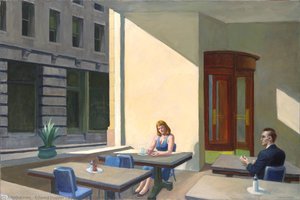 Sunlight in a Cafeteria - Edward Hopper
Edward Hopper’s Sunlight in a Cafeteria (1958) stands as a profound pillar of the American Realism movement, capturing the quiet, unsettling drama of urban existence. Through a masterful interplay of brilliant sunlight and encroaching shadows, Hopper transforms a mundane cafeteria into a stage for psychological depth. This work is essential to our study of the era because it embodies the growing sense of post-war alienation; despite the physical proximity of the figures, an invisible emotional gulf separates them, rendered through stark, geometric compositions and a muted palette of beige and gray.
The painting’s evocative use of chiaroscuro does more than just illuminate a scene—it invites us into a state of introspection. Today, this aesthetic of moody minimalism finds a striking parallel in contemporary interior design, where the use of dramatic lighting and neutral, atmospheric tones is frequently employed to create spaces of quiet contemplation and sophisticated stillness.
Long Branch, New Jersey - Winslow Homer
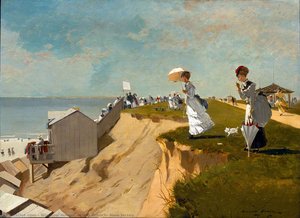 Long Branch, New Jersey - Winslow Homer
Winslow Homer’s 1869 masterpiece, Long Branch, New Jersey , serves as a luminous window into the social fabric of the American Gilded Age. As a defining pillar of the American Realism movement, this work earns its place among the top ten for its ability to elevate a transient moment of seaside leisure into a profound study of light and human connection. Through his masterful use of plein air techniques, Homer captures the rhythmic interplay between the expansive Atlantic and the elegantly dressed figures gathered upon the dunes.
The painting’s soft blues and warm, sandy tones do more than replicate a landscape; they evoke a sense of nostalgic tranquility that transcends time. One cannot help but reflect on how this scene mirrors our own enduring pursuit of peace within the natural world. For the discerning collector, bringing such a piece into a contemporary space offers a sophisticated dialogue between historical grandeur and modern serenity, providing an anchor of cultural depth to any curated environment.
Men of the Docks - George Wesley Bellows
 Men of the Docks - George Wesley Bellows
The lines in Men of the Docks by George Wesley Bellows aren’t drawn; they’re choreographed . This is not merely a composition; it is a dance frozen in time . Within this 1912 masterpiece, the chaotic energy of a New York City dockyard finds its harmony through bold, expressive brushwork and an atmospheric, wintry palette. Bellows, a titan of the Ashcan School, captures the raw, unvarnished grit of urban industry, where the heavy silhouettes of ships and the toil of dockworkers emerge from a haze of cool grays and muted blues. The thick, impasto texture lends a tactile vitality to the scene, making the movement of the harbor feel almost palpable. What if your walls could breathe rhythm ? Our hand-painted oil reproductions allow you to bring this historical pulse into your home, preserving the visible brushstrokes and profound emotional depth of Bellows' original vision.
The fox hunt pensylvania academy of the fine arts - Winslow Homer
 The fox hunt pensylvania academy of the fine arts - Winslow Homer
Winslow Homer’s The Fox Hunt serves as a profound window into the soul of American Realism, capturing the raw, unyielding tension of the natural world. As one of the definitive masterpieces of this movement, it earns its place in our top ten through its masterful ability to balance dramatic action with atmospheric stillness. The composition—a fox caught in mid-leap against a stark, wintry landscape, shadowed by a watchful raven—encapsulates the era's focus on honest, direct observation and emotional depth.
Homer utilizes a palette of biting blues and bone whites, punctuated only by the warm russet of the fox, to evoke the visceral struggle for survival. This work invites us to contemplate the delicate balance between life and death, predator and prey. For the modern collector, the painting’s essence offers a timeless dialogue; its themes of resilience and quiet strength provide an enduring sense of drama and natural dignity, making it a commanding centerpiece for any curated collection.
Max Schmitt in a Single Scull - Thomas Eakins
 Max Schmitt in a Single Scull - Thomas Eakins
Acquiring Max Schmitt in a Single Scull by Thomas Eakins is far more than an aesthetic choice; it is a profound investment in the enduring legacy of American art history. As a definitive pillar of the American Realism movement, this 1871 masterpiece captures the rhythmic grace of the Schuylkill River with unparalleled anatomical precision and atmospheric depth. Eakins masterfully balances the dynamic energy of the rower against a tranquil landscape of muted greens and luminous, soft blues, where light dances across the water's surface in a display of impressionistic brilliance. The painting’s historical weight and cultural resonance make it an essential reference for any serious collection.
For the modern connoisseur, this work offers a timeless sense of prestige. A high-quality, hand-painted oil reproduction carries the same aesthetic authority and quiet dignity as the original, providing a sophisticated focal point that elevates modern luxury interiors with its serene, commanding presence.
Girl with a Hay Rake - Winslow Homer
 Girl with a Hay Rake - Winslow Homer
Before he became the titan of American maritime scenes, Winslow Homer revolutionized the medium of watercolor, proving it could possess the same weight and dignity as oil. In his 1878 masterpiece, Girl with a Hay Rake , we witness this technical leap firsthand. Through a delicate dance of translucent pigments and loose, expressive brushstrokes, Homer captures an autumnal orchard bathed in soft, diffused light. There is no forced drama here—only the quiet prestige of a moment suspended. The muted palette of ochre, moss green, and deep earth tones evokes a sense of profound stillness and the rhythmic pulse of rural life. This mastery of atmosphere and naturalistic truth defines the very soul of American Realism . Bringing such a piece into a modern study or home office does more than decorate; it introduces a sense of focused tranquility and historical depth, grounding a contemporary workspace in the timeless, hardworking spirit of the American landscape.
Under a Palm Tree - Winslow Homer
 Under a Palm Tree - Winslow Homer
In Winslow Homer’s Under a Palm Tree , the luminous, sun-drenched gold filtering through verdant fronds establishes an immediate atmosphere of tranquil intimacy. This mastery of light—achieved through delicate, translucent watercolor washes—is precisely why this work stands as one of the Top 10 Masterpieces That Defined the American Realism Art Movement . Homer does not merely paint a scene; he captures the very pulse of light and shadow, using a palette that balances warm, human tones against the cool, rhythmic shadows of the tropical canopy. For the modern collector, integrating such a piece into a living space offers more than mere decoration; the painting’s serene color scheme can serve as an emotional anchor for a room, providing a sense of organic calm and light-drenched respite in a contemporary dining room or sunlit study. It invites a quiet, contemplative energy that transforms a modern interior into a sanctuary of historical grace.
Trout Breaking - Winslow Homer
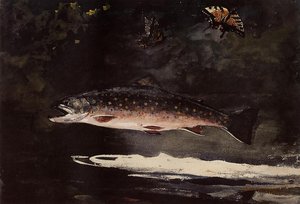 Trout Breaking - Winslow Homer
Imagine standing beside a tranquil New England stream, where the only sound is the soft ripple of water against stone, until—suddenly—the surface shatters. In Winslow Homer’s 1889 watercolor, Trout Breaking , this precise moment of kinetic energy is captured with breathtaking precision. Eschewing the ornate traditions of European academies, Homer utilized his mastery of observation to define the essence of American Realism, focusing on the raw, unadorned truth of the natural world.
This masterpiece earns its place among the movement's top ten through its ability to transform a fleeting biological impulse into a profound symbol of resilience and vitality. The delicate interplay of light and water creates a sense of spontaneous life that transcends the paper itself. Integrating such a work into a modern home offers more than mere decoration; it invites a meditative connection to nature’s rhythms, bringing the quiet, enduring strength of the American landscape into our daily lives.
Conclusion
As we step away from these canvases and the evening light begins to soften across the gallery, we are left with a profound realization: these masterpieces are far more than static relics of a historical movement. They are living, breathing presences—vibrant echoes of a nation’s soul that continue to resonate within our modern lives. The American Realists did not merely paint scenes; they captured the very essence of truth, finding the sublime in the everyday and the monumental in the mundane. These works possess a unique power to transcend time, bridging the gap between the nineteenth century and the present day through their raw, unvarnished honesty.
To bring such a piece into one’s own space is to invite that same sense of wonder and groundedness into the home. Whether it is the quiet strength found in a portrait or the sweeping narrative of a landscape, these paintings serve as enduring anchors of culture and emotion. We invite you to wander further through our full collection , where the legacy of this movement remains preserved for a new generation of admirers, ready to transform your surroundings with the timeless beauty of the masters.