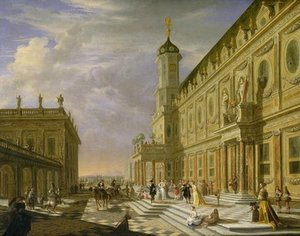
Portret Hieronymus Janssens

21 najpoznatijih djela umjetnika Hieronymus Janssens, svako jedinstveno

Ažurirano Studeni 2026 · rangirano prema našoj ocjeni popularnosti (pretraživanja, posjeti i narudžbe za svako djelo) · 22 djela Hieronymus Janssens u našem katalogu

Ukratko

The Menuet (1650) je slika autora Hieronymus Janssens koja privlači najviše pogleda; original se nalazi u muzeju Bavarske državne slikopisne zbirke, München. Nakon toga, pogled se usmjerava na Charles II dancing at a Ball at Court (1660) i Game of Main chaude"" (1650). Među 22 djela umjetnika Hieronymus Janssens u našem katalogu, ovih 21 su najpoznatija, od kojih je svako jedinstveni original predstavljen s godinom nastanka, muzejom i razlogom zbog kojeg je vječno.

1624 – 1693, Antwerp Baroque Najviše djela: Bavarske državne slikopisne zbirke

Top 10 djela Hieronymus Janssens kroz oči galerije

1
The Menuet (1650) od Hieronymus Janssens

The Menuet

1650 · Oil On Panel · Bavarske državne slikopisne zbirke, München

The Menuet is a work by Hieronymus Janssens, a Flemish genre painter. He was born in Antwerp, Belgium, in 1624. This specific painting dates to 1650, a year that marks a moment in the artist's long career in the Low Countries.

2
Charles II dancing at a Ball at Court (1660) od Hieronymus Janssens

Charles II dancing at a Ball at Court

1660 · Oil · Royal Collection, London

The scene unfolds within the grand, crowded atmosphere of a ball in The Hague, where the air seems to hum with the movement of a courtly gathering. In this lively moment, Hieronymus Janssens captures King Charles II of England as he engages in dance. He moves through the hall alongside his sister, Mary of Orange, their figures central to the swirling activity of the room. This elegant display of social…

5
Portrait of a Family (1650) od Hieronymus Janssens

Portrait of a Family

1650 · Oil On Canvas · Hallwyl Museum, Stockholm

The artwork titled Portrait of a Family is a painting by the artist Hieronymus Janssens. This work is categorized as Genremåleri, or genre painting. The subject matter focuses on a group of figures within a structured setting, a common characteristic of the genre during the seventeenth century.

6
A Picture Gallery with Fashionable Visitors (1664) od Hieronymus Janssens

A Picture Gallery with Fashionable Visitors

1664 · Oil On Canvas · Uppark

In the quiet, grand halls of an imaginary gallery, we find ourselves amidst the elegant company of A Picture Gallery with Fashionable Visitors. This work, painted by Hieronymus Janssens, transports the viewer into a meticulously constructed space where the boundaries between reality and art dissolve. The scene unfolds within a vast, opulent interior, a setting that invites us to linger among the figures gathered there. It is a moment frozen…

7
The Game of Pat-a-Cake (1675) od Hieronymus Janssens

The Game of Pat-a-Cake

1675 · Oil On Canvas

The Game of Pat-a-Cake is an oil painting by the Flemish genre painter Hieronymus Janssens. This work originates from the mid-seventeenth century. The subject matter focuses on social interaction and leisure among a group of figures. The scene is set within a landscape that includes trees and architectural elements such as columns.

Slavna djela umjetnika Hieronymus Janssens, od 11. do 21. broj

Motivi koji su privukli pažnju Hieronymus Janssens

Četiri teme koje se najčešće ponavljaju u ovim originalima, svaka s svojim vrhunskim primjerom.

Muzeji koji čuvaju originalna djela umjetnika Hieronymus Janssens

8 muzeja u kojima se nalazi najviše djela s ove stranice.

Muzej Grad Djela autora Hieronymus Janssens Slike iz ovog popisa
Bavarske državne slikopisne zbirke, MünchenBavarske državne slikopisne zbirke München 1 The Menuet
Royal Collection, LondonRoyal Collection London 1 Charles II dancing at a Ball at Court
Museum of Fine Arts Ghent (MSK), GentMuseum of Fine Arts Ghent (MSK) Gent 1 Game of Main chaude""
Kraljevski muzeji lijepih umjetnosti Belgije, BruxellesKraljevski muzeji lijepih umjetnosti Belgije Bruxelles 1 Patty-cake
Hallwyl Museum, StockholmHallwyl Museum Stockholm 1 Portrait of a Family
UpparkUppark 1 A Picture Gallery with Fashionable Visitors
Palais des Beaux-Arts de Lille, LillePalais des Beaux-Arts de Lille Lille 1 A Ball on the Terrace of a Palace
Ermitaž, Sankt PeterburgErmitaž Sankt Peterburg 1 The Ball -

Hieronymus Janssens kroz desetljeća: jedan jedinstveni original za svako

Djela po desetljećima

Odaberite desetljeće kako biste vidjeli original koji ga definira.

Slike umjetnika Hieronymus Janssens: pitanja za galeriju

Koje je najpoznatije djelo umjetnika Hieronymus Janssens?Otkrijte odgovor

The Menuet (1650), Bavarske državne slikopisne zbirke, München. Nakon njih slijede Charles II dancing at a Ball at Court (1660) i Game of Main chaude"" (1650).

U kojoj je dobi Hieronymus Janssens stvorio/la The Menuet?Otkrijte odgovor

26 godina: The Menuet datira iz 1650, a Hieronymus Janssens je rođen/a 1624.

Koja su deset najpoznatijih slika umjetnika Hieronymus Janssens?Otkrijte odgovor

The Menuet, Charles II dancing at a Ball at Court, Game of Main chaude"", Patty-cake, Portrait of a Family, A Picture Gallery with Fashionable Visitors, The Game of Pat-a-Cake, A Gentleman Paying Court, A Ball on the Terrace of a Palace i A Feast in an Interior. Gornji rang prikazuje godinu i muzej za svako od njih.

Koliko je poznatih djela umjetnika Hieronymus Janssens?Otkrijte odgovor

Naš katalog sadrži 22 djela umjetnika Hieronymus Janssens, datiranih od 1650 do 1675.

Gdje se mogu vidjeti najpoznatiji originali umjetnika Hieronymus Janssens?Otkrijte odgovor

Većinom u Bavarske državne slikopisne zbirke (München), Royal Collection (London) i Museum of Fine Arts Ghent (MSK) (Gent). Gornja tablica muzeja navodi sve njih.

U kojem je razdoblju Hieronymus Janssens stvorio/la svoje najpoznatije slike?Otkrijte odgovor

U 1650s: 4 od 21 djela na ovoj stranici nastalo je tada, od čega je The Menuet The Menuet.

Koje je najranije, a koje najkasnije poznato djelo Hieronymus Janssens?Otkrijte odgovor

Na ovoj stranici najstarije djelo je iz The Menuet (1650), a najnovije iz The Game of Pat-a-Cake (1675).

Koje je motive Hieronymus Janssens preferirao?Otkrijte odgovor

People (7), Architecture (5) i Figures (4), kroz svih 21 djela na ovoj stranici.

S kojim je materijalima Hieronymus Janssens najčešće slikao?Otkrijte odgovor

Oil On Canvas, za 4 od 21 djela na ovoj stranici.

Kojem umjetničkom pravcu pripada rad Hieronymus Janssens?Otkrijte odgovor

Baroque, sudeći po originalima na ovoj stranici.

Hieronymus Janssens: portret umjetnika

Hieronymus Janssens: The Painter of Elegant Company

Born in Antwerp in 1624 and passing away there in 1693, Hieronymus Janssens – often referred to as “Den Danser” or “the dancer” – stands as a pivotal figure in the development of Flemish genre painting during the mid-seventeenth century. His legacy isn’t one of grand historical narratives or religious fervor, but rather a captivating portrayal of aristocratic leisure and social life within meticulously rendered interiors and expansive outdoor settings. Janssens wasn't merely documenting scenes; he was crafting carefully constructed conversations, inviting viewers into a world of refined entertainment, musical performance, and subtle moral commentary.

Janssens’ artistic journey began under the tutelage of Christoffel Jacobsz van der Laemen in 1636-1637. This early training laid the groundwork for his future specialization in dance scenes – a genre he would master with remarkable skill and influence. He formally registered as a master in the Guild of Saint Luke in Antwerp in 1643-1644, marking his entry into the professional art world. His marriage to Catharina van Dooren in 1650 solidified his domestic life while simultaneously fueling his artistic output. Throughout his career, Janssens was a prolific artist, taking on four pupils – including Jacob Lafosse (III) – demonstrating a commitment to passing down his techniques and vision. His works are frequently signed and dated between 1646 and 1661, providing valuable insight into the timeline of his creative endeavors.

The World of ‘Conversation Pieces’

Janssens' paintings primarily fall under the umbrella of what became known as “conversation pieces.” This burgeoning genre, particularly prominent in Antwerp during this period, moved away from the dominant themes of religious and mythological subjects. Instead, it focused on depicting scenes of everyday aristocratic life – gatherings filled with music, dance, conversation, and often, a touch of revelry. These paintings weren’t intended as mere decorative objects; they were designed to be viewed and discussed, fostering social interaction amongst their patrons.

His compositions are characterized by an acute attention to detail, meticulously rendered costumes, elaborate interiors, and the subtle nuances of human expression. Janssens skillfully captured the atmosphere of these gatherings, conveying a sense of both elegance and underlying tension. He frequently depicted dance scenes set within grand houses or on expansive terraces – locations that served as backdrops for intricate social interactions. The nickname “Den Danser” arose from his specialization in these dynamic depictions of movement and grace.

Architectural Visions and Influences

Beyond the lively gatherings, Janssens also excelled at architectural paintings, often creating imaginary palaces, churches, temples, and art galleries. These works demonstrate a sophisticated understanding of perspective and design, drawing inspiration from both existing buildings – notably the house of Rubens in Antwerp – and prints by Hans Vredeman de Vries, a prominent Northern Renaissance artist known for his innovative use of linear perspective. Janssens skillfully combined elements of classical architecture with imaginative embellishments, creating visually stunning and often theatrical spaces.

His architectural paintings frequently incorporated chiaroscuro—the dramatic contrast between light and shadow—to heighten the sense of drama and depth. He collaborated on several projects with other artists like Dirck van Delen, Wilhelm Schubert van Ehrenberg, and Jacobus Ferdinandus Saey, showcasing a collaborative approach to artistic creation.

Rubens’ Legacy and Moral Undertones

Janssens' work is inextricably linked to the legacy of Peter Paul Rubens, one of the most influential painters of the Baroque era. Janssens admired Rubens’ ability to capture movement and emotion, particularly evident in his famous “Garden of Love” (Prado Museum). Rubens demonstrated how a garden could be used as a setting for amorous dalliance and courtship – an idea that Janssens adopted and developed in his own paintings. Many of Janssens' elegant company scenes, such as depictions of the Prodigal Son dining with a music-making party, subtly carry moralistic messages, reflecting the societal concerns of the time.

For example, some of these scenes depict excessive drinking and apparent dissolute behavior, suggesting a critique of aristocratic excess. However, Janssens’ art wasn't simply didactic; it also celebrated the pleasures of refined society, capturing the beauty and sophistication of the Dutch elite. His work served as a visual commentary on social norms and values, offering both entertainment and subtle moral instruction.

Notable Works and Lasting Influence

Among Janssens’ most notable works are “Ball on the Terrace of a Palace” (Palais des Beaux-Arts de Lille, 1658) and “A Picture Gallery with Fashionable Visitors” (Uppark House and Garden, West Sussex), both dated to the 1660s. These paintings exemplify his mastery of composition, detail, and atmospheric perspective. Janssens’ influence extended beyond his own lifetime, inspiring later Flemish genre painters such as Jan Josef Horemans the Younger, whose “Presenting the Newborn” borrowed heavily from Janssens' "Ball on the Terrace." His contributions to the development of the ‘conversation piece’ genre cemented his place as a significant figure in 17th-century art.