Portret Gaspare Diziani

27 najpoznatijih djela umjetnika Gaspare Diziani, galerijska selekcija

Ažurirano Listopad 2026 · rangirano prema našoj ocjeni popularnosti (pretraživanja, posjeti i narudžbe za svako djelo) · 27 djela Gaspare Diziani u našem katalogu

Ukratko

Od svih originala koje je Gaspare Diziani ostavio, najpoznatiji je Dawn (1738) u kolekciji muzeja Metropolitan Museum of Art, New York. Samo iza njih slijede Laying Venus (1714) i The Family of Darius before Alexander the Great (1728). Naš katalog sadrži 27 djela umjetnika Gaspare Diziani; galerija je čuvala onih 27 koja svijet najviše divi, a svako je prikazano s datumom nastanka, muzejom i pričanom.

1689 – 1767, Belluno Najviše djela: Bavarske državne slikopisne zbirke

Top 10 djela umjetnika Gaspare Diziani: izbor galerije

1
Dawn (1738) od Gaspare Diziani

Dawn

1738 · Oil On Canvas · Metropolitan Museum of Art, New York

Gaspare Diziani’s Dawn is an oil on canvas ceiling decoration created in 1738. The work functions as an allegorical representation of the morning, designed to crown the interior of a room. In this composition, the central figure of Dawn is surrounded by several cherubic putti. To the left, three putti engage in playful activities, including the carrying of a basket overflowing with flowers and foliage. On the right, a single…

2
Laying Venus (1714) od Gaspare Diziani

Laying Venus

1714 · Oil

The canvas presents a reclining female figure positioned slightly to the right of the center. This central subject is surrounded by several smaller figures, identified as cupids or putti, whose limbs and movements create a sense of rhythmic motion around the main body. The composition is asymmetrical, utilizing fluid and organic lines to define the soft contours of the human forms and the sweeping folds of the large fabric backdrop.…

3
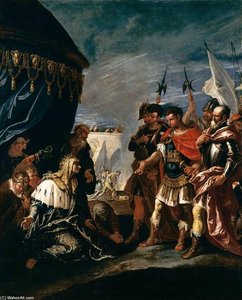
The Family of Darius before Alexander the Great (1728) od Gaspare Diziani

The Family of Darius before Alexander the Great

1728 · Oil On Canvas · Bavarske državne slikopisne zbirke, München

The scene captures a pivotal encounter between the conqueror Alexander the Great and the defeated Persian royalty. On the left, the family of Darius seeks refuge under an ornate canopy, their gestures conveying profound distress and supplication. Opposite them, Alexander and his military entourage occupy the right side of the composition, projecting an aura of command and authority. The arrangement of figures creates a dynamic tension, using diagonal lines to…

4
Monk (1735) od Gaspare Diziani

Monk

1735 · Oil On Canvas · Statens Museum For Kunst, Kopenhagen

In "Monk" by Gaspare Diziani, the viewer enters a quiet, private space where time seems to hold its breath. The composition centers on a close-up portrait of an elderly man, focusing intently on his upper body and his weathered hands. He sits in a moment of profound stillness, his gaze cast downward toward a small crucifix held between his fingers. At the very bottom of the frame, the presence of…

5
Praying Monk (1735) od Gaspare Diziani

Praying Monk

1735 · Oil · Statens Museum For Kunst, Kopenhagen

The artwork titled Praying Monk is an oil painting created by the Italian artist Gaspare Diziani. This specific piece dates to 1735. The subject is a solitary figure depicted in a moment of religious devotion, rendered in a style characteristic of the late Baroque period.

6
Moses trampling on the Pharaoh’s crown (1743) od Gaspare Diziani

Moses trampling on the Pharaoh’s crown

1743 · Oil On Canvas · Narodni muzej u Varšavi, Varšava

The scene unfolds in 1743 through the hand of Gaspare Diziani, who captures the tension of Moses trampling on the Pharaoh’s crown. This work emerges from a life shaped by the light of Italy, beginning in the town of Belluno where the artist was born in 1689. Every brushstroke carries the weight of a vision developed through years of observation and movement within the great artistic centers of the era.

7
Joseph Is Sold by His Brothers (1755) od Gaspare Diziani

Joseph Is Sold by His Brothers

1755 · Oil On Canvas · Bavarske državne slikopisne zbirke, München

The canvas captures a moment of fractured kinship under a heavy, dramatic sky. In this 1755 oil painting, the biblical narrative of Joseph unfolds through a dense arrangement of figures caught in the tension of a transaction. A rugged, hilly landscape provides a stark backdrop to the human drama unfolding in the foreground. The composition relies on a strong chiaroscuro effect, where light strikes the edges of flowing drapery and…

8
Joseph Interprets the Dreams of Pharaoh (1755) od Gaspare Diziani

Joseph Interprets the Dreams of Pharaoh

1755 · Oil · Bavarske državne slikopisne zbirke, München

The composition centers on a large-scale, monochrome depiction of a biblical encounter within a grand, vaulted hall. Joseph stands in a central position, gesturing toward Pharaoh, who is seated upon a massive throne. The architectural setting is defined by heavy, classical columns and wide arches that recede into a dark, shadowed background. The lighting is directional, descending from an upper source to create high-contrast highlights on the figures' skin and…

9
The Family of Darius Pleading to Alexander (1745) od Gaspare Diziani

The Family of Darius Pleading to Alexander

1745 · Oil On Canvas · Nationalmuseum, Stockholm

In this expansive oil on canvas, we find ourselves witnessing a pivotal moment of human drama set against a grand, classical backdrop. The scene captures the family of Darius in the immediate aftermath of the Battle of Gaugamela, seeking clemency from Alexander the Great. There is a profound sense of tension held within the crowded foreground, where the weight of loss meets the uncertainty of survival. The figures are caught…

10
sketch for a plafond - painting (1750) od Gaspare Diziani

sketch for a plafond - painting

1750 · Ink On Paper

In this sketch for a plafond - painting by Gaspare Diziani, a celestial drama unfolds within a swirling, monochromatic realm. The composition pulls the eye upward through a circular, sweeping motion that mimics the very heavens. Figures, perhaps mythological or divine in nature, drift amidst voluminous and billowing clouds that seem to churn with life. Every shape feels organic and curvilinear, contributing to an airy atmosphere where gravity appears to…

Izbor umjetnika Gaspare Diziani se nastavlja, od 11 do 27

Slavna djela Gaspare Diziani po razdobljima

Motivi koji su privukli pažnju Gaspare Diziani

Četiri teme koje se najčešće ponavljaju u ovim originalima, svaka s svojim vrhunskim primjerom.

Muzeji koji čuvaju originalna djela umjetnika Gaspare Diziani

8 muzeja u kojima se nalazi najviše djela s ove stranice.

Muzej Grad Djela autora Gaspare Diziani Slike iz ovog popisa
Bavarske državne slikopisne zbirke, MünchenBavarske državne slikopisne zbirke München 3 The Family of Darius before Alexander the Great, Joseph Is Sold by His Brothers, Joseph Interprets the Dreams of Pharaoh
Statens Museum For Kunst, KopenhagenStatens Museum For Kunst Kopenhagen 2 Monk, Praying Monk
Nationalmuseum, StockholmNationalmuseum Stockholm 2 The Family of Darius Pleading to Alexander, The Adoration of the Lamb. Study
Szépművészeti Múzeum, BudimpeštaSzépművészeti Múzeum Budimpešta 2 Adoration of the Magi, Adoration of the Magi
Metropolitan Museum of Art, New YorkMetropolitan Museum of Art New York 1 Dawn
Narodni muzej u Varšavi, VaršavaNarodni muzej u Varšavi Varšava 1 Moses trampling on the Pharaoh’s crown
Gemäldegalerie, BerlinGemäldegalerie Berlin 1 Christ before Pilate
Los Angeles County Museum of Art, Los AngelesLos Angeles County Museum of Art Los Angeles 1 The Assumption of the Virgin

Gaspare Diziani desetljeće po desetljeće: original koji definira svako od njih

Djela po desetljećima

Odaberite desetljeće kako biste vidjeli original koji ga definira.

Pitanja kolekcionara o slikama umjetnika Gaspare Diziani

Po kojem je djelu Gaspare Diziani najpoznatiji/a?Otkrijte odgovor

Dawn (1738), Metropolitan Museum of Art, New York. Nakon njih slijede Laying Venus (1714) i The Family of Darius before Alexander the Great (1728).

Koliko je godina Gaspare Diziani imao/la kada je nastalo djelo Dawn?Otkrijte odgovor

49 godina: Dawn datira iz 1738, a Gaspare Diziani je rođen/a 1689.

Koja su deset najpoznatijih djela umjetnika Gaspare Diziani?Otkrijte odgovor

Dawn, Laying Venus, The Family of Darius before Alexander the Great, Monk, Praying Monk, Moses trampling on the Pharaoh’s crown, Joseph Is Sold by His Brothers, Joseph Interprets the Dreams of Pharaoh, The Family of Darius Pleading to Alexander i sketch for a plafond - painting. Gornji rang prikazuje godinu i muzej za svako od njih.

Koliko je slika ostavio/la Gaspare Diziani?Otkrijte odgovor

Naš katalog sadrži 27 djela umjetnika Gaspare Diziani, datiranih od 1714 do 1757.

U kojim se muzejima nalaze remek-djela umjetnika Gaspare Diziani?Otkrijte odgovor

Većinom u Bavarske državne slikopisne zbirke (München), Statens Museum For Kunst (Kopenhagen) i Nationalmuseum (Stockholm). Gornja tablica muzeja navodi sve njih.

U kojim je godinama Gaspare Diziani naslikao svoja najpoznatija djela?Otkrijte odgovor

U 1750s: 7 od 27 djela na ovoj stranici nastalo je tada, od čega je Joseph Is Sold by His Brothers Joseph Is Sold by His Brothers.

Koja su prva i posljednja poznata originalna djela umjetnika Gaspare Diziani?Otkrijte odgovor

Na ovoj stranici najstarije djelo je iz Laying Venus (1714), a najnovije iz Christ before Pilate (1757).

Koje je motive Gaspare Diziani najčešće birao?Otkrijte odgovor

Drapery (7), Figures (6) i Woman (5), kroz svih 27 djela na ovoj stranici.

Koju je tehniku najčešće koristio/la Gaspare Diziani?Otkrijte odgovor

Oil On Canvas, za 6 od 27 djela na ovoj stranici.

Koji se radovi umjetnika Gaspare Diziani nalaze u muzeju Bavarske državne slikopisne zbirke?Otkrijte odgovor

The Family of Darius before Alexander the Great, Joseph Is Sold by His Brothers i Joseph Interprets the Dreams of Pharaoh: Bavarske državne slikopisne zbirke, München posjeduje 3 djela s ove stranice.

Gaspare Diziani: život i djelo

The Radiant Legacy of Gaspare Diziani

In the luminous era of the late Baroque and the burgeoning Rococo, Gaspare Diziani emerged as a painter of profound technical assurance and dramatic flair. Born in the serene town of Belluno, Italy, his artistic journey began under the guidance of Antonio Lazzarini, a foundation that would eventually lead him to the heart of the Venetian art world. As he moved toward Venice, Diziani immersed himself in the prestigious studios of Gregorio Lazzarini and the influential Sebastiano Ricci. These early mentors provided him with the tools to master the sweeping movements and emotional depth characteristic of his era, allowing him to develop a style that resonated with both religious fervor and aristocratic elegance.

Diziani’s career was marked by a remarkable ability to navigate the shifting tides of 18th-century aesthetics. While his work shared the stage with contemporaries like Giambattista Tiepolo, Diziani carved out a unique space through his versatility and command over both canvas and fresco. His early period, spanning roughly between 1710 and 1720, saw him contributing significant works to sacred spaces, such as the Mary Magdalene for the church of Santo Stefano in Belluno and the Entry into Jerusalem for San Teodoro in Venice. These religious commissions allowed him to explore the interplay of light and shadow, a hallmark of the late Baroque that would later soften into the more delicate, ornamental textures of the Rococo.

A Master of Light and Grandeur

The breadth of Diziani’s influence extended far beyond the borders of the Republic of Venice. His reputation for excellence carried him to the courts of Dresden and Munich, demonstrating a reach that transcended local boundaries and touched the great cultural centers of Europe. This international presence is perhaps best exemplified by the sheer scale of his ambition; one of his most monumental achievements remains the largest painting housed within the Hermitage Museum in St. Petersburg, a testament to his ability to command vast, immersive spaces.

Beyond his grand canvases, Diziani’s artistry was deeply rooted in the decorative traditions of his time. His skill in fresco painting is evident in his work on the Life of Saint Helena at the Scuola del Vin, where he transformed architectural surfaces into narrative windows of spiritual intensity. Whether working on a small-scale preparatory sketch or a massive ceiling piece, his hand was characterized by a certain celerity and technical confidence that captured the very essence of the Rococo spirit—a blend of grace, movement, and light.

The enduring significance of Gaspare Diziani lies in his role as a bridge between eras. He successfully synthesized the dramatic tension of the Baroque with the airy, ornamental beauty of the Rococo, leaving behind a body of work that continues to fascinate scholars and art lovers alike. Through his mastery of color and composition, he helped define the visual language of an age of splendor.