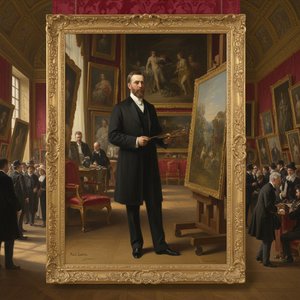
Early Life, Family and Artistic Training
Gustave Fayet was born in Béziers, France, on 20 May 1865. His early years were shaped by a family deeply rooted in the visual arts, providing him with a natural environment for creative development. He did not learn his craft in isolation; instead, his education began at home, guided by the hands of those closest to him.
He learned to draw and paint under the direct instruction of his father, Gabriel Fayet. This mentorship was supplemented by the guidance of his uncle, Léon Fayet, who also helped shape his technical abilities. Through these family connections, Gustave Fayet was introduced to the nuances of composition and form from a young age.
The artistic sensibilities of his mentors played a significant part in his development. Both his father and his uncle held a deep admiration for pre-impressionist painters, finding inspiration in the works of Adolphe Monticelli and Camille Corot. This early exposure to such influences helped establish the foundation upon which he would eventually build his own personal way of seeing the world.
Technique and Personal Artistic Style
Gustave Fayet possessed a curiosity that refused to stay within the lines of a single medium. He was a man of many hands, working as a painter, watercolorist, and ceramicist, but his creative reach extended into the very fabric of domestic life. He designed rugs, wallpapers, and fabrics, and even applied his hand to book illustration and interior design. This versatility was not a lack of focus, but rather a reflection of a mind that saw no boundary between fine art and the objects used in daily living.
His aesthetic was deeply personal, moving away from the fleeting light of Impressionism and the rigid rules of academic training. Instead, his work leaned toward Symbolism, seeking to express ideas through form and color rather than mere imitation of nature. There is a certain kinship in his approach to the works of Paul Gauguin and Odilon Redon, particularly in how he used his art to create a cohesive atmosphere. He did not merely paint a scene; he sought to build a world through a wide variety of techniques and materials.
This multifaceted approach allowed him to move seamlessly from the delicate touch of a watercolorist to the tactile, earthy nature of stoneware. His ability to merge these different disciplines meant that his artistic vision could inhabit a room as much as a canvas. Whether working with ceramics or designing intricate patterns for textiles, his hand remained distinctly his own, shaped by a desire to integrate art into the lived environment.
Patrons, Collections and Business Ventures
Fayet’s life was defined by a restless, entrepreneurial spirit that extended far beyond the canvas. He was a man of many practical pursuits, managing a private bank and overseeing mining operations in the Pyrenees. His interests in the land led him to become a vineyard owner, and he applied his sense of design to various industries. In 1896, he founded a stoneware workshop in Béziers alongside Louis Paul, a venture that allowed him to explore the tactile qualities of ceramics and stoneware.
His passion for collecting was deeply personal and closely tied to his friendships within the art world. He was a significant supporter of Paul Gauguin, acting as one of the artist's main clients and lending many of his own paintings to Gauguin exhibitions between 1903 and 1925. His private collection was substantial, holding works by Degas, Manet, Pissarro, and Gauguin. These pieces were not merely objects to him but part of a life lived in close proximity to the creators of his era.
In 1908, Fayet made a significant acquisition by purchasing the Abbaye de Fontfroide near Narbonne, France. He took on the task of reconstructing the abbey, turning it into a space where he could exhibit many of the paintings from his collection. This site became a place where his personal interests in art and architecture met, providing a setting for works like those by Odilon Redon to be seen in a specific, intentional environment.
Legacy and Modern Recognition
For much of the time following his death, the true scope of Gustave Fayet's influence remained largely hidden from the public eye. His works were often held in private hands, making his personal contributions to the decorative arts and painting difficult for many to encounter. However, recent decades have seen a renewed effort to bring his multifaceted life back into view. Since 2005, a dedicated Fayet Room has been open at the Abbaye de Fontfroide, providing a space where his vision for the abbey can be understood. This was followed in 2006 by a retrospective exhibition at the museum of Elne, which helped reintroduce his name to those interested in the history of the south of France.
A significant moment in the modern understanding of his life occurs in the mid-2020s. The Fondation Louis Vuitton in Paris is set to host an exhibition titled Gustave Fayet: Collector—Artist Designer, running from 9 October 2026 to 8 March 2027. This major event seeks to bridge the gap between his identity as a creator and his role as a collector. The exhibition brings together more than 250 works from his extraordinary collection, many of which had been dispersed across the globe after he passed away. By presenting his own creations alongside the works he once owned, this exhibition offers a clearer look at a man who lived his life through the lens of art and design.