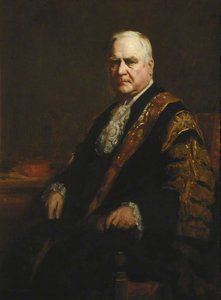
The Master of the Meticulous: The Life and Legacy of George Fiddes Watt
In the grand tapestry of late Victorian and Edwardian British art, few threads are woven with as much precision and dignity as those left by George Fiddes Watt. Born in Edinburgh in 1873, Watt emerged from the heart of Scotland’s artistic tradition to become a preeminent portraitist of his era. His journey began within the rigorous academic environments of Gray's School of Art and the Royal Scottish Academy, institutions that instilled in him a profound respect for classical technique and anatomical accuracy. This foundational training allowed him to bridge the gap between the traditionalism of the past and the evolving sensibilities of the early 20th century, creating a body of work that remains a testament to the power of realistic observation.
Watt’s artistic identity was deeply rooted in the Beaux Arts tradition, a style that demanded mastery over light, texture, and form. Drawing inspiration from the legendary works of John Everett Millais and Frederic Leighton, he approached each canvas with a commitment to luminous realism. His technique was particularly noted for its sophisticated use of oil paints; through the delicate application of glazing, Watt achieved a remarkable tonal range that breathed life into his subjects. Whether capturing the subtle sheen of silk drapery or the weathered lines of an elderly face, his brushwork possessed a rare ability to convey both physical presence and psychological depth.
A Chronicle of Character: Portraiture and Prestige
The true essence of Watt’s contribution to art history lies in his prolific output of portraiture, which exceeded three hundred completed works. He was a painter of people, possessed of a unique ability to capture the essence of individuals across the social spectrum. His commissions were not merely records of likeness but studies in character and status. Through his eyes, we encounter the weight of political responsibility and the quiet grace of private life:
- The Political Elite: Watt was frequently entrusted with the likenesses of prominent statesmen, including H.H. Ascent and A.J. Balfour, rendering them with a sense of monumental composure that reflected their historical importance.
- The Dignity of the Individual: His portraits such as Sir Charles Bine Renshaw of Barochan and Garvocks demonstrate his mastery of dark, rich tones and the dignified atmosphere characteristic of Victorian portraiture.
- Intimate Studies: Beyond the halls of power, Watt found profound beauty in personal subjects. His work The Artist's Mother (1910) serves as a poignant example of his ability to blend realistic detail with subtle, almost impressionistic brushwork to create a tender study of light and texture.
- Academic Excellence: His skill in capturing the essence of the era is further seen in his 1890s portrait of the 1st Viscount Finlay of Nairn, a work that exemplifies the academic rigor of his early career.
Beyond the Studio: Landscapes and Lasting Recognition
While his fame was anchored in the studio, Watt’s artistic curiosity occasionally led him away from the controlled environment of portraiture toward the expansive beauty of the natural world. His forays into landscape painting provided a fascinating counterpoint to his structured portraits. These works, such as his evocative depictions involving a lioness in Somaliland, reveal an artist capable of capturing movement and the untamed spirit of nature, proving that his technical mastery was not limited to the human form but extended to the very atmosphere of the earth itself.
The significance of George Fiddes Watt extends far beyond the frames of his canvases. His professional achievements were marked by prestigious recognitions that solidified his standing in the British art community. His election to the Royal Society of Arts in 1924 and the receipt of an honorary LL.D. from Aberdeen University in 1955 serve as enduring symbols of his contribution to both artistic scholarship and cultural excellence. As we look back upon his life, we see more than just a painter; we see a chronicler of an age, a master of light, and a dedicated guardian of the classical tradition.