Filipp Malyavin का चित्र

59 सबसे प्रसिद्ध Filipp Malyavin पेंटिंग्स, जिनमें से प्रत्येक अद्वितीय है

नवमबर 2026 में अपडेट किया गया · हमारे लोकप्रियता स्कोर (प्रत्येक कृति के लिए खोज, विज़िट और ऑर्डर) के आधार पर रैंक किया गया · 59 कृतियाँ Filipp Malyavin की हमारे कैटलॉग में

संक्षेप में

Peasant Woman Dancing वह Filipp Malyavin की पेंटिंग है जो सबसे अधिक ध्यान आकर्षित करती है। इसके बाद, दृष्टि Turks (1895) और Women's happiness (Women) (1900) पर जाती है। हमारे कैटलॉग में Filipp Malyavin की 59 कृतियों में से, ये 59 सबसे प्रसिद्ध हैं, जिनमें से प्रत्येक को उसके वर्ष, उसके संग्रहालय और उसके चिरस्थायी होने के कारण के साथ एक अद्वितीय मूल कृति के रूप में प्रस्तुत किया गया है।

1869 – 1940, Kazanka सर्वाधिक कृतियाँ: त्रत्यकोव गैलरी

गैलरी की दृष्टि से Filipp Malyavin की शीर्ष 10 पेंटिंग्स

1
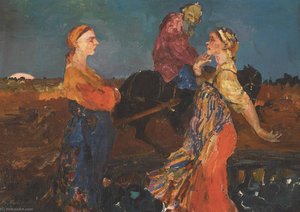
Peasant Woman Dancing द्वारा Filipp Malyavin

Peasant Woman Dancing

Oil On Canvas

The canvas erupts in a sudden, frantic energy as a woman moves through a storm of pigment. She is enveloped in a chaotic explosion of fiery red, orange, and yellow hues that seem to pulse with a life of their own. Her voluminous drapery cascades downward, creating a sense of relentless movement that pulls the eye into the center of her dance. The background is not a place, but a…

2
Turks (1895) द्वारा Filipp Malyavin

Turks

1895 · Pencil

In the artwork "Turks" by Filipp Malyavin, the composition is organized along a horizontal axis. The subject matter is ethnographic in nature, focusing on three figures identified as Turks. These individuals are depicted in traditional attire, likely representing people from the Ottoman Empire or the surrounding regions. The arrangement of the figures is side-by-side, with each person occupying roughly equal space within the frame. This placement creates a sense of…

3
Women's happiness (Women) (1900) द्वारा Filipp Malyavin

Women's happiness (Women)

1900 · Oil

In Women's happiness (Women), Filipp Malyavin captures a profound sense of communal connection. Painted about 1900, this work focuses on a group of women gathered in a moment of shared joy. The subject matter centers on maternal and communal happiness, presenting a scene of intimacy that feels both immediate and deeply felt. There is a quiet strength in how these figures occupy the space together.

4
Nude female (1910) द्वारा Filipp Malyavin

Nude female

1910 · Oil

In the vertical expanse of "Nude female" by Filipp Malyavin, a seated woman occupies the center of the frame. Her arms are raised behind her head, a gesture that creates a sense of movement and vulnerability within the composition. This classical nude subject is presented through a direct and intimate perspective, drawing the viewer into a private moment of stillness. The figure is framed by a background of deep reds…

6
Porträt der Else Prior Havemann. (1940) द्वारा Filipp Malyavin

Porträt der Else Prior Havemann.

1940 · Oil

A seated woman faces the viewer directly in this 1940 oil portrait. She is rendered with a centered, three-quarter length composition that emphasizes her presence against a dark, atmospheric background. Her golden-blonde hair falls in waves around a pale face, marked by rosy cheeks and deep red lips. A light blue, sleeveless gown provides the primary color block, its surface defined by thick impasto strokes that suggest heavy fabric. A…

7
Laughing Peasant Woman द्वारा Filipp Malyavin

Laughing Peasant Woman

Oil

Laughing Peasant Woman by Filipp Malyavin centers on a single, expressive subject: a woman’s face caught in a moment of genuine laughter. The composition focuses on the crinkling around her eyes and her open mouth, capturing a fleeting sense of joy and life. This focus on the individual's emotional state allows the viewer to engage directly with the character and vitality of the subject.

8
Girl with a Book द्वारा Filipp Malyavin

Girl with a Book

Oil

In this intimate scene, we find a woman caught in a private moment of reflection. She holds a book in her hands, her gaze drifting away from the pages as if lost in thought or perhaps reacting to a sudden, unspoken idea. The setting is an interior space, marked by the presence of a clock on the wall, which lends a sense of passing time to her stillness. There is…

Filipp Malyavin की प्रसिद्ध पेंटिंग्स, संख्या 11 से 59 तक

Filipp Malyavin की प्रसिद्ध पेंटिंग्स, कालखंड के अनुसार

वे विषय जिन्होंने Filipp Malyavin का मन मोह लिया

इन मूल कृतियों में बार-बार आने वाले चार विषय, जिनमें से प्रत्येक का सबसे उत्कृष्ट उदाहरण यहाँ प्रस्तुत है।

वे संग्रहालय जहाँ Filipp Malyavin की मूल कृतियाँ रखी गई हैं

वे 2 संग्रहालय जिनमें इस पृष्ठ की सर्वाधिक पेंटिंग्स मौजूद हैं।

संग्रहालय शहर Filipp Malyavin की कृतियाँ इस सूची की पेंटिंग्स
त्रत्यकोव गैलरी, मॉस्कोत्रत्यकोव गैलरी मॉस्को 1 Whirlwind
स्टेट रूसी संग्रहालय, सेंट पीटर्सबर्गस्टेट रूसी संग्रहालय सेंट पीटर्सबर्ग 1 Peasant Women

दशकों तक Filipp Malyavin: प्रत्येक के लिए एक अद्वितीय मूल कृति

दशकवार कृतियाँ

उस दशक को चुनें जो उसकी पहचान है और उसकी मूल कृतियाँ देखें।

Filipp Malyavin की पेंटिंग्स: गैलरी के लिए प्रश्न

Filipp Malyavin की सबसे प्रसिद्ध कृति कौन सी है?उत्तर देखें

Peasant Woman Dancing। इसके बाद Turks (1895) और Women's happiness (Women) (1900) आते हैं।

Filipp Malyavin की कौन सी दस पेंटिंग्स सबसे प्रसिद्ध हैं?उत्तर देखें

Peasant Woman Dancing, Turks, Women's happiness (Women), Nude female, Portrait of Alexandra Balashova, Porträt der Else Prior Havemann., Laughing Peasant Woman, Girl with a Book, Male Nude और A Girl। ऊपर दी गई रैंकिंग में प्रत्येक का वर्ष और संग्रहालय दिया गया है।

Filipp Malyavin की कितनी कृतियाँ ज्ञात हैं?उत्तर देखें

हमारे कैटलॉग में Filipp Malyavin की 59 कृतियाँ हैं, जो 1895 से 1940 तक की हैं।

सबसे प्रसिद्ध Filipp Malyavin मूल कृतियाँ कहाँ देखी जा सकती हैं?उत्तर देखें

अधिकतर त्रत्यकोव गैलरी (मॉस्को) और स्टेट रूसी संग्रहालय (सेंट पीटर्सबर्ग) में। ऊपर दी गई संग्रहालय तालिका में उन सभी की सूची दी गई है।

Filipp Malyavin ने अपनी सबसे प्रसिद्ध पेंटिंग किस काल के दौरान बनाई थीं?उत्तर देखें

1900s में: इस पृष्ठ पर मौजूद 59 कृतियों में से 2 उस समय बनाई गई थीं, जिनमें से Women's happiness (Women) इनमें से हैं।

Filipp Malyavin की कौन सी प्रसिद्ध पेंटिंग सबसे पुरानी है, और कौन सी सबसे नवीनतम?उत्तर देखें

इस पृष्ठ पर, सबसे पुरानी कृति Turks (1895) है और नवीनतम Porträt der Else Prior Havemann. (1940) है।

Filipp Malyavin किन विषयों को पसंद करते थे?उत्तर देखें

इस पृष्ठ पर 59 कृतियों में Russian art (6), Women (5) और Woman (5)

Filipp Malyavin ने सबसे अधिक किन सामग्रियों से पेंटिंग की?उत्तर देखें

इस पृष्ठ पर मौजूद 59 कृतियों में से 5 के लिए Oil।

Filipp Malyavin: कलाकार का एक चित्र

The Soul of the Russian Soil: The Life of Filipp Malyavin

To understand the work of Filipp Andreevich Malyavin, one must first understand the raw, untamed spirit of the Russian countryside from which he emerged. Born in 1869 in the village of Kazanki to a humble peasant family, Malyavin’s early years were defined by the rhythms of rural life and an innate, almost primal connection to the earth. Even as a young child, his hands were never idle; he spent his days sculpting clay figurines of birds and animals, a practice that foreshadowed a lifetime of profound tactile expression. His journey from a penniless village boy to a celebrated figure in the Russian art world is nothing short of legendary, fueled by a spiritual fascination with the icons brought to his village by traveling monks.

This early exposure to the sacred art of icon painting would leave an indelible mark on his aesthetic DNA. Driven by a thirst for divine beauty, Malyavin traveled to Mount Athos in Greece at the age of sixteen, a pilgrimage funded by the very villagers who had witnessed his burgeoning talent. While he found himself disappointed to discover that the monks there primarily copied Russian icons rather than practicing a unique Athonite style, this period of monastic life served as a crucible for his development. As a novice, he mastered the art of murals and icons, learning how to use color not merely as decoration, but as a vessel for spiritual intensity and emotional weight.

From Monastic Silence to Academic Brilliance

The trajectory of Malyavin’s life shifted dramatically in 1891 through a chance encounter with Vladimir Beklemishev, a Russian sculptor and professor. Recognizing the raw genius within the young monk, Beklemishev facilitated Malyavin’s move to St. Petersburg, where he enrolled in the prestigious Academy of Arts. It was here that his peasant roots met the rigorous discipline of classical training. Studying under the legendary realist Ilya Repin, Malyavin began to synthesize his deep-seated knowledge of religious iconography with the burgeoning movements of modernism and realism.

Unlike many of his contemporaries who sought to escape their origins through academic refinement, Malyavin leaned into them. He utilized the technical prowess gained at the Academy to elevate the subject matter of the common folk. His work became a bridge between the sacred and the profane, applying the bold, emotive brushwork of a master to the vibrant, often chaotic energy of peasant life. This unique perspective allowed him to capture the essence of the Russian soul—a mixture of profound suffering and unbridled, ecstatic joy.

A Legacy of Color and Motion

Malyavin’s mature style is characterized by an almost violent use of color and a sense of kinetic energy that seems to burst from the canvas. He is perhaps most renowned for his masterpiece, Whirlwind, a painting that serves as a breathtaking metaphor for the turbulent history and spirit of Russia. In this work, the swirling masses of peasant women dancing are rendered with such vigorous brushstrokes and saturated hues that the viewer can almost hear the music and feel the wind of the movement.

His artistic significance lies in his ability to transcend mere portraiture or genre painting. Through his use of:

  • Bold, expressive palettes that utilize reds and deep earth tones to evoke passion and struggle;
  • Dynamic compositions that capture the rhythmic, often frenetic motion of folk celebrations;
  • A synthesis of styles blending the flat, symbolic power of icons with the textured realism of the late 19th century;
Malyavin created a visual language that was uniquely his own. Even as he moved toward the end of his life in Nice, France, his work remained anchored to the heartbeat of the Russian landscape, ensuring his place as one of the most evocative chroniclers of human vitality and cultural identity.